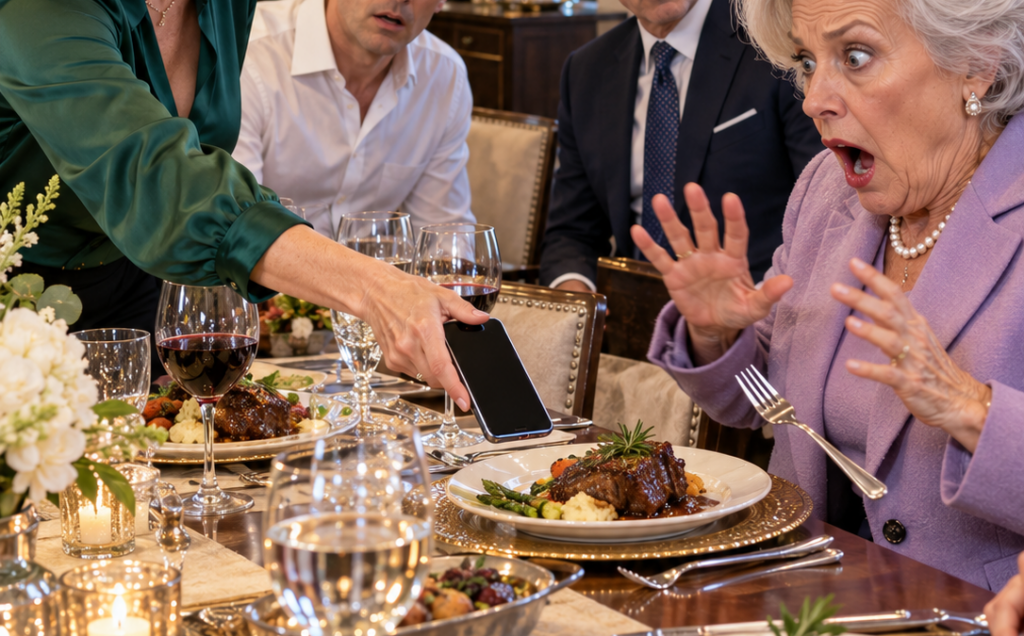
I nodded.
“How long?”
“Three years.”
Her eyes widened.
Bennett leaned forward.
“Mom, where did you get this dinner?”
She didn’t answer.
He looked at my phone.
Then at the food.
Then back at his mother.
“Mom?”
Eleanor stood suddenly.
“I don’t feel well.”
“Mother, sit down.”
“I said I don’t feel well!”
She grabbed her purse and hurried toward the front door.
A moment later, it slammed behind her.
Nobody spoke.
My phone lay beside her abandoned plate.
Bennett picked it up and slowly reviewed the fourteen orders.
When he finished, he looked at me.
“Why didn’t you tell me?”
I looked down.
“I wasn’t sure how.”
He sat back.
For the first time that evening, I saw something in his face worse than embarrassment.
Disappointment.
Not in me alone.
In everything he’d believed about his mother.
Our guests were gracious.
They stayed for dessert, complimented the meal, and avoided discussing Eleanor.
Patricia Lowe, one of the partners’ wives, insisted on a second helping of lamb.
“Nadia,” she said, “I don’t care where those short ribs came from. This lamb is extraordinary.”
Her kindness nearly made me cry.
After everyone left, Bennett and I sat at the kitchen table.
The house was quiet.
He looked exhausted.
“Three years,” he said.
I nodded.
“Fourteen orders?”
“Yes.”
“And every Thanksgiving, she told us she’d cooked everything herself?”
“Yes.”
He rubbed his forehead.
“My mother used to tell me her pot roast was an old family recipe.”
I reached for his hand.
“Ben, I don’t know anything about her cooking before she started ordering from me.”
He stared at the floor.
“I’m angry with her.”
“I know.”
“But I’m hurt that you didn’t tell me.”
That was harder to hear.
“I should have,” I admitted.
“Why didn’t you?”
I thought carefully.
“Because I knew what it would do to her if I exposed her. And I wasn’t sure I wanted to be responsible for that.”
He looked at me for a long time.
Then he sighed.
“I wish you’d trusted me enough to let me help.”
He was right.
My silence hadn’t been entirely generous.
It had also kept a secret between us.
We talked until nearly midnight.
Bennett apologized for all the times he’d allowed Eleanor’s insults to pass without firmly defending me.
I apologized for hiding something that affected our family.
And we agreed on one thing.
Things couldn’t continue the way they had.
The following morning, Eleanor appeared at my commercial kitchen.
It was a little after six.
I was checking the day’s production schedule when Marcus came into my office.
“Chef, there’s a woman here asking for you.”
“Who?”
He hesitated.
“Your mother-in-law.”
I went into the kitchen.
Eleanor stood beside the prep table wearing the same camel-colored coat she’d worn the previous evening.
Her silver hair was untidy.
She had no lipstick on.
She looked older than I’d ever seen her.
“Can we talk?” she asked.
I sent Marcus to finish checking the deliveries and pulled out two chairs near the office.
Eleanor sat carefully.
For a long moment, she stared at her hands.
Then she said, “I can’t cook.”
I waited.
“I’ve never been able to cook properly.”
She gave a miserable little laugh.
“Seventy-one years old. And I can barely make scrambled eggs.”
I didn’t know what to say.
She continued.
“My mother had a housekeeper. We lived in Ladue. I wasn’t allowed in the kitchen much. Mother thought cooking was something other people did.”
She paused.
“Then I married Richard.”
Richard was Bennett’s father. He’d died almost ten years earlier.
“His mother, Agnes, was a wonderful cook,” Eleanor said. “Everyone praised her. She won ribbons at the state fair. She could feed twenty people without opening a cookbook.”
I nodded.
“Our first Thanksgiving was in 1979. Fourteen people came to our apartment.”
Her voice became very quiet.
“I wanted everything to be perfect.”
She told me how she’d purchased a turkey without understanding how long it needed to thaw.
She’d worked all morning.
When her husband carved it at the table, the center wasn’t properly cooked.
Agnes laughed.
Then she said, in front of the entire family, “Maybe next year you should start with a chicken.”
Richard laughed, too.
Eleanor looked toward the window.
“I’ve never forgotten that.”
I felt something shift inside me.
Those words.
Start with a chicken.
She’d said them to me.
More than once.
“The following Thanksgiving,” Eleanor continued, “I ordered dinner from a delicatessen. I transferred everything into my serving dishes. I told everyone I’d cooked since dawn.”
She swallowed.
“And they loved it.”
“Eleanor…”
“They praised my turkey. My potatoes. My pie. Richard was so proud.”
Her eyes filled.
“For the first time since I’d married him, I felt like I was good enough.”
She covered her face.
“So I kept doing it.”
For decades, Eleanor had purchased meals from delis, restaurants, and caterers, then served them as her own.
Nobody had questioned it.
And as the years passed, the deception became more difficult to abandon.
By the time Bennett was grown, he believed his mother was an extraordinary cook.
And Eleanor couldn’t bear the thought of disappointing him.
Then she met me.
A young woman from a diner family who could actually cook.
“I was frightened of you,” she whispered.
I stared at her.
“Of me?”
She nodded.
“You made that lamb dinner when you were engaged. I tasted it and realized immediately that you knew what you were doing.”
“So you insulted it?”
She closed her eyes.
“Yes.”
“Why?”
“Because I was afraid you’d discover the truth. I thought if everyone believed you were inexperienced, they wouldn’t believe you if you ever questioned my cooking.”
The room felt very quiet.
Eleanor looked at me.
“I treated you exactly the way Agnes treated me.”
Tears ran down her cheeks.
“And I am so ashamed.”
I sat there thinking about five years of humiliation.
The jokes about my parents.
The insults.
The way she’d dismissed my grandmother’s recipes.
