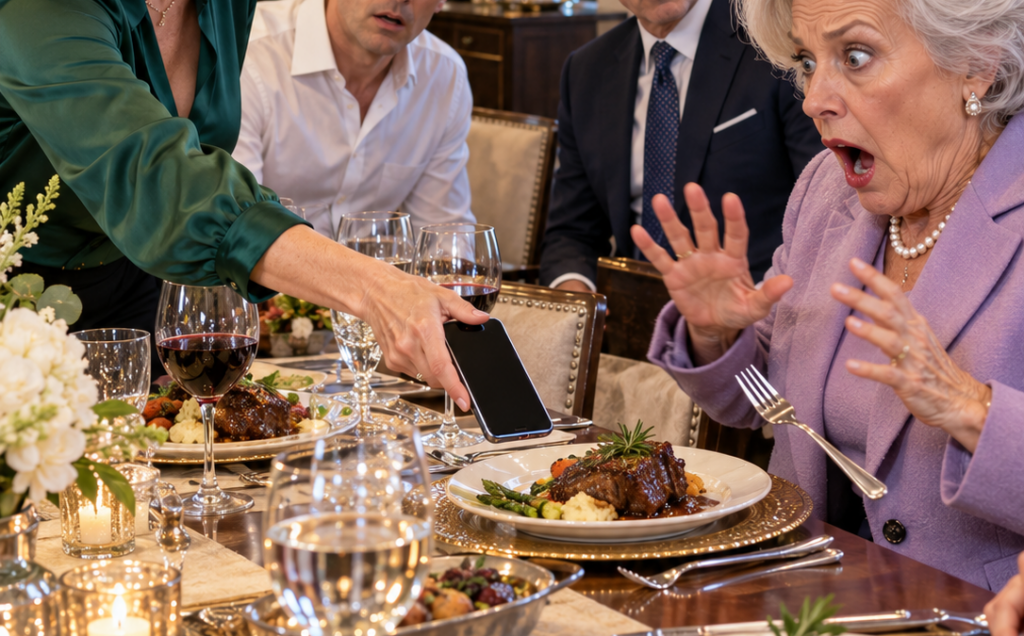
Her fear explained her behavior.
But it didn’t excuse it.
“Eleanor,” I said, “you didn’t have to know how to cook for me to respect you.”
She nodded, crying.
“And my parents worked very hard to build a good life. You didn’t have to make them small to feel important.”
“I know.”
“You hurt me.”
“I know.”
I took a breath.
“I can understand why you were afraid. But I can’t pretend those five years didn’t happen.”
She looked at me.
“I wouldn’t ask you to.”
For the first time, I believed she meant it.
We sat in silence for several minutes.
Then I stood.
“I need to start the bread.”
Eleanor nodded and reached for her purse.
“I should go.”
She got halfway to the door before I spoke.
“Eleanor?”
She turned.
“Have you ever wanted to learn?”
She looked confused.
“Learn what?”
“To cook.”
Her expression changed.
“Oh, Nadia. I’m too old.”
I almost smiled.
“That’s not what I asked.”
She glanced toward the commercial ovens.
“I’ve always been afraid.”
“Then we start small.”
I took a spare apron from a hook.
It was white, with Saffron & Salt embroidered across the front.
I held it out.
“Would you like to make bread?”
She stared at the apron.
“I wouldn’t know where to begin.”
“That’s why I’m here.”
She hesitated.
Then, very slowly, she took it.
I showed her how to measure flour, water, salt, yeast, and olive oil.
She spilled flour across the counter.
Her dough was too wet at first.
When she tried kneading it, half of it stuck to her fingers.
“Oh, I’ve ruined it,” she said.
“No, you haven’t.”
She looked doubtful.
“Add a little flour. Try again.”
She did.
A few minutes later, she said, “I’m terrible at this.”
I laughed.
“Of course you are. It’s your first time.”
“My hands don’t do what yours do.”
“They will learn.”
She looked down at the dough.
Then she gave a small laugh.
Not a sarcastic one.
A genuine laugh.
By seven-thirty, we had a pan of focaccia in the oven.
When it emerged, the bread was uneven.
One side was thicker.
The edges weren’t perfectly shaped.
But it was golden and fragrant.
I cut a warm piece and handed it to her.
Eleanor took a bite.
She chewed slowly.
Then she looked at the bread.
“I made this.”
I nodded.
“You did.”
She began crying again.
But this time, she was smiling.
That afternoon, Eleanor visited Bennett.
She told him everything.
About the disastrous Thanksgiving in 1979.
About the humiliation she’d carried for decades.
About the meals she’d purchased and claimed as her own.
And about the cruelty she’d shown me because she was frightened of being exposed.
Bennett listened.
Then he asked one question.
“Mom, why couldn’t you just tell me?”
Eleanor looked down.
“Because you were so proud of me.”
He moved closer.
“Mom, I didn’t love you because you made good pot roast.”
She began crying.
He hugged her.
Later, Bennett told me something I hadn’t expected.
“When I was in college,” he said, “I tried to make Mom’s pot roast. I failed three times.”
I smiled.
“I’m sure it wasn’t that bad.”
“It was terrible. And I thought it meant I’d never be able to cook like her.”
He shook his head.
“All these years, I’ve been comparing myself to a recipe she didn’t even have.”
We laughed.
It was the first time we’d laughed about Eleanor without bitterness.
Eleanor began coming to the kitchen every Tuesday morning.
Not every week went smoothly.
She overmixed pancake batter.
She scorched a saucepan.
Once, she forgot the garlic in garlic bread.
Another time, she put a cake in the oven without the baking powder and couldn’t understand why it came out so dense.
But she returned.
Again and again.
She learned to roast vegetables.
Then chicken.
Then soup.
Eventually, she made a simple lasagna.
The first time she served it to Bennett, he took a bite and smiled.
“Mom, this is really good.”
She looked suspicious.
“Are you just saying that?”
He shook his head.
“No. It needs a little more salt, but it’s good.”
Eleanor laughed.
And for once, she accepted a compliment without needing everyone to believe she’d been perfect from the beginning.
Our relationship changed slowly.
There were awkward moments.
Occasionally, she slipped into her old habit of correcting me in front of others.
But now she’d catch herself.
Once, when I served roasted vegetables at Sunday dinner, she began criticizing the seasoning.
Then she stopped.
“Actually,” she said, “Nadia, how did you make those?”
It wasn’t a grand gesture.
But it mattered.
She also called my parents.
I hadn’t asked her to.
She told them she’d made unfair remarks about their work and background.
My father listened quietly.
Then he said, “Mrs. Vance, there’s nothing shameful about feeding people for a living.”
“I know that now,” Eleanor answered.
He paused.
“Good. Then perhaps one day you’ll let me show you how to make a proper Greek lemon soup.”
She laughed.
“I would like that very much.”
The following Thanksgiving, Eleanor asked if she could host.
I was hesitant.
Not because I didn’t trust her to cook.
Because I didn’t want another holiday built around pretending everything was perfect.
She understood.
“This year,” she said, “I want everyone to know exactly what I made. And exactly what I didn’t.”
So we made a plan.
Eleanor would prepare the turkey and mashed potatoes.
I would bring vegetables, spanakopita, and tzatziki.
My parents would bring pastries.
Bennett would make cranberry sauce.
Nobody had to prove anything.
On Thanksgiving morning, Eleanor called me at seven.
“Nadia, the turkey’s in the oven.”
“Good.”
“I’ve checked the thermometer twice.”
“Excellent.”
“Do you think I should check it again?”
I laughed.
“Not yet, Eleanor.”
She lowered her voice.
“I’m nervous.”
“I know.”
“What if it isn’t perfect?”
“Then we’ll still have Thanksgiving.”
She was quiet.
Then she said, “I wish someone had told me that forty years ago.”
