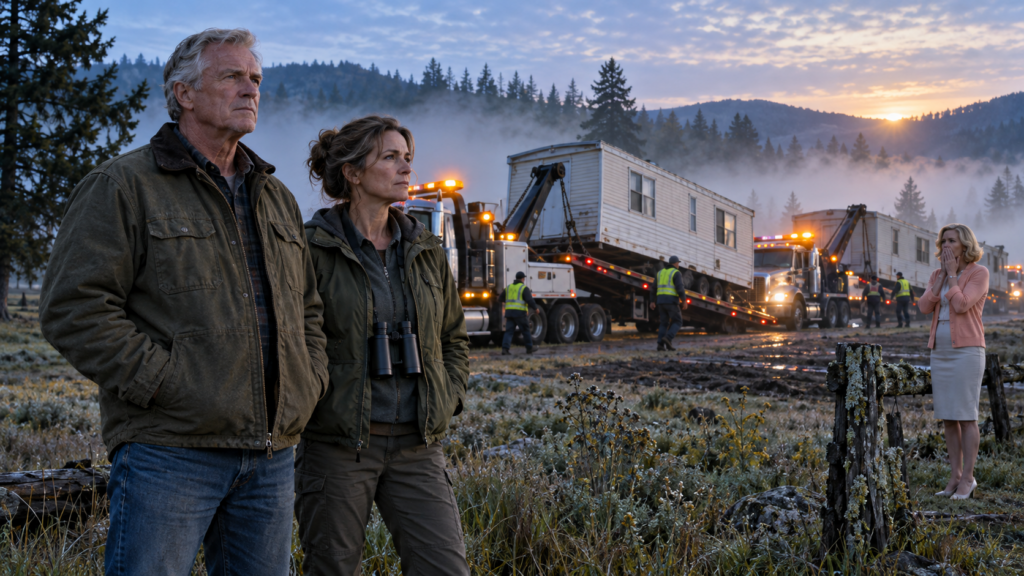
“Put the camper right there. He won’t be back for another month.”
That was apparently what HOA president Celeste Warren told a resident while directing a forty-foot fifth-wheel trailer onto my grandfather’s meadow.
When my wife and I returned to northern Idaho six weeks later, that single trailer had multiplied into twenty-seven.
Boat trailers.
ATV haulers.
Campers.
Snowmobile rigs.
Utility trailers piled with construction debris.
Someone had even installed a professionally printed sign at the entrance:
PINEHAVEN RESERVE OVERFLOW STORAGE
$200 PER MONTH
PERMITS AVAILABLE AT HOA OFFICE
The only problem?
Pinehaven didn’t own the meadow.
I did.
My name is Cole Barrett.
For twenty-seven years, I worked law enforcement investigations for the U.S. Forest Service—timber theft, wildfire cases, illegal road construction, commercial vehicle violations, the kind of work where one wrong VIN or forged easement can turn a routine field inspection into a federal case.
My wife, Laura, spent almost thirty years as a wildlife biologist working around Lake Pend Oreille.
Neither of us considered ourselves dramatic people.
So when we came around the bend that August morning and saw twenty-seven trailers covering the six-acre meadow my grandfather had cleared in 1951, I didn’t scream.
Laura lowered her coffee.
“That’s new.”
“Apparently.”
We parked.
I counted every rig.
Twenty-seven exactly.
Then I crossed the county road to the Pinehaven HOA office.
Celeste Warren sat behind the front desk wearing a peach cardigan and gold glasses.
“Cole,” she said brightly. “Welcome home.”
“Why is my meadow full of trailers?”
Her smile never moved.
“The board clarified the community easement while you were away.”
“What community easement?”
She slid a photocopy across the desk.
AMENDED EASEMENT DECLARATION.
According to the document, my property now included “common recreational storage rights” benefiting Pinehaven residents.
It carried a recording number.
A notary stamp.
Legal-looking language.
Celeste folded her hands.
“We’ve collected permits for months. It’s actually been very successful.”
I looked at the document again.
Then I noticed the recording number.
Wrong format.
I had pulled property records from the county for decades. Their current numbering system didn’t look anything like this.
Then I recognized the notary’s name.
Her commission had been suspended years earlier after a fraud investigation I had testified in.
Finally, I read the easement language.
It sounded like someone had blended a real-estate brochure with legal vocabulary they found online.
I pushed the document back.
“Celeste, this isn’t real.”
Her expression hardened.
“Our attorney disagrees.”
“You have fourteen days to remove every trailer.”
She laughed once.
“Twenty-seven families rely on this storage.”
“That’s unfortunate.”
“You’re going to create a community crisis.”
“No. You created one when you rented land you don’t own.”
I stood.
“Fourteen days.”
Her smile disappeared.
I walked home.
Laura was waiting beside the first trailer with a notebook.
“VINs first,” she said.
By dinner, we had photographed and documented every rig.
License plate.
VIN.
Make.
Model.
Location.
Time stamp.
The next day, I pulled the original easement.
It granted Pinehaven residents one thing:
Ingress and egress across a narrow access strip.
Driving through.
Nothing more.
The document specifically prohibited parking and storage.
Two days later, a sheriff’s deputy arrived because Celeste reported me for “harassing residents.”
I sat him at my kitchen table.
I gave him the real easement.
Then the fake amendment.
Then the public notary record.
He read everything.
Finally, he closed his citation book.
“This looks civil from your side.”
He stood.
“From hers… maybe not.”
Before leaving, he gave me the name of a state investigator who handled development fraud.
That night, Celeste posted to Pinehaven’s private social-media page accusing an “elderly neighboring landowner” of acting irrationally and threatening community families.
I was sixty-one.
Apparently that now qualified as elderly.
Laura read the post twice.
Then she smiled.
Not pleasantly.
Within an hour, she had printed her professional credentials, her wildlife-management history, and a formal request demanding the defamatory post be removed.
It disappeared before dinner.
Celeste’s husband, developer Brent Warren, called next.
He left a voicemail threatening a lawsuit if I interfered with HOA operations.
He didn’t know my voicemail automatically archived to a secured server.
I forwarded the recording to the state investigator.
His reply:
KEEP EVERYTHING.
Then our son, Mason, came home from his wildland-fire assignment.
The three of us spent Sunday checking every trailer again.
That was when Laura stopped beside a bass-boat trailer.
She crouched near the fender.
“Cole.”
Something in her voice made me turn.
She scraped a thin layer of dried mud into a sample bag.
Then she opened the transom drain.
Brown water dripped out.
Laura stared at it.
“This boat has been somewhere it shouldn’t.”
She sent samples to a regional wildlife laboratory.
Three days later, the result came back.
Trace material consistent with invasive quagga mussel contamination.
My stomach dropped.
Lake Pend Oreille had spent decades avoiding what other western waterways had suffered—clogged infrastructure, damaged fisheries, expensive decontamination programs.
Now a boat that had been stored illegally on my meadow had returned from contaminated water without proper clearance.
We checked the other boat trailers.
Then Laura discovered something worse.
One belonged to Brent Warren himself.
His boat had previously been flagged for enhanced invasive-species inspection.
The documentation showing final clearance was incomplete.
I looked out across the twenty-seven trailers.
Suddenly this wasn’t a parking dispute.
Someone had turned my land into an unauthorized commercial storage yard.
The HOA had been charging residents monthly fees.
The easement supporting those fees appeared fabricated.
And at least one stored boat carried evidence connected to an invasive species capable of damaging the lake.
I called attorney Benjamin Holt.
He reviewed everything at my kitchen table.
Then he leaned back.
“You’ve got property fraud, forged documents, questionable HOA revenue, and an environmental problem sitting on the same six acres.”
“What do we do?”
He looked toward the meadow.
“We do absolutely everything by the book.”
Certified notices went to all twenty-seven trailer owners.
Thirty-one days before towing.
Photographs attached.
Real easement attached.
Warning signs posted every fifty feet.
