Every delivery documented.
Then Benjamin found the money.
For four years, Pinehaven had collected roughly a quarter-million dollars in “overflow storage fees.”
Only a fraction appeared in legitimate HOA expenses.
Large payments had gone to a consulting company owned by Celeste’s sister.
The state investigator stared at the bank records for almost a minute.
Then he looked at me.
“Don’t touch those trailers early.”
“I wasn’t planning to.”
“Good.”
He closed the folder.
“Because if they’re still there when your notice period expires, I want everyone involved to believe they won.”
Thirty days later, twenty-seven trailers still covered my meadow.
And at 9:18 the night before towing became legal, Celeste personally brought another boat trailer onto the property.
She parked it directly beside one of my tow-zone signs.
Then she posed for a photograph beneath a handmade sign reading:
WE DON’T BACK DOWN.
My trail camera recorded the entire thing.
I sent the footage to the investigator.
Two minutes later, he replied:
SEE YOU AT SIX.
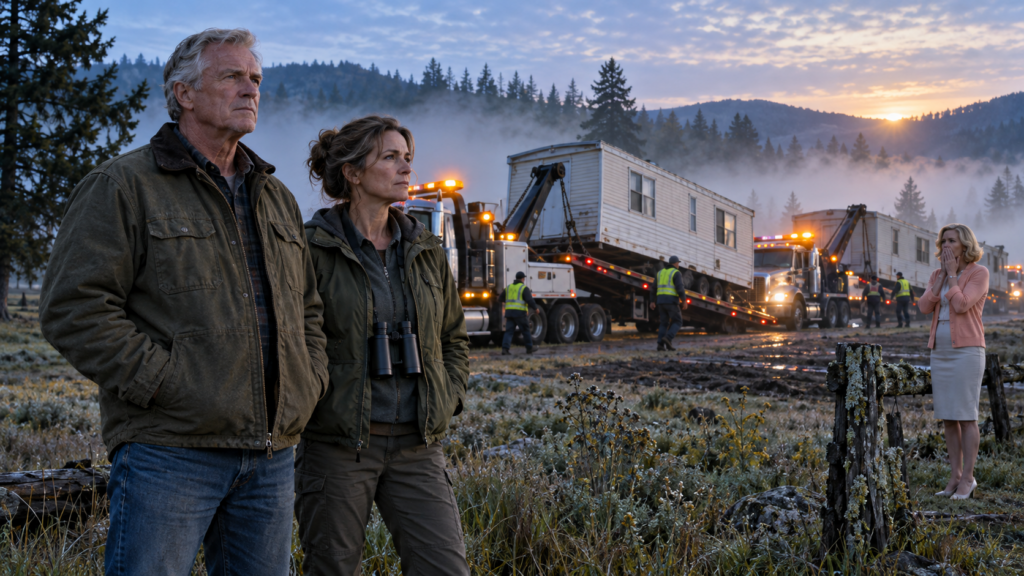
At 5:59 the next morning, six tow trucks idled outside my gate.
State investigators waited behind them.
Wildlife officers were parked down the road.
Laura stood beside me holding her field notebook.
Mason checked the cameras one final time.
The clock turned 6:00.
The first winch cable tightened.
And Celeste Warren’s boat began sliding onto the flatbed.
At 6:09, Celeste’s SUV came flying up the county road.
She jumped out wearing pajama pants beneath a robe, phone already recording.
“STOP! Those are HOA assets!”
Nobody stopped.
The towing company had my deed, the statutory notice, photographs, certified-mail records, and owner information for every trailer.
The first rig was already secured.
Then Celeste noticed the state investigator behind her.
He stepped forward.
“Celeste Warren?”
Her face changed.
He produced a warrant.
Before she could answer, another state unit was entering the Pinehaven HOA office to speak with Brent.
Wildlife officers moved toward the contaminated boat trailers.
By 6:40, fifteen trailers were gone.
By 7:25, all twenty-seven had been removed from the meadow.
Residents began arriving in robes, slippers, sweatpants, and expressions ranging from outrage to confusion.
One man shouted that he’d paid the HOA for legal storage.
I held up the original easement.
“That’s exactly the problem.”
Then the Attorney General’s office announced a civil investigation into the storage fees Pinehaven had collected from residents.
A wildlife officer confirmed multiple trailers required further invasive-species inspection.
Celeste stood beside the patrol vehicle, staring at the empty meadow.
For four years, she had charged people to park on land she didn’t own.
Now the trailers were gone.
But the money trail remained.
And Benjamin had found one final document.
A spreadsheet labeled:
FUTURE REVENUE SITES.
My meadow wasn’t the only property the Warrens had planned to use.
Six other parcels were listed.
None belonged to Pinehaven.
When residents saw the map, the anger stopped being aimed at me.
It turned toward the people they had trusted…
The first Pinehaven resident to knock on my door was a retired mechanic named Harold Pike.
He arrived just after noon.
His fishing trailer had been number sixteen.
He had already paid the towing company and recovered it from the temporary impound area.
“I owe you an apology,” he said.
“You don’t.”
“I parked on your land.”
“Because the HOA sold you permission.”
He looked toward the empty meadow.
“I paid them twenty-four hundred dollars over the last year.”
That number mattered.
Not because Harold was unique.
Because he wasn’t.
One resident after another had paid monthly storage fees believing Pinehaven legally controlled the meadow.
Some had signed annual permits.
Others received laminated windshield tags.
The HOA had created rules.
Inspection forms.
Waiting lists.
Late-payment penalties.
An entire business.
Built on somebody else’s property.
Benjamin obtained Pinehaven’s financial records through the civil investigation.
The picture became clearer.
Storage fees had been collected for nearly four years.
The total exceeded $250,000.
Some money paid for administrative costs.
A small amount covered signs and permit materials.
But more than $200,000 had been routed through consulting invoices to Warren Community Marketing.
Owner:
Celeste’s older sister.
The invoices used vague descriptions.
Community outreach.
Member engagement.
Amenity strategy.
Storage program communications.
State investigators wanted evidence of what services were actually performed.
There wasn’t much.
Then they found email traffic between Celeste and her sister.
One message read:
Keep descriptions general. Storage account doesn’t need unnecessary questions.
Another:
Brent says once we establish four or five years of uninterrupted use, ownership becomes harder for Barrett to challenge politically.
Not legally.
Politically.
That distinction told Benjamin exactly what they were doing.
“They knew the easement wasn’t real.”
“How?”
“Because if they honestly believed they possessed storage rights, they wouldn’t need years of reliance to pressure you.”
The forged document was sent for examination.
The supposed amended easement had never been recorded by the county.
The recording number belonged to no valid filing.
The notary acknowledgment was invalid.
Investigators traced the file used to create the document to a computer assigned to the HOA office.
Brent’s attorney argued that he had relied on information provided by others.
Then investigators recovered draft versions from his development company’s cloud storage.
One early draft contained a note:
Need recorded-looking language before summer permits.
That was difficult to explain.
Meanwhile, the environmental side of the case expanded.
Laura and the state wildlife team examined the boat-storage records.
Three trailers showed trace material requiring full decontamination.
One belonged to Harold.
He was horrified.
“I went through the inspection station.”
His documentation confirmed it.
The trace contamination likely came from contact with another boat or contaminated standing water.
That actually helped him.
He had followed the rules.
Another owner had not.
The most serious case involved Brent’s boat.
Records showed it had been stopped during an enhanced invasive-species inspection the year before.
Initial material had triggered a required decontamination process.
Investigators found gaps in the completion records.
They also found photographs posted online weeks later showing the same boat in Lake Pend Oreille.
