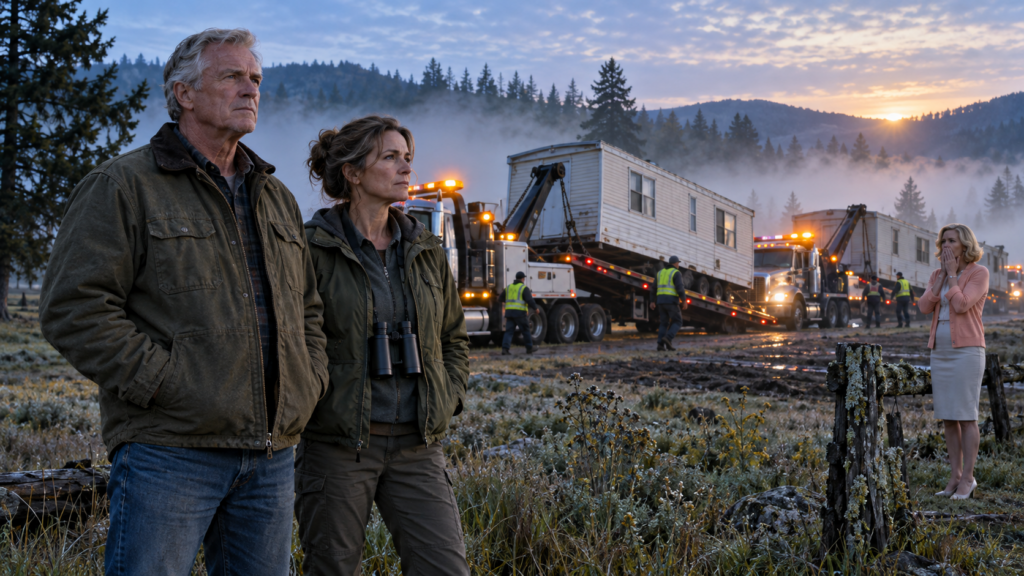
That led to a separate investigation.
Laura insisted that we be careful with the story residents were telling.
“We don’t call these people environmental criminals just because their trailers were parked here.”
She was right.
Most Pinehaven residents had been deceived twice.
First about the land.
Then about the safety of the storage operation.
So when local media arrived, I kept my statement simple.
“This meadow is private property. The HOA did not have storage rights here. The trailers were removed after proper notice. Environmental agencies are handling any boat-related concerns.”
That was it.
No insults.
No victory speech.
Celeste had spent years turning confidence into authority.
I had no intention of making the same mistake.
The Pinehaven board held an emergency meeting that evening.
More than seventy homeowners attended.
Celeste obviously wasn’t there.
Brent wasn’t either.
Their attorney sent a statement advising the board not to discuss active criminal matters.
That left the remaining directors facing people who wanted answers.
Harold stood first.
“How long did the board know the meadow wasn’t ours?”
Nobody answered.
A woman near the back asked:
“Who approved payments to Celeste’s sister?”
Silence.
Another resident held up one of the storage permits.
“This says ‘authorized common property.’ Who wrote that?”
One board member finally spoke.
“Celeste handled the program.”
That answer made the room angrier.
Because “Celeste handled it” had apparently been the operating procedure for years.
The board voted to suspend all storage-related activity.
Then they commissioned an independent audit.
Within a week, three directors resigned.
The others stayed only long enough to organize a new election.
Benjamin advised me not to attend.
“This is their mess to clean up.”
He was right.
The important fights were happening elsewhere.
State investigators examined the forged easement.
The Attorney General reviewed whether residents had paid storage fees based on false representations.
Wildlife agencies inspected boats.
The county reviewed whether Pinehaven had operated an unlicensed commercial storage facility.
And Benjamin filed a civil action confirming that the meadow carried no parking or storage easement.
Pinehaven responded with a claim of prescriptive rights based on years of open use.
That argument didn’t survive long.
Four years of unauthorized parking did not magically produce the property interest they claimed.
The judge dismissed the central access theory and left the HOA with a very simple reality:
They never had the right to run the storage yard.
Then came restitution.
The new Pinehaven board made an important decision.
Instead of spending years defending Celeste’s program, it cooperated with the investigation and agreed to return improperly collected storage fees where records supported repayment.
Residents received credits and refunds.
Insurance covered part of the association’s losses.
Other claims were pursued against responsible parties.
The new board also adopted a rule that should have existed from the beginning:
No HOA contract involving real property could be approved without independent title verification.
Harold joked that they had spent thousands of dollars learning what every twelve-year-old already understood.
“Don’t rent out somebody else’s yard.”
I liked Harold.
The criminal cases moved more slowly.
Real investigations usually do.
The forged easement was serious.
So were the financial records.
But Benjamin repeatedly reminded me:
“Charges aren’t convictions. Let the process work.”
Eventually, Celeste entered a plea resolving several fraud- and document-related charges.
She was ordered to pay restitution and barred from serving as an officer of Pinehaven under the settlement terms connected to the civil case.
Brent faced separate consequences involving development representations and the environmental investigation.
His company lost contracts.
Several lenders backed away.
The future expansion plans around Pinehaven died quietly.
The most significant outcome, at least to Laura, had nothing to do with Celeste.
It involved the lake.
The boat-trailer investigation exposed gaps in local invasive-species compliance and storage practices.
State wildlife officials expanded outreach around mandatory inspection and decontamination.
Additional funding was directed toward monitoring high-risk boats entering the watershed.
Laura was asked to join a long-term regional advisory team.
The day she received the invitation, she sat on our porch for almost half an hour without speaking.
Finally, I asked:
“You happy?”
She looked toward the lake.
“Yes.”
“Doesn’t look like it.”
“Some things are too important to celebrate loudly.”
That was Laura.
Mason eventually returned to his fire crew.
Before leaving, he helped me dismantle the temporary impound fence.
The meadow looked enormous once it was empty.
For weeks, I kept expecting to see fiberglass campers or boat trailers when I stepped outside.
Instead, there was grass.
Nothing remarkable.
Exactly what I wanted.
Then Laura made a suggestion.
“Don’t turn it back into hay.”
“Why?”
“Because twenty-seven trailers almost turned this place into evidence forever.”
She looked toward the water.
“Make it something useful.”
So we did.
We restored the six acres with native bunchgrass.
Added pollinator strips.
Built a small open-air pavilion from larch milled on our property.
Installed an educational display about Lake Pend Oreille, invasive species, and responsible boat inspection.
Beside it, I placed a photograph of my grandfather standing in the same meadow in 1958.
His old stock pond behind him.
A hunting dog at his feet.
No HOA.
No trailers.
No signs.
Just land.
We called it the Barrett Meadow Stewardship Preserve.
The name sounded fancier than I preferred.
Laura chose it.
Therefore, that was the name.
Once a month from late spring through early fall, we opened the pavilion for a free lake-stewardship program.
Wildlife biologists talked about invasive species.
Local officers discussed boating laws.
Kids looked through microscopes.
Retired fishermen argued about water temperatures.
The Pinehaven residents started coming too.
At the first event, Harold arrived with folding chairs.
“Permission to park?”
I stared at him.
He grinned.
I pointed toward the marked visitor area.
“Temporary permission granted.”
He saluted.
The new Pinehaven president was Ruth Talbot, a retired hospice nurse who had never wanted the job.
That alone made her more qualified than half the people who had held it before.
Her first meeting lasted thirty-seven minutes.
No motivational slides.
No speeches about community excellence.
