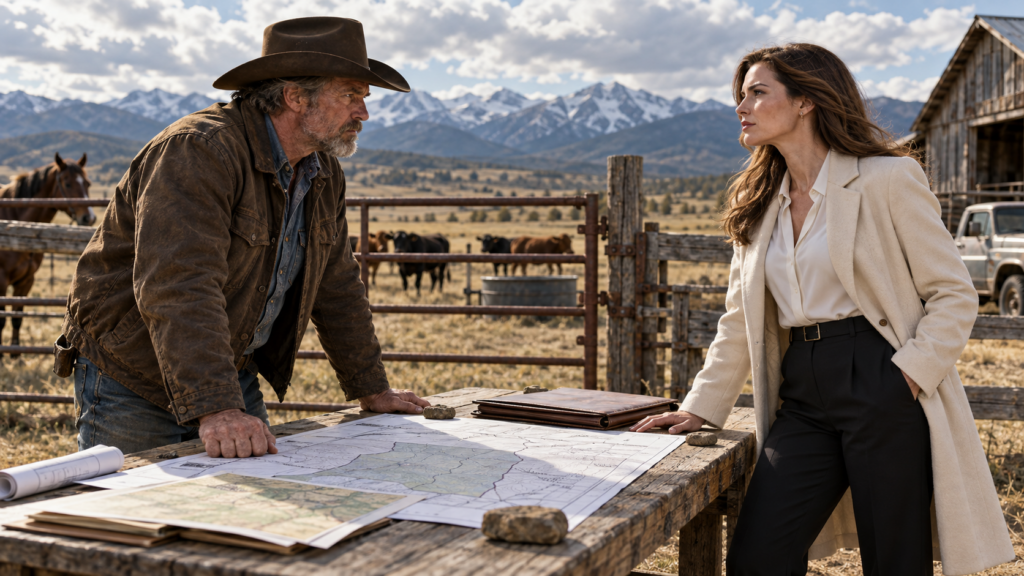
The first thing the HOA president did after driving onto my 8,500-acre valley was tell me I no longer controlled it.
The second thing she did was threaten me when I asked her to prove it.
She stood beside my grandfather’s old cattle gate in a cream-colored coat, surrounded by six board members and three pickup trucks carrying green-and-gold signs that read:
CEDAR HEIGHTS COMMUNITY LAND — RESIDENT ACCESS ONLY
I stared at the sign.
Then at her.
“You’re standing on my ranch.”
She smiled.
“Not anymore, Mr. Mercer. This valley is part of the Cedar Heights community plan.”
I looked behind her.
Eight thousand five hundred acres of Montana grassland, timber, creek bottom, and mountain pasture stretched toward the western ridge.
My grandfather had spent fifty-three years protecting it.
Every fence post.
Every cattle trail.
Every spring.
Every mile of access road.
And now a woman I’d never met had driven through my gate and announced that her homeowners association controlled it.
“Show me the deed.”
Her smile disappeared.
“The HOA doesn’t need a deed.”
“Then show me the easement.”
“We have community authority.”
“That’s not a legal document.”
She stepped closer.
“Mr. Mercer, I suggest you think very carefully before becoming hostile. The county relies heavily on our development. Permits, road access, inspections—things can become inconvenient when people refuse to cooperate.”
That was when I understood this wasn’t confusion.
It was pressure.
My name is Caleb Mercer.
I’m fifty-four years old, and three months before that conversation, I inherited Mercer Valley from my grandfather, Walter Mercer.
He bought the first section in 1968.
Over the next forty years, he added adjoining parcels whenever neighboring ranchers retired or families moved away.
By the time I was born, Mercer Valley had become one continuous piece of land stretching from Dry Creek in the south to Elk Ridge in the north.
Granddad wasn’t wealthy in the way people usually mean it.
His trucks were old.
His boots were older.
He repaired tractors instead of replacing them.
But he believed land mattered because nobody could manufacture more of it.
“Never confuse paper wealth with ground beneath your feet,” he used to tell me.
When he died at ninety-one, he left the valley to me.
The deed package filled an entire archive box.
Recorded plats.
Boundary surveys.
Water rights.
Grazing agreements.
Conservation restrictions.
Old road easements.
Mineral reservations.
Everything indexed.
Granddad had been meticulous.
He knew exactly where every acre began and ended.
Apparently, Cedar Heights did not.
The subdivision sat along the eastern edge of the valley.
Two hundred and thirty upscale homes built on land that had once belonged to another ranch family.
Their sales brochures promised “unrestricted access to Montana’s natural open spaces.”
That sentence would eventually explain almost everything.
The HOA president was Vanessa Crowley.
Forty-seven.
Real estate broker.
Professional smile.
Zero tolerance for being questioned.
She had been elected president six months earlier and apparently decided that the valley visible from Cedar Heights should function as an extension of the subdivision.
At first, residents used one old gravel road crossing a narrow corner of my property.
That road had a recorded easement.
I knew about it.
Granddad had granted passage decades earlier to the previous ranch owners.
It allowed travel from one county road to another.
Nothing else.
No recreation rights.
No trail access.
No grazing.
No parking.
No authority to manage surrounding land.
Passage.
That was all.
But sometime during Granddad’s final years, Cedar Heights began stretching the meaning.
Residents rode ATVs off the road.
Then horseback riders appeared.
Then hiking signs.
Then HOA trail maps.
By the time I inherited the property, Vanessa had apparently convinced herself that repeated trespassing had evolved into ownership.
The morning after our confrontation, I found thirteen new signs across the valley.
CEDAR HEIGHTS TRAIL 4
PRIVATE COMMUNITY RECREATION AREA
HOA MAINTAINED LAND
One sign stood more than half a mile inside my recorded boundary.
Another had been bolted directly to one of Granddad’s cedar fence posts.
I didn’t remove anything.
Not yet.
I photographed every sign.
GPS coordinates.
Time.
Date.
Direction.
Then I called my attorney, Rachel Donnelly.
“Don’t argue with them,” she said.
“I already asked for documents.”
“What did they give you?”
“A threat.”
“Even better. Document that too.”
Rachel had handled agricultural property disputes for nearly twenty years.
Her advice was simple.
Build the record first.
So I did.
I photographed tire tracks.
Survey flags.
HOA workers painting tree trunks.
Temporary barriers.
Fresh gravel dumped near an interior ranch road.
Then I discovered the first piece of equipment.
A compact excavator.
Parked beside my north fence.
Bucket down.
HOA contractor logo on the door.
Two workers were widening a trail toward Elk Ridge.
I approached slowly.
“Who authorized this?”
The foreman looked confused.
“Cedar Heights.”
“Who at Cedar Heights?”
“President Crowley.”
“This is private property.”
He pulled out his phone.
“She told us the land was HOA controlled.”
I photographed the machine and job sheet.
Then I asked everyone to stop until ownership could be verified.
To their credit, they did.
Vanessa arrived twenty minutes later.
She was furious.
“You cannot interfere with HOA contractors.”
“They’re on my land.”
“This road serves our residents.”
“That doesn’t make the surrounding property yours.”
She pointed toward the excavator.
“The board authorized improvements.”
“Your board can authorize improvements on HOA property.”
She stepped closer.
“We have been maintaining this area for years.”
“Maintenance doesn’t transfer title.”
“That will be for a judge to decide.”
Finally, something we agreed on.
The next day, Rachel sent a formal demand.
It included my deed.
The recorded plat.
The easement.
A property description.
And a clear instruction that Cedar Heights stop placing signs, performing work, or representing my land as HOA property.
Vanessa responded with one paragraph.
The Cedar Heights HOA disputes Mr. Mercer’s interpretation of historical community rights and will continue managing community-use areas pending review.
Rachel called me.
“She’s just admitted they’re continuing after receiving notice.”
“Useful?”
“Very.”
Then we hired a licensed surveyor.
