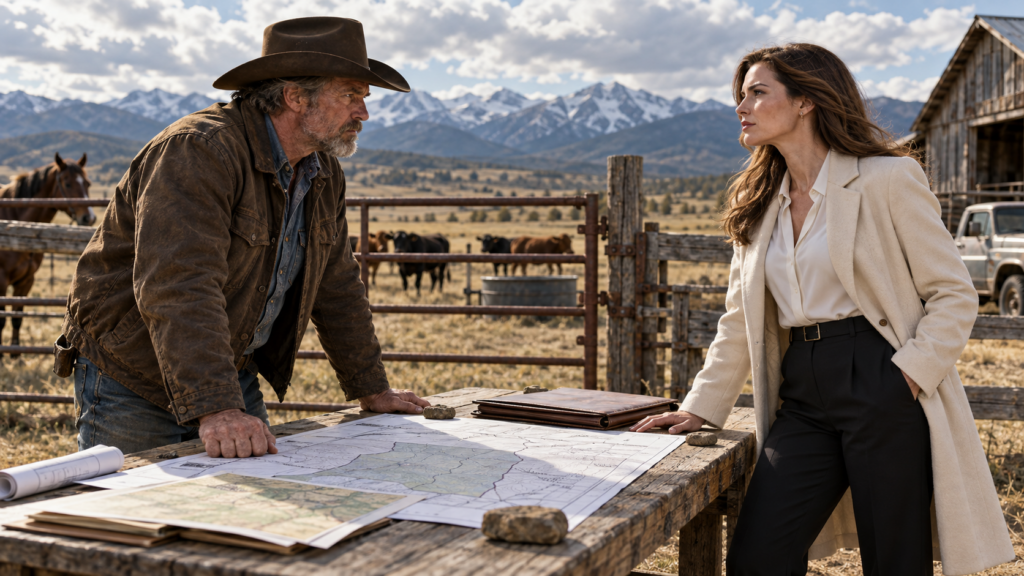
Sometimes the record answers for you.
The written decision arrived twelve days later.
I opened the email at the same kitchen table where Granddad used to sort veterinary receipts.
Rachel called before I’d finished reading.
“You see it?”
“I’m on page six.”
“Skip to the order.”
I did.
The court recognized my ownership of Mercer Valley and rejected the HOA’s claim to broad management or recreational authority over the property.
The existing roadway easement remained valid for its defined purpose.
Nothing more.
The order directed Cedar Heights to stop representing areas outside that easement as HOA-controlled property.
Unauthorized signs and equipment had to be removed.
New recreational improvements outside the easement were prohibited without my permission.
The disturbed sites were to be restored under an agreed plan.
I read the final paragraph twice.
Then closed the laptop.
No cheering.
No fist pump.
Just silence.
Outside the kitchen window, the valley stretched toward Elk Ridge.
Exactly where it had always been.
The removal process began the following week.
Two sheriff’s deputies were present because tensions had been high, not because anyone expected violence.
The HOA contractor arrived with a flatbed.
First went the signs.
CEDAR HEIGHTS TRAIL 4.
COMMUNITY RECREATION AREA.
RESIDENT ACCESS ONLY.
Each one was unbolted.
Loaded.
Gone.
The concrete footings were pulled.
The gravel turnout was narrowed back to the legal road area.
Trail markers came off trees.
Workers repaired fencing.
Daniel Price checked the work.
I didn’t stand there celebrating.
Mostly, I helped.
One young contractor looked embarrassed.
“Mr. Mercer, I didn’t know.”
“I know.”
“We were told this belonged to the HOA.”
“I know that too.”
“Sorry.”
“Then help put it back.”
He did.
That’s all I needed.
Vanessa resigned three weeks later.
Not because the court ordered it.
The Cedar Heights board asked her to step down after residents demanded an accounting of the valley program and decisions that led to the lawsuit.
Thomas became interim president.
His first letter to the neighborhood was the exact opposite of Vanessa’s style.
No dramatic language.
No threats.
No talk about community authority.
Just facts.
Mercer Valley is privately owned. Cedar Heights retains only the recorded roadway easement described in association documents. Residents must not leave the easement or enter adjoining Mercer property without permission.
Then came something I appreciated.
The board apologizes to Mr. Mercer for prior communications implying broader authority than the association possessed.
I printed that letter.
Not for revenge.
For the file.
Granddad would have approved.
He believed agreements only mattered if you could find them later.
The most unexpected part came that summer.
A group of residents asked whether I would consider limited hiking access.
My first instinct was no.
After everything that happened, no would’ve been easy.
But the request was different this time.
They didn’t arrive with signs.
Or workers.
Or authority they hadn’t earned.
Thomas came alone.
“We’re asking.”
“Not telling?”
He smiled.
“Definitely asking.”
I thought about Granddad.
He had refused permanent HOA recreational rights.
That didn’t mean he hated neighbors.
He hated losing control of the land.
There was a difference.
So I created a small voluntary access program.
Three Saturdays each summer.
Guided walks.
No ATVs.
No permanent trails.
No commercial fees.
No implied future rights.
Written permission each time.
Silas Morgan, my ranch manager, helped lead the groups.
Residents saw parts of the valley most had only viewed from their decks.
The old cottonwoods along Dry Creek.
Granddad’s original cattle camp.
A spring house built in 1972.
Elk tracks near the ridge.
Children asked questions.
Adults mostly listened.
At the end of the first walk, Melissa Owens stood beside the gate.
“I think we treated this place like an amenity.”
“It isn’t.”
“I know that now.”
“What is it?”
She looked across the pasture.
“Somebody’s home.”
That was enough.
I restored Granddad’s cedar post where the HOA had mounted one of its signs.
The wood had been scarred by bolts.
I could have replaced it.
Instead, I filled the holes and left the marks visible.
History shouldn’t always be sanded smooth.
Some damage deserves to remain recognizable.
Beside it, I installed one small sign.
MERCER VALLEY PRIVATE WORKING LAND EST. 1968 ACCESS BY PERMISSION
No threats.
No cameras.
No giant warnings.
Just the truth.
A year after Vanessa first drove through my gate, I rode the north pasture before sunrise.
The grass was silver with frost.
Cattle moved slowly near the creek.
The mountains caught the first orange light.
I stopped where Granddad used to sit on horseback and inspect the eastern fence.
When I was twelve, I asked him why he checked boundaries so often.
He said:
“Because a fence doesn’t protect land, Caleb. People respecting what it means protects land.”
I didn’t understand then.
I do now.
Vanessa’s mistake wasn’t simply crossing a property line.
It was believing repetition could replace permission.
That enough signs could create ownership.
That enough meetings could create authority.
That enough confidence could turn somebody else’s valley into community property.
But ownership has a source.
Deeds.
Recorded rights.
Surveys.
Agreements.
Law.
And when those things matter, volume doesn’t beat evidence.
I protected Mercer Valley the boring way.
I took photographs.
Saved letters.
Hired a surveyor.
Listened to my attorney.
Kept lawful access open.
Avoided threats.
Went to court.
And let the records speak.
Not as exciting as chasing somebody off the land with a shotgun.
Much more effective.
When I reached the southern meadow, the old gravel easement came into view.
A Cedar Heights resident drove slowly across it.
He saw me.
Raised one hand.
I waved back.
He stayed on the road.
That small detail made me smile.
The HOA still had exactly what the law allowed.
Passage.
I still had exactly what Granddad left me.
The valley.
Nothing legitimate had to be destroyed for my rights to be respected.
That mattered.
Because property rights work both ways.
If I expected Cedar Heights to respect mine, I had to respect theirs.
Even after everything.
Especially after everything.
