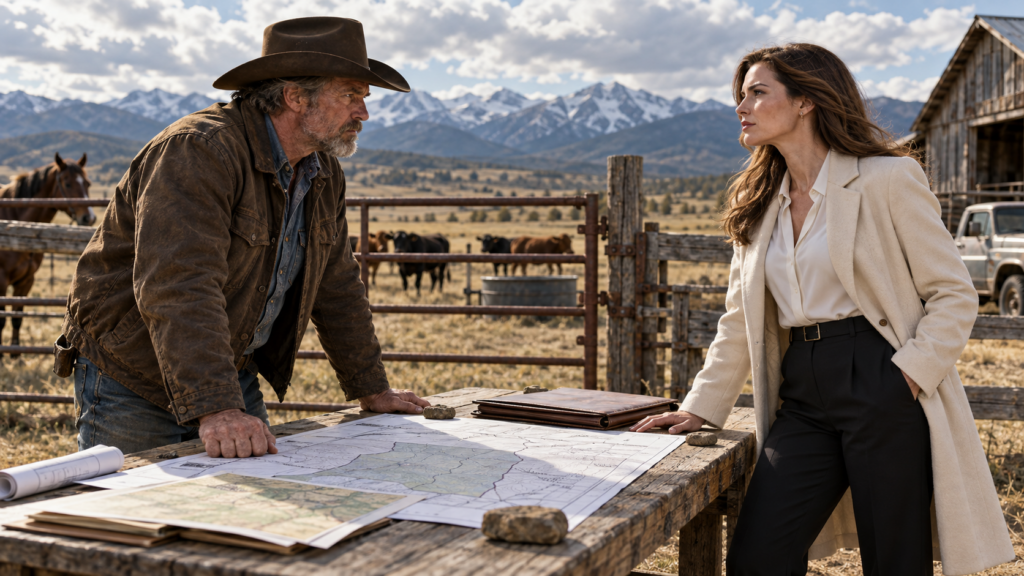
His name was Daniel Price.
He spent four days on the valley.
He reviewed the recorded plats.
Recovered original monuments.
Located iron pins.
Checked fence alignments.
Verified road coordinates.
And compared current HOA markers against the legal boundaries.
When he returned, he spread the survey across my kitchen table.
“Caleb.”
“How bad?”
He pointed toward the eastern section.
“Their closest sign is seventy-two feet inside your land.”
Then another.
“This trail marker is four hundred eighty feet inside.”
Then the excavator location.
“Nearly nine hundred.”
“And the road?”
“The easement exists.”
I nodded.
“But?”
“But the easement is forty feet wide.”
He traced the line.
“The HOA’s new parking area extends two hundred ten feet beyond it.”
That report changed everything.
Now it wasn’t my word against Vanessa’s.
We had independent professional evidence.
Rachel assembled the packet.
Deeds.
Survey.
Photographs.
Recorded easement.
HOA correspondence.
Contractor work orders.
Everything.
She sent Vanessa one final demand.
Remove the signs.
Stop construction.
Restore disturbed areas.
Do not interfere with lawful ranch operations.
Three days passed.
Nothing.
Then the sheriff’s department called me.
Vanessa had reported that I was “obstructing lawful community access.”
Two deputies arrived that afternoon.
Vanessa arrived five minutes later carrying a binder.
She looked pleased.
“This should finally settle it.”
One deputy asked me for my documents.
I handed him the survey.
He studied it.
Then the deed.
Then the easement.
Vanessa interrupted.
“The HOA has exercised control over that land for years.”
The deputy looked at her.
“Do you have title?”
“We have community-use rights.”
“Recorded?”
She opened the binder.
Inside were trail maps.
HOA meeting minutes.
Maintenance invoices.
Newsletters.
Not a deed.
Not an easement granting recreation.
Not a legal property transfer.
The deputy closed the binder.
“This looks like a civil property dispute.”
Vanessa smiled.
“Exactly.”
He continued.
“But this survey appears to show your signs and work area inside Mr. Mercer’s boundary. Until a court says otherwise, I’d strongly suggest nobody expand the activity.”
Her smile vanished.
That evening, three Cedar Heights board members called Rachel privately.
They wanted to know whether Vanessa had ever shown us any legal ownership document.
She hadn’t.
Apparently, she hadn’t shown them one either.
For the first time, the board was questioning her.
And the following morning, Rachel called me with the sentence I’d been waiting for.
“We’re filing.”
“What exactly?”
“A request for declaratory and injunctive relief. We ask the court to determine the property rights and stop further unauthorized activity while the case is reviewed.”
I looked across the valley.
Vanessa had treated confidence like evidence.
Now she was going to have to prove every claim in front of someone who wouldn’t care how confidently she said it.
A judge.
The court issued a temporary order preventing either side from expanding activity in the disputed areas until the ownership question could be reviewed.
Vanessa immediately told residents I’d “closed their valley.”
I hadn’t.
The recorded passage easement remained open.
What stopped was everything outside it.
No new trails.
No parking expansion.
No HOA signs deeper inside the ranch.
No excavation.
At the hearing, Rachel started with the simplest evidence.
My deed.
Then the recorded plat.
Then Daniel Price’s licensed survey.
Then the original easement.
Forty feet wide.
Passage only.
The HOA attorney produced years of maintenance receipts, neighborhood maps, photographs of residents hiking, and board minutes referring to the valley as “community open space.”
The judge asked one question.
“Where is the document transferring ownership or recreational rights to the association?”
The attorney requested time to answer.
Vanessa whispered something beside him.
He shook his head.
Then one Cedar Heights board member testified that Vanessa had repeatedly assured them the HOA’s rights were “already established.”
When asked what document supported that statement, he said he’d never seen one.
Another admitted the board approved trail improvements based on Vanessa’s representations.
The judge ordered a fuller review of the title history.
That should have worried Vanessa.
Instead, outside the courthouse, she walked directly toward me.
“You think this is over?”
“No.”
“We can bury you in litigation.”
Rachel stepped between us.
“Vanessa, I strongly recommend you stop making statements like that.”
She stared at us.
Then walked away.
Two weeks later, the title search came back.
And buried inside it was the document that ended Cedar Heights’ entire claim.
Not only had Granddad never granted them control of the valley.
Twenty-three years earlier, he had explicitly rejected a developer’s request for recreational access.
The rejection had been recorded with the county.
Cedar Heights had built its entire claim on a right my grandfather had already refused in writing…
The recorded rejection was only three pages long.
It had been filed in 2003, years before Cedar Heights was fully built.
The original developer had approached my grandfather with a proposal.
Residents of the future subdivision would receive recreational access to Mercer Valley.
Hiking.
Horseback riding.
Seasonal ATV trails.
In return, Granddad would’ve received annual maintenance payments.
He refused.
His response was brief.
Passage rights already recorded shall remain unaffected. No recreational, management, or possessory rights are granted beyond the existing roadway easement.
Rachel read that sentence twice.
Then looked at me.
“Your grandfather couldn’t have made this clearer.”
I ran my finger over his signature.
Walter Mercer.
Same heavy handwriting I remembered from birthday cards and feed invoices.
“Did the developer receive it?”
Rachel turned the page.
“Certified acknowledgment.”
The development company had signed for it.
Even better, Cedar Heights’ original subdivision disclosures referenced the same roadway easement.
Nothing more.
The HOA’s attorney received the document on a Monday.
By Wednesday, he requested a settlement conference.
Vanessa objected.
The rest of the board overruled her.
That told me the dispute had changed.
It was no longer Caleb Mercer against Cedar Heights.
It was becoming Cedar Heights against its own president’s decisions.
The settlement conference took place in a plain county meeting room.
No courtroom.
No audience.
Just lawyers, board representatives, me, Vanessa, and too much bad coffee.
Rachel laid out our position.
