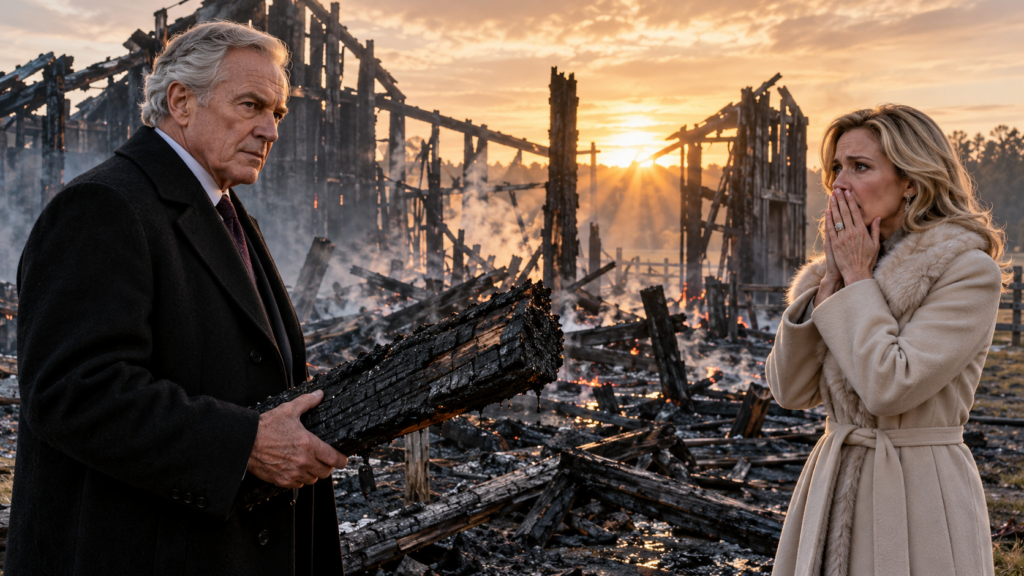
At 5:47 on a freezing Iowa morning, I stood in the ashes of the barn my great-grandfather had built with his own hands.
The oak beams were still smoking.
Twisted roofing metal glowed red beneath collapsed timber.
The air tasted like diesel fuel, burned corn dust, and seventy years of family history.
And across the road, parked beneath a streetlight, sat the white Mercedes belonging to the woman who had spent three months trying to force me off my land.
Brenda Kilpatrick.
HOA president.
Real estate broker.
Self-appointed ruler of Milfield Estates.
She thought she had finally solved her problem.
My barn was gone.
My property had been damaged.
And if her plan worked, I’d get tired, frightened, and desperate enough to sell.
What she didn’t know was that before retirement, I had spent twenty-seven years as a federal judge handling public-corruption and civil-rights cases.
She had googled my name.
She’d seen “retired judge.”
What she apparently hadn’t read was the part about the county officials, developers, and contractors I’d helped send to prison.
My name is Thaddeus Brennan.
Three years earlier, after my wife Margaret died of cancer, I left the bench and moved onto forty-seven acres my family had owned since 1948.
My great-grandfather Seamus Brennan had come to Iowa after World War II with shrapnel in one leg, a Purple Heart in a dresser drawer, and enough stubbornness to build a future out of raw land.
In 1952, he built the corn barn.
Hand-cut oak.
Mortise-and-tenon joints.
A fieldstone foundation.
No decorative nonsense.
Just a building designed to survive Iowa winters.
It did.
For more than seventy years.
Until Brenda decided it was hurting property values.
Milfield Estates surrounded my land on three sides.
Eight hundred forty-seven nearly identical houses wrapped around what had once been cornfields.
The subdivision was built long after my property had been established, and my land was not part of its HOA.
Legally, Brenda had no authority over me.
She disagreed.
Her first visit came while I was repairing my grandfather’s old John Deere.
She walked up the gravel driveway in a cream suit and heels that sank into the dirt with every step.
“Mr. Brennan, I’m Brenda Kilpatrick, president of Milfield Estates.”
“I know who you are.”
Her smile tightened.
“We need to discuss your agricultural structures.”
I wiped grease from my hands.
“What about them?”
“That barn is visible from seventeen homes. Residents have complained.”
“It’s a barn.”
“It’s an eyesore.”
“It’s also outside your HOA.”
She folded her arms.
“Property values don’t stop at property lines.”
“Legal authority does.”
That was the first moment I saw what was underneath the smile.
Her eyes went cold.
“Mr. Brennan, people who refuse reasonable cooperation sometimes discover that other problems begin appearing.”
I had heard threats dressed in polite language for most of my career.
This one wasn’t particularly creative.
“What kind of problems?”
She smiled again.
“Oh, I’m sure we’ll both find out.”
A week later, the county code-enforcement officer arrived.
His name was Dale Hoffman.
He carried fourteen complaints.
Noise.
Dust.
Rodents.
Septic concerns.
Improper agricultural equipment storage.
Environmental hazards.
Fourteen complaints in seven days against a farm that had existed since before the subdivision.
Dale looked miserable.
“Anonymous?” I asked.
“Most of them.”
“Most?”
He hesitated.
Then he showed me his phone.
There was a voicemail transcript from Brenda.
It asked for “immediate and comprehensive enforcement” at my property and reminded Dale that her husband’s construction company had several county contracts awaiting approval.
I read it twice.
Then looked at him.
“Did she just threaten county business if you don’t harass me?”
Dale swallowed.
“I’m trying to keep my job.”
I believed him.
So I explained the agricultural protections that applied to the property and told him to document what he actually observed.
Normal farm operations.
No emergency.
No dangerous condition.
Nothing requiring enforcement.
Before leaving, Dale whispered, “Judge, you didn’t get this from me.”
“I won’t need to.”
Brenda called that night.
“I understand you interfered with a county inspection.”
“I documented it.”
“You seem to enjoy making things difficult.”
“Only for people who earn it.”
Her voice hardened.
“You have no idea how much influence I have in this county.”
That was the first useful thing she told me.
Because people with real influence rarely need to announce it.
People abusing influence do.
Then came the lawsuit.
Brenda’s attorneys claimed the barn was structurally dangerous and demanded demolition plus damages for reduced property values.
The filing accused it of attracting vermin, trespassers, and—in language so absurd I initially thought it was a typo—”potential concealment opportunities for criminal actors.”
A seventy-year-old corn barn had apparently become a national-security issue.
But the law firm’s name caught my attention.
Hawthorne Sterling & Associates.
Not a small-town firm.
A major development practice out of Des Moines.
Someone was spending serious money to remove a barn from forty-seven acres.
So I checked property records.
That was when this stopped being about aesthetics.
Over the previous eighteen months, three shell companies had quietly purchased agricultural parcels surrounding Milfield Estates.
Different company names.
Same mailing address.
Randy Kilpatrick’s construction office.
Brenda’s husband.
One tract after another.
Except mine.
My forty-seven acres sat directly between the existing development and several hundred acres already under contract.
Without my property, the expansion couldn’t connect cleanly.
With it, they could build roads, utilities, and another entire phase.
Suddenly the barn wasn’t an eyesore.
It was leverage.
I called Michael Chen, one of my former clerks, now a civil-rights attorney in Chicago.
“Michael, someone is using county officials to pressure me into selling agricultural land.”
He laughed.
“Please tell me they’re doing it in writing.”
“They are.”
“Then I’m coming to Iowa.”
Within days, he had filed responses challenging the harassment and preserving potential federal civil-rights claims against anyone misusing government authority.
Then an old federal contact called me.
Special Agent Sarah Kowalski.
“Thad, we need to talk.”
“About Brenda?”
“About the people behind Brenda.”
My hand tightened around the phone.
