Owners were given meaningful appeal rights.
Major expenditures required competitive bids.
And no board member could participate in decisions involving a company in which they had a financial interest.
None of that was revolutionary.
It was just governance.
But after years of Brenda, ordinary fairness felt radical.
Mrs. Chen became the unofficial archivist.
She kept copies of the old violation letters and board minutes in labeled boxes.
“Why save them?” I asked.
“Because people forget.”
She tapped the lid.
“And people who forget eventually elect another Brenda.”
I couldn’t argue.
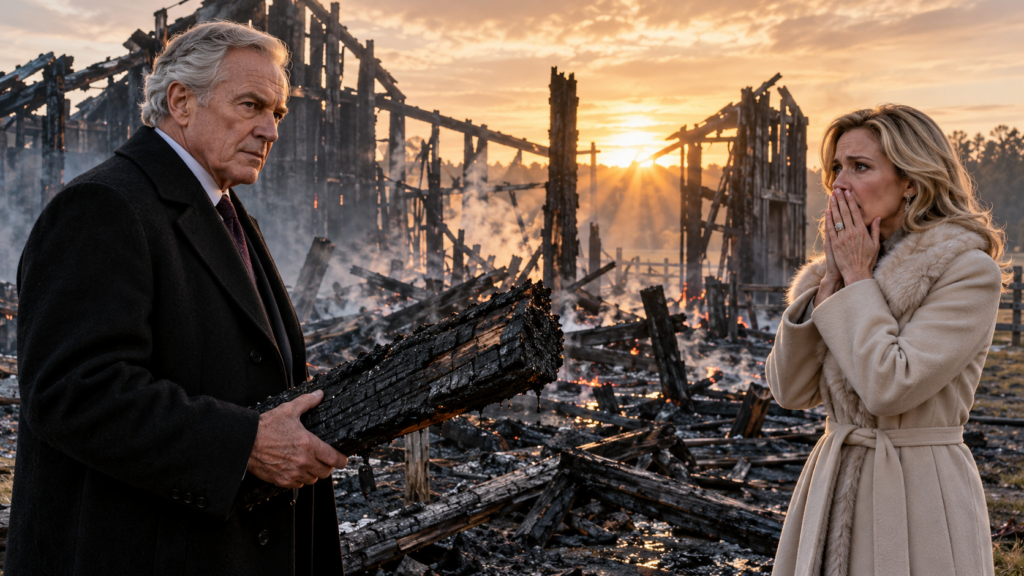
Six months after the fire, volunteers came to rebuild my barn.
I hadn’t asked for a community project.
They organized it anyway.
Farmers brought oak.
A veterans group paid for hardware.
Amish carpenters from two counties over volunteered several weekends.
Families from Milfield Estates brought food.
Marcus showed up with a tool belt that had apparently never been worn.
“You know how to use any of that?” I asked.
“Absolutely not.”
“Good. Carry lumber.”
He laughed.
The new frame rose where the old barn had stood.
We didn’t try to recreate every board exactly.
That would’ve been dishonest.
The original was gone.
But we used salvaged stones from Seamus’s foundation.
The charred hammer was mounted inside the entrance.
Beneath it, a small brass plate read:
**BUILT 1952 BURNED 2024 BUILT AGAIN**
That was enough.
Michael Chen and I used part of the civil recovery to start a small legal-assistance program.
Nothing grand.
No national crusade.
Just consultations for rural landowners and homeowners dealing with questionable enforcement, boundary disputes, retaliatory code actions, or development pressure.
The principle was simple.
People needed help early.
Before the liens.
Before the forced sales.
Before a minor dispute became financial ruin.
We brought in attorneys who understood agricultural property law.
Surveyors volunteered time.
Retired clerks taught people how to pull public records.
Former code officers explained the difference between a legitimate violation and selective enforcement.
The first month, twelve people called.
By the end of the year, there were more than a hundred inquiries.
Most weren’t dramatic.
Some callers were simply wrong about what the law allowed.
We told them so.
Helping people fight abuse doesn’t mean telling everyone they’re a victim.
Sometimes the answer is:
Yes, that rule applies to you.
Yes, the city can require that repair.
No, your neighbor isn’t violating your boundary.
But other times, a document revealed something important.
And those were the cases that reminded me why the program mattered.
One afternoon, Dale Hoffman came by the rebuilt barn.
The former code officer looked older.
Tired.
He stood beneath the mounted hammer.
“I should’ve said no to her earlier.”
“You eventually did.”
“Not soon enough.”
“No.”
He looked surprised that I didn’t soften it.
I wasn’t trying to punish him.
But forgiveness doesn’t require rewriting history.
He nodded.
“I’ve taken another job. Different county.”
“Code enforcement?”
“Building inspections.”
I raised an eyebrow.
He laughed.
“I read every statute now.”
“Then maybe something useful came out of it.”
Before leaving, he turned back.
“Judge?”
“Yeah?”
“Thanks for not treating me like I was Brenda.”
“You weren’t.”
That distinction was the whole point.
A year after the arrests, I sat on the porch watching sunlight fall across the new barn.
The farm sounded like it always had.
Wind through corn leaves.
A distant tractor.
Birds settling into the tree line.
For the first time since Margaret died, I felt something close to peace.
Not victory.
Victory is too loud.
Peace was quieter.
It was knowing nobody was coming up the driveway with invented authority.
Knowing the county code office wasn’t being used as somebody’s private weapon.
Knowing Marcus could park his truck in his driveway without wondering which petty rule Brenda might invent next.
Knowing Mrs. Chen could hang laundry if she wanted.
Knowing Tom Patterson could ride his motorcycle.
Knowing children could draw hopscotch squares without generating a violation letter.
Small freedoms.
The kind people don’t appreciate until somebody starts rationing them.
That evening, Marcus drove over.
He brought two beers and sat beside me.
“HOA meeting tonight.”
“Shouldn’t you be there?”
“It ended.”
“What time did it start?”
“Six.”
I looked at my watch.
“Six forty-two.”
He grinned.
“Forty-two minutes.”
“Brenda would’ve still been on opening remarks.”
“Exactly.”
We watched the barn for a while.
Then Marcus said, “You know what scared me most about her?”
“What?”
“Not the fines.”
I waited.
“That she made us feel like resisting was more exhausting than surrendering.”
I nodded.
That was accurate.
“She counted on everybody fighting alone.”
“And that stopped working.”
“Yes.”
He raised his bottle.
“To organized annoyance.”
I laughed.
“I’ve heard worse legal doctrines.”
Sometimes people ask what Brenda’s biggest mistake was.
Burning the barn?
Threatening the county officer?
Using government pressure?
Trying to bribe me?
Those were mistakes.
Serious ones.
But her biggest mistake came earlier.
She believed authority and power were the same thing.
They aren’t.
Authority has a source.
A statute.
A deed.
A contract.
An election.
A lawful office.
Power can come from fear.
Money.
Connections.
Threats.
Reputation.
People confusing confidence with legitimacy.
Brenda had plenty of power.
For years, she convinced residents, contractors, and officials that saying something confidently made it true.
Then she encountered records.
And witnesses.
And people willing to ask:
What gives you the right to do this?
That question destroyed more of her empire than anything I ever said from a federal bench.
Before winter, I planted two oak trees beside the new barn.
One for Seamus.
One for Margaret.
They were small.
Barely taller than I was.
I knew I’d never see them reach the size of the trees Seamus had harvested for his original beams.
That didn’t bother me.
Not everything you build is meant to be finished in your lifetime.
Sometimes your job is simply to put something good into the ground and trust somebody else to protect it.
I stood between those two saplings one cold morning and looked across the property.
Forty-seven acres.
