Brenda raised one hand.
“Certain individuals outside this community have abused legal connections and media relationships to create the false appearance of wrongdoing.”
Then Sarah Kowalski stood.
She had been sitting three rows from the front in jeans and a dark jacket.
“Mrs. Kilpatrick.”
Brenda stopped.
Sarah displayed her credentials.
“Special Agent Sarah Kowalski, Federal Bureau of Investigation.”
The room changed instantly.
People stood.
Reporters moved forward.
Commissioner Fitzpatrick looked toward the nearest exit.
Two agents were already there.
Brenda gripped the podium.
“I’m sorry. Is there a reason federal agents are disrupting a private community meeting?”
“Yes.”
Sarah’s voice remained calm.
“We’re executing federal warrants.”
For the first time since I’d known her, Brenda looked uncertain.
Not frightened.
Not yet.
Just uncertain.
That was enough.
Sarah turned toward me.
“Judge Brennan.”
I stood.
Technically, I was no longer Judge Brennan in any official sense.
But in Milfield, people still called me that.
I walked to the front carrying the evidence bag.
Then I placed Seamus’s hammer on the podium.
The charred handle made a soft sound against the wood.
“This belonged to my great-grandfather.”
Nobody spoke.
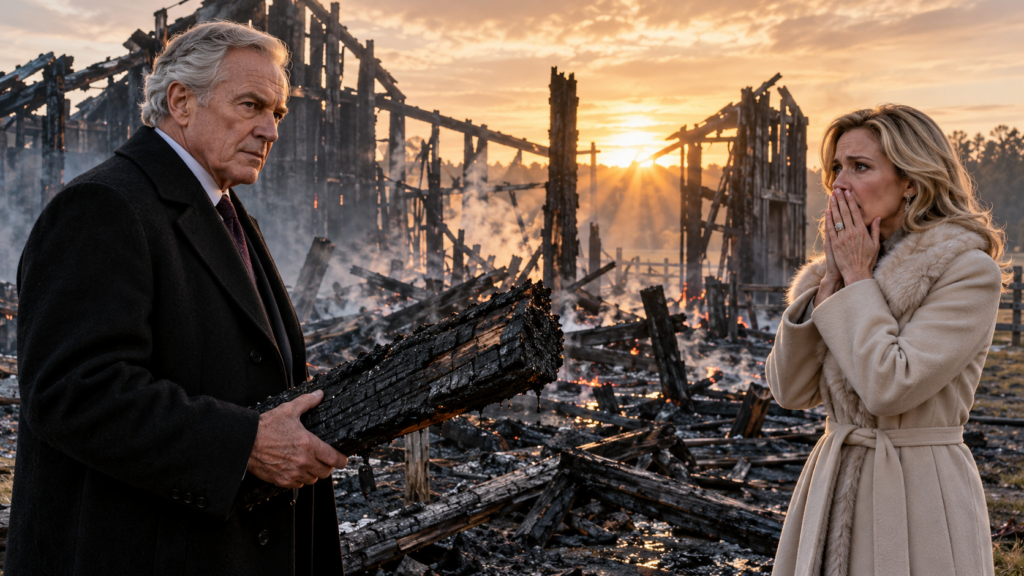
“He used it to build the barn that burned six months ago.”
Brenda stared at me.
I continued.
“Since that fire, federal investigators have been examining whether the destruction of my property was part of a broader effort to pressure rural landowners into below-market sales.”
Randy stood.
“This is defamatory.”
An agent moved closer.
“Sit down, Mr. Kilpatrick.”
He did.
I didn’t make accusations beyond what the investigation could support.
No speeches about guilt.
No courtroom theatrics.
Instead, Sarah played the recording from my kitchen.
Commissioner Fitzpatrick’s voice filled the speakers.
“County government has many tools at its disposal.”
Then Brenda:
“We have the ability to make your legal problems disappear.”
Then Fitzpatrick again:
“Building inspections, septic assessments, tax reviews. These processes can become very thorough.”
The room was completely silent.
Sarah stopped the recording.
Brenda stared straight ahead.
“That conversation is being misrepresented.”
Sarah replied, “You can address that with counsel.”
Then she read the warrant.
The charges alleged conspiracy, fraud, bribery-related offenses, obstruction, and civil-rights violations connected to the broader land-acquisition scheme.
Separate state and federal proceedings would address the barn fire and associated property crimes.
Randy was taken into custody next.
Commissioner Fitzpatrick followed.
Then two county employees.
More arrests were made the following morning.
Not everyone named in the investigation was charged.
Some had simply followed bad administrative decisions without criminal intent.
Others cooperated early.
That distinction mattered.
Justice isn’t improved by sweeping innocent people into a conspiracy because their names appear in the same file.
But the people who knowingly participated faced consequences.
The months after the arrests were less dramatic than that meeting.
Paperwork replaced handcuffs.
Grand-jury testimony.
Subpoenas.
Bank records.
Emails.
Construction contracts.
Property transfers.
Phone records.
Witness interviews.
Prosecutors traced the relationship between development companies, county decisions, and distressed land purchases.
Some transactions turned out to be legitimate.
Others raised serious concerns.
The investigation ultimately established a pattern of coordinated pressure involving certain officials and private businesses.
The government’s theory was straightforward.
Identify desirable rural property.
Create regulatory and financial pressure.
Increase the owner’s cost of resistance.
Then offer a below-market purchase through a related entity.
In several cases, the people targeted were older farmers or families without the money to sustain a long legal fight.
My property had been different for one reason.
They’d picked someone who knew what records to preserve and who had access to lawyers and investigators willing to look deeper.
That fact bothered me.
Because justice shouldn’t depend on whether the victim used to be a federal judge.
Marcus Rodriguez became one of the strongest witnesses.
He testified about discriminatory enforcement inside Milfield Estates and the threat concerning his citizenship.
Mrs. Chen brought years of notices.
Tom Patterson produced citations that appeared after he publicly criticized Brenda.
Jennifer Walsh had recordings and dated correspondence.
Each story alone might have looked petty.
Together, they showed how fear had become a management tool.
One evening, Marcus sat at my kitchen table after another federal interview.
“I still don’t understand why we let it go on so long.”
“Because each incident looked small.”
He nodded.
“An eighty-dollar fine. A letter. A threat.”
“Exactly.”
“You think that’s how people like her win?”
“I think that’s how power gets normalized.”
He looked toward the dark window.
“One stupid little thing at a time.”
“Until nobody remembers what normal looked like.”
He sat quietly.
Then smiled.
“I remember now.”
The barn-fire investigation produced its own evidence.
Accelerant analysis confirmed deliberate ignition.
Vehicle records placed multiple relevant vehicles near the property.
Phone data and communications tied several individuals to the planning and aftermath.
Brenda denied ordering the fire.
Prosecutors had to prove what each defendant actually knew and intended.
Ultimately, plea negotiations resolved several charges.
Brenda entered a federal plea involving conspiracy, fraud-related offenses, and civil-rights violations.
Other charges were handled through the broader agreement and related proceedings.
Commissioner Fitzpatrick also pleaded guilty to offenses arising from misuse of office and participation in the scheme.
Randy Kilpatrick’s companies faced civil consequences, contract cancellations, and financial penalties.
Some defendants received prison.
Others received probation after cooperation.
Restitution orders attempted to compensate victims for proven losses.
No sentence perfectly matched what had happened.
They never do.
Prison couldn’t rebuild Seamus’s barn.
Money couldn’t erase the night I watched it burn.
But consequences mattered.
So did exposure.
Milfield Estates changed after Brenda left.
Not overnight.
Fear has inertia.
The new board held its first meeting in the same community center.
Marcus was elected president.
His opening statement lasted less than two minutes.
“The HOA exists to maintain shared property and enforce rules fairly. It does not exist to control people’s lives.”
The residents applauded.
Then he did something Brenda would never have done.
He published the budget.
Every line.
Contracts.
Legal fees.
Reserve balances.
Vendor relationships.
The board adopted term limits.
Violation hearings required documented rule citations.
