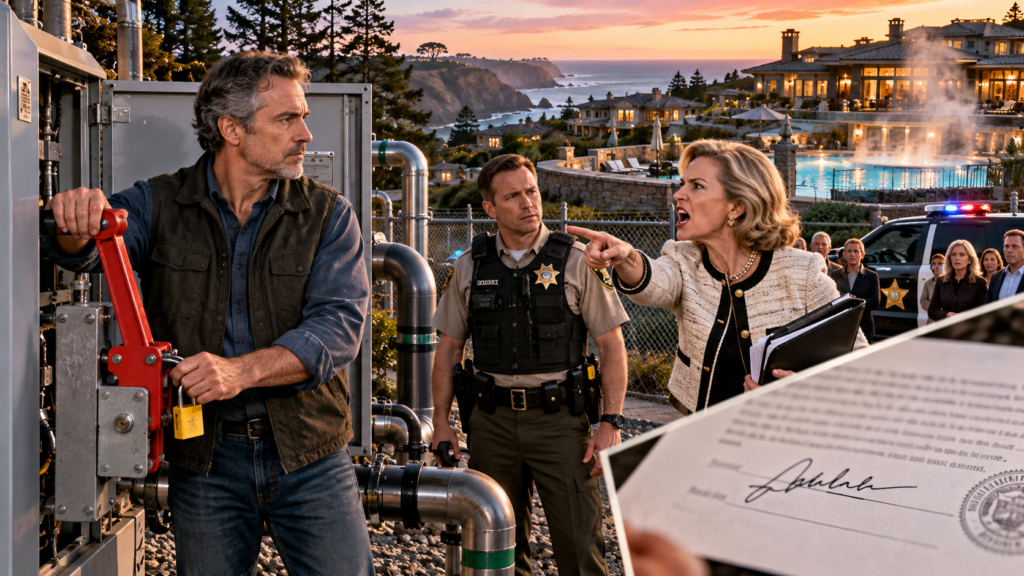
Robert and I followed the load through the trees.
Hidden beneath wet redwood needles was a heavy electrical cable.
It crossed my property.
Went through a freshly cut hole in my fence.
And disappeared beneath Pacific Crest’s clubhouse.
Robert stared at the connectors.
Then at me.
“I know who installed this.”
My stomach tightened.
“Who?”
He pointed toward the specialized fittings.
“Bradley Cole.”
Bradley had been my electrical contractor for twenty years.
He knew every access code on my property.
And according to a bank record Hannah found less than an hour later, a shell company he controlled had just received $85,000 from Evelyn’s commercial development.
The HOA hadn’t simply stolen heat.
Someone I trusted had helped them break into my private power system.
The clubhouse gala ended early.
That was the least important consequence, but it was the one Pacific Crest homeowners experienced first.
Without the illegal geothermal connection and with the unauthorized electrical feed isolated, the building’s heating system could no longer pretend it had legitimate energy behind it.
People in formal clothes gathered around gas fireplaces while technicians tried to determine which systems could safely remain online.
I wasn’t there to enjoy that.
I was back at Whispering Bluff with Marcus, Hannah, Robert, and Clara, assembling records.
Every document we had.
The original temporary license.
The ninety-day extension.
Utility telemetry.
Photographs of the illegal geothermal pump.
The forged covenant.
The hidden electrical line.
Bank records linking Bradley’s shell company to Pacific EcoThermal Ventures.
Corporate filings showing Evelyn’s ownership interest.
The more we organized, the less this looked like an aggressive HOA dispute.
But Marcus kept correcting me whenever I got ahead of the evidence.
“We know there are serious questions.”
“We know she forged my signature.”
“We know someone did.”
“She presented it.”
“Yes. Presentation is evidence. Authorship is another question.”
That precision mattered.
Anger likes certainty before facts earn it.
Good cases do the opposite.
Pacific Crest’s board called an emergency meeting the following afternoon.
Evelyn did not attend.
Her attorney had advised her not to.
Arthur Vance, a retired aerospace engineer who had known my father, stood in front of the homeowners.
He started with the temporary utility license.
Six months.
Then ninety days.
Not permanent.
Then he showed the homeowners what the association had been telling them for years.
That Whispering Bluff was obligated to supply geothermal energy indefinitely.
Those two stories could not both be true.
The treasurer, Norah Ellis, brought financial records.
She had spent weeks reconciling accounts after noticing unexplained project expenses.
Hundreds of thousands had moved from reserve and infrastructure accounts through consulting invoices.
Some of the payments were associated with Donald Mercer’s firm.
Others connected to site preparation tied to the commercial wellness development.
Norah had not yet concluded every transaction was improper.
But she had enough unanswered questions to demand an independent forensic audit.
The homeowners voted for one.
They also suspended Evelyn’s spending authority pending review.
That was the first time Pacific Crest began separating itself from her.
The forensic accountants worked quickly.
They discovered that approximately $620,000 in association funds had been routed into expenditures connected to projects the board had not clearly approved as HOA obligations.
Some invoices were legitimate.
Others were not.
A portion benefited the commercial development in which Evelyn held an interest.
That changed the entire political atmosphere.
Residents who had been angry at me for cutting off “their” heat started asking why their reserve fund had been supporting somebody else’s investment.
Then Bradley began cooperating.
He admitted Evelyn and Julian had approached him months earlier.
They wanted continuity.
No outages.
No questions.
The geothermal arrangement needed to remain operational until the commercial financing closed.
Bradley knew our microgrid better than almost anybody.
That was why they wanted him.
He said they told him the permanent utility paperwork was being completed.
Then I issued the thirty-day termination notice.
That was when everything became desperate.
The unauthorized electrical feed had been intended as a temporary backup.
A few days.
Maybe a week.
Just long enough to keep the clubhouse and development infrastructure functioning while investors were reassured.
Bradley told investigators he had convinced himself it was temporary and therefore manageable.
He was an experienced electrician.
He knew better.
The safety bypass around our equipment was particularly damaging to his story.
There are mistakes.
Then there are deliberate decisions to defeat safeguards.
He had done the second.
Donald Mercer’s records led investigators deeper.
Emails showed discussion of an “easement instrument” necessary for state filings.
One message asked whether the historical utility arrangement could be “papered permanently.”
Another contained a draft covenant using recording information copied from unrelated property records.
That document eventually became the covenant Evelyn waved at Deputy Miller.
A forensic document examination later supported what Marcus spotted immediately.
The signature was not mine.
The notary information did not correspond with a valid execution.
The recording references were inconsistent with the purported transaction.
State and county investigators took over those issues.
That was important too.
I did not have Evelyn arrested.
Marcus didn’t.
Hannah didn’t.
Evidence moved through agencies that had no loyalty to my family.
The commercial project froze almost immediately.
Investors wanted proof of lawful energy rights.
There was none.
The geothermal source belonged to Whispering Bluff.
The electrical source belonged to Whispering Bluff.
Pacific Crest itself had no permanent right to either.
And the development company certainly did not.
The $4.5 million financing did not magically vanish, but funding was halted while investors, lenders, and regulators reviewed what they had been told.
Civil claims followed.
Then regulatory complaints.
Then criminal investigations concerning the forged document, misused funds, and electrical tampering.
Pacific Crest homeowners removed Evelyn from the board before any criminal case was resolved.
The vote wasn’t dramatic.
No one cheered.
Arthur told me later that silence was worse.
Evelyn had spent eighteen months making herself synonymous with the association.
Now the residents were trying to save the association from her.
Arthur became interim president.
His first trip to Whispering Bluff was completely different from Evelyn’s first visit.
He walked.
No SUV.
No guards.
No portfolio.
Norah and another board member came with him.
Clara made hot cider.
We sat at our kitchen table.
Arthur didn’t ask whether Pacific Crest had a legal right to my heat.
He knew the answer.
He asked whether I would consider helping the affected homeowners temporarily while they installed their own lawful system.
Forty families still relied on the old thermal branch.
Some were elderly.
Some had children.
A cold coastal winter didn’t care who elected Evelyn.
I could have said no.
Part of me wanted to.
