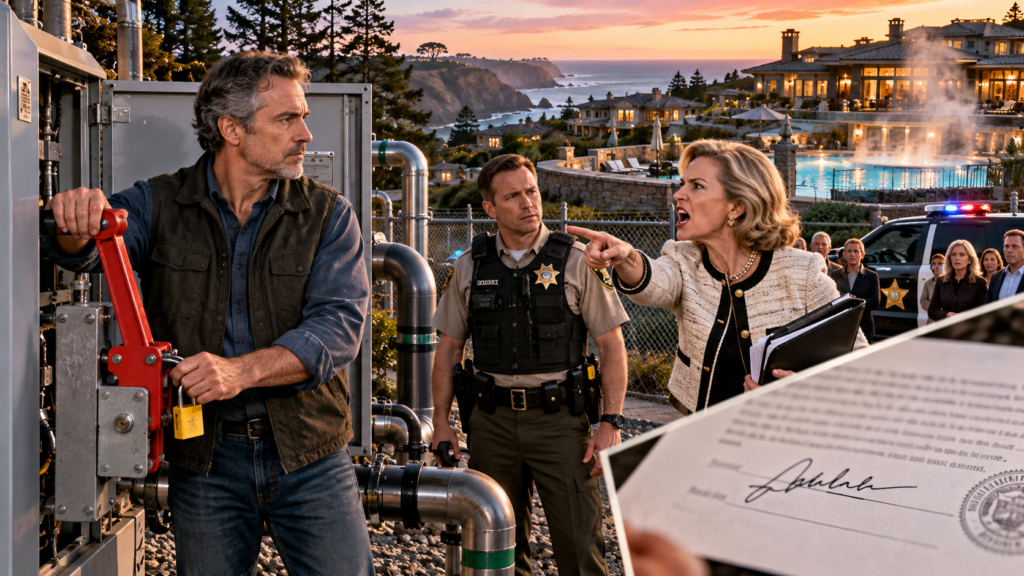
Then Clara looked at me.
She didn’t need to speak.
My father had granted the original connection because neighbors needed help.
Evelyn had corrupted the arrangement.
The homeowners hadn’t.
So we wrote a new license.
This time, no one relied on a handshake.
Thirty days.
Metered consumption.
Independent escrow.
County-supervised operation.
No commercial development load.
No transfer of rights.
Automatic termination.
Pacific Crest paid for every unit of energy used.
They funded repairs to my fence and electrical equipment.
They reimbursed documented legal and engineering costs tied to the emergency.
Most importantly, they began installing their own permanent system immediately.
Seventeen days later, Pacific Crest’s new pumping station and transformer equipment went live.
Robert and Arthur met at the boundary.
They closed the temporary valve.
Unbolted the old connection.
Capped it.
Then removed the remaining bridge between our systems.
The temporary favor my father had started years earlier was finally over.
Properly.
Recorded.
Documented.
Finished.
The criminal cases took much longer.
That is usually how real consequences work.
Months of documents.
Interviews.
Motions.
Accounting.
Arguments about intent.
Evelyn eventually entered a plea resolving several charges tied to the misuse of association funds and false documents.
The court imposed prison time and substantial restitution.
Julian faced separate securities and fraud consequences connected to representations made to investors.
Donald Mercer lost the ability to continue operating as he had and faced regulatory penalties.
Bradley’s cooperation reduced his exposure, but it did not erase what he had done.
He lost professional privileges for a period, paid restitution, and faced criminal consequences tied to the unsafe work.
I never celebrated any of it.
Bradley hurt the most.
Evelyn had always been an adversary.
Bradley had eaten at my table.
He attended Hannah’s graduation.
He knew my father.
There is something especially ugly about discovering that somebody did not need to break into your house because you had already given him the code.
Months later, he wrote me a letter.
I almost threw it away.
Clara told me to read it once.
He didn’t ask forgiveness.
That helped.
He admitted that the money had made him rationalize one compromise after another.
First, sharing technical information.
Then altering access.
Then maintaining the illegal geothermal pump.
Finally, the hidden electrical connection.
Every step felt temporary to him.
Until the accumulation became criminal.
At the end he wrote:
I kept telling myself I was only buying them time. I never asked whose time I was stealing.
I put the letter in a drawer.
I still don’t know whether I forgave him.
Pacific Crest changed more productively.
The new board rewrote its financial controls.
Large capital expenditures required multiple approvals.
Related-party business interests had to be disclosed.
Outside legal review became mandatory for easements, property rights, and utility agreements.
Reserve-account transactions were published to homeowners.
The rules were boring.
Good governance often is.
The abandoned five-acre wellness-development parcel eventually became part of a conservation arrangement.
No luxury spa.
No heated pools.
No commercial geothermal plant secretly fed from my wells.
Instead, native coastal vegetation returned.
A walking trail crossed part of it.
The first time Arthur asked whether I minded residents using the trail, I laughed.
“Is it on my land?”
“No.”
“Then why are you asking me?”
“Old habits.”
That was when I knew the relationship had actually changed.
The strangest part came the following summer.
Lightning started a brush fire two miles north of our boundary.
Dry wind pushed flames through the timber.
For a few hours, both Whispering Bluff and Pacific Crest were in real danger.
Nobody discussed lawsuits.
Nobody discussed HOA rules.
Our maintained logging roads gave fire crews access to the ridge.
Pacific Crest volunteers helped clear brush.
Our water infrastructure supported emergency suppression operations under fire-department direction.
Arthur worked beside Robert hauling hose.
Hannah helped relay thermal mapping information.
We fought the same fire.
Afterward, we stood in smoke-blackened clothes watching crews extinguish the last hotspots.
Arthur looked at me.
“Your father would’ve helped.”
“Yes.”
“So would you.”
I smiled.
“I just did.”
That was the better ending to the utility dispute.
Not Evelyn going to prison.
Not investors losing money.
Not the forged document exposed.
Neighbors learning the difference between dependence and entitlement.
My father had shared heat because someone needed help.
Evelyn turned generosity into a claim of ownership.
That was the mistake underneath everything.
A favor is not an easement.
Silence is not consent.
Long use does not automatically transform every temporary arrangement into somebody else’s property.
And when the thing being borrowed becomes part of a private commercial venture, pretending it belongs to the borrower eventually becomes very expensive.
Today, Whispering Bluff still runs on its own systems.
Solar array.
Battery storage.
Geothermal wells.
Backup generators.
The equipment is better monitored now.
Codes changed.
Physical keys changed.
Remote alerts improved.
We installed redundant tamper detection on every external junction.
Hannah made sure of that.
Pacific Crest has its own utility infrastructure.
When their meters spin, they pay their own bill.
When mine spin, I pay mine.
It is amazing how peaceful neighboring properties become when everybody understands where the line is.
Sometimes I walk down to the ridge substation at sunset.
The copper disconnect lever is still there.
Heavy.
Unattractive.
Industrial.
Evelyn once screamed that pulling that lever would destroy an entire community.
It didn’t.
It exposed a dependency that should never have existed.
There is a difference.
The last time Arthur visited, he brought sourdough bread his wife had baked and a jar of blackberry preserves.
We stood by the split-rail fence talking about salmon season.
At one point he looked toward the old utility trench.
“Hard to believe all this started with a pipe.”
“No.”
He glanced at me.
“It started when somebody decided the pipe belonged to them.”
He laughed.
“Fair enough.”
After he left, Clara joined me near the bluff.
Below us, waves broke against the dark rocks.
Pacific Crest’s lights glowed along the northern ridge.
Our own lodge lights shone behind us.
Two communities.
