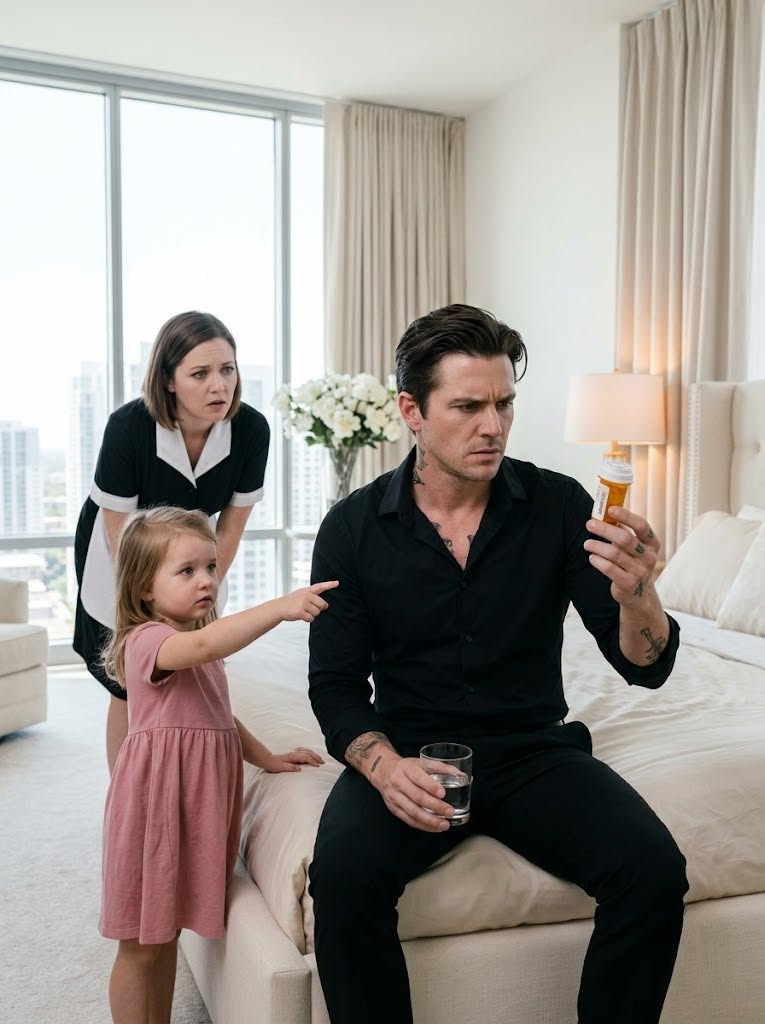
At 7:04 on an ordinary Tuesday morning, Damian Cross lifted two pills to his mouth the way he had lifted them every morning for three years—without looking, without thinking, without a single question.
Then a six-year-old voice from the doorway stopped his hand in midair.
“Boss. That medicine looks different today.”
The room had two armed men in it, a head of security, and a man who had not been interrupted in years.
Nobody moved.
Damian looked down at his palm.
Two blue tablets.
Heart medication.
Same shape.
Same size.
Almost the same color.
Almost.
The blue was wrong.
Slightly duller.
The kind of wrong a tired eye would miss.
The kind of wrong somebody had counted on.
Damian slowly closed his fist.
The bottle had been sealed.
Delivered.
Signed for.
Stored inside a house where almost everyone had worked for him for years.
And somewhere behind those walls, whoever had done it might still be walking the halls, waiting to learn whether Damian Cross was dead.
The mansion was always quiet at seven in the morning except for the humming.
It came from somewhere down the east corridor, small and tuneless, the sound a child made when she had forgotten she was supposed to remain invisible.
Damian had learned to notice sounds.
Sounds told you where people were.
Where people were told you what they wanted.
He had built an entire life around that arithmetic.
He sat at the long marble table in his private study exactly as he did every morning.
Water.
Folded napkin.
White medicine bottle.
Three years since the surgery that almost killed him.
Three years of the same routine.
He reached for the bottle without looking.
His hands knew its weight.
The click of the cap.
The number of tablets inside.
Then:
“Boss.”
Damian stopped.
Sophia stood in the doorway.
Six years old.
Daughter of Alina, one of the housekeepers.
Yellow shirt too large for her.
Two crooked braids.
Hands hidden behind her back.
“That medicine looks different today.”
Marcus Hale, Damian’s head of security, immediately moved.
“Sophia. That’s enough. Go find your mother.”
“No,” Damian said.
Quietly.
The room became quieter.
Marcus stopped.
Damian opened his hand again.
“What do you mean different?”
Sophia glanced toward Marcus as though uncertain whether she was still in trouble.
Damian pulled out the chair beside him.
“Come here.”
She approached slowly.
He held out his palm.
Sophia pointed without touching.
“They’re too gray.”
One of Damian’s guards exchanged a glance with Marcus.
Damian noticed.
“How do you know what they normally look like?”
Sophia shrugged.
“You take them every morning.”
That answer unsettled him more than it should have.
“You watch me?”
“You sit here when Mommy cleans the windows.”
She pointed toward the tall glass wall behind him.
“The normal ones are blue like my crayon.”
Damian looked at Marcus.
“Bring yesterday’s supply.”
Marcus did not argue.
He opened a secured drawer in the adjoining cabinet and removed the previous bottle, retained because Damian’s medical staff required medication logs.
One tablet was placed beside the new one.
Nobody needed laboratory training.
The difference was visible once you knew to look.
Marcus’s expression hardened.
Damian stood.
“Seal the room.”
The guards moved.
“No one enters or leaves the property without being logged.”
Marcus nodded.
“What about staff?”
“Do not frighten them.”
His gaze went toward Sophia.
“Especially not in front of the children.”
Sophia looked up.
“Am I in trouble?”
Damian stared at her.
“No.”
“You look mad.”
“I am.”
“At me?”
“No.”
She considered that.
“Okay.”
Then she pointed at his closed fist.
“Don’t eat those.”
For the first time that morning, one of the guards almost smiled.
Damian did not.
“Excellent advice.”
Alina appeared seconds later.
She had clearly been running.
“Sophia!”
She crossed the room and pulled her daughter close.
“I’m so sorry, Mr. Cross. She was supposed to stay in the laundry room while I—”
“Stop.”
Alina went pale.
Damian softened his voice deliberately.
“She did nothing wrong.”
He looked at Sophia.
“She may have prevented something very serious.”
Alina looked from him to the pills.
Then to Marcus.
“What happened?”
“We don’t know yet.”
That was important.
Damian had spent much of his life around men who treated suspicion as proof.
It was how innocent people became convenient answers.
He was not going to do that inside his own house.
A physician from Damian’s private medical team arrived twenty-five minutes later.
The questionable tablets were sealed for testing.
The new bottle, old bottle, packaging, delivery records, and security footage were preserved.
Nobody touched anything unnecessarily.
Damian took his medication from a separately verified emergency supply.
Then he called everyone with access to his medical routine into the library.
Fourteen people.
Household manager.
Nurse.
Security supervisors.
Personal assistant.
Driver.
Two kitchen staff.
Delivery coordinator.
Marcus.
Alina stood near the back because her cleaning schedule had placed her in the study each morning.
Sophia sat outside with the housekeeper.
Damian looked around the room.
Someone expected anger.
Someone expected threats.
They got neither.
“At 7:04 this morning, Sophia noticed that my medication appeared different.”
Several heads turned toward Alina.
Damian saw it.
“She is not the subject of this meeting.”
Everyone looked forward again.
“The medication is being tested.”
He paused.
“Until we know what happened, nobody is accused of anything.”
Marcus watched him carefully.
“But records will be reviewed. Access will be reconstructed. Anyone who remembers something unusual should speak to Marcus or outside counsel privately.”
The personal assistant, Evelyn Shaw, raised a hand.
“The pharmacy seals every bottle.”
“I know.”
“So either the pharmacy made an error or—”
“Or something else happened.”
Damian did not finish the sentence for her.
The laboratory called before noon.
The tablets were not Damian’s prescribed medication.
That was enough.
The house changed instantly.
Not visibly.
No shouting.
No weapons in hallways.
But everyone could feel the pressure.
Marcus brought Damian to the security office.
“Three access points,” he said.
“Pharmacy. Transit. House.”
“Start with evidence, not assumptions.”
