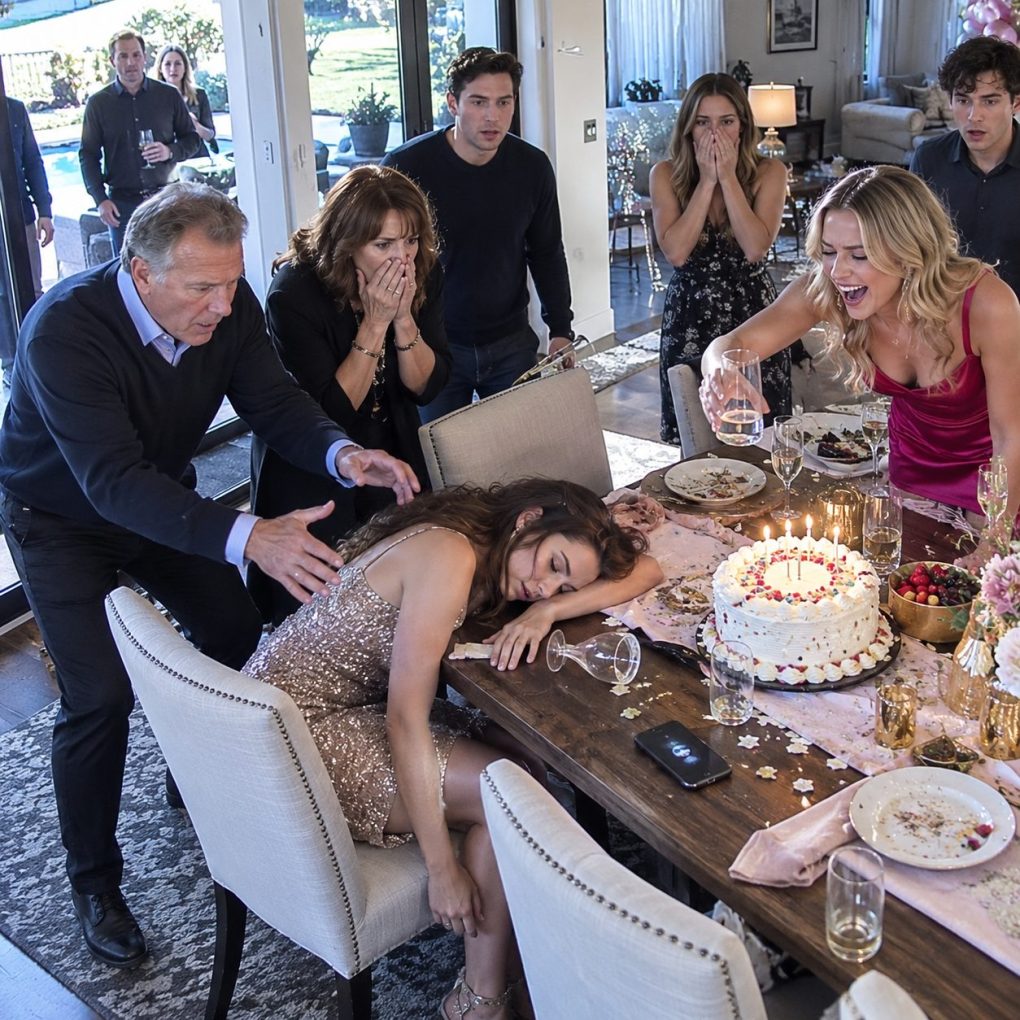
Madison had sent my father a text the afternoon of her birthday.
*You said she needs to calm down. Can I use one of those pills you keep?*
His reply appeared underneath.
*Absolutely not. Leave your sister alone.*
I read it again.
For the first time since the party, I felt a little of the tightness in my chest release.
Then Detective Harris turned the page.
A second message, sent two hours later, read:
*Fine. But if she starts talking about Grandma’s house again, don’t expect me to be nice.*
My father hadn’t answered.
Investigators had also reviewed footage from Daniel’s phone. He’d been recording the birthday cake when Madison prepared my lemonade at the kitchen counter.
The video didn’t show exactly what she’d placed in the glass, but it showed her handling the prescription bottle, then laughing with a cousin before carrying the drink to me.
Later, in a recorded interview, Madison admitted she’d taken medication from Dad’s cabinet and put it into my lemonade.
She insisted she hadn’t meant to hurt me.
“She said she wanted you to stop arguing and relax,” Detective Harris explained.
I thought about Sophie standing in the doorway.
“She watched me collapse.”
The detective nodded.
“That’s part of what makes this serious.”
Madison was subsequently charged in connection with administering the medication without my consent. The precise charges and outcome would be decided through the court process, but the evidence was no longer something my parents could dismiss as a misunderstanding.
I left the station carrying a copy of the report.
Dad called before I reached my car.
“Rachel, please come over. We need to talk.”
I almost declined.
Instead, I drove to the house where I’d grown up.
Mom opened the door. Madison sat on the sofa with red eyes and a crumpled tissue. Dad stood beside the fireplace.
Nobody offered me a seat.
“Tell her you didn’t mean it,” Mom urged.
Madison looked up.
“I didn’t know you’d react like that.”
I placed the laboratory report on the coffee table.
“You didn’t know what would happen because you didn’t know what you were doing.”
Her eyes dropped.
Dad cleared his throat.
“I told her not to touch that medication.”
“I saw your message,” I said.
He looked relieved.
Then I asked, “Why did you tell the paramedics I’d probably had too much to drink?”
His shoulders sank.
“I didn’t want Madison arrested.”
There it was.
Not a misunderstanding. Not confusion.
He’d known enough to be frightened, yet his first instinct had been to protect the person who’d caused it.
Mom began crying.
“We could lose our daughter over this.”
I looked at her.
“You almost did.”
The room went quiet.
Madison covered her face. Dad stared at the report. Mom reached for my hand, but I moved it gently into my lap.
“I won’t lie for her,” I said. “And Sophie won’t be coming here until I believe she’s safe.”
Nobody argued.
Over the following months, Madison’s case proceeded through the courts. She eventually accepted responsibility through a plea agreement, receiving probation, court-ordered counseling, and community service. My parents stopped asking me to change my account after speaking with an attorney.
Dad apologized for misleading the paramedics. Mom apologized for asking me to protect Madison before asking whether I was all right.
I accepted their words without pretending they repaired everything.
Six months later, Sophie and I baked a birthday cake in Grandma’s old kitchen.
She spilled flour across the counter and laughed so hard she got some in her hair.
“Mommy,” she asked, “are we inviting Grandma and Grandpa?”
“Not this year, sweetheart.”
She considered that, then handed me a spoonful of frosting.
“Okay. More for us.”
I smiled and tasted it.
That evening, as I washed the dishes, I noticed the little birthday card Sophie had made for Madison still tucked into a drawer.
On the front, she’d drawn our whole family holding hands.
I couldn’t bring myself to throw it away.
But I didn’t put it back on the refrigerator, either.
Some things can be forgiven slowly. Others require distance before forgiveness is even possible.
And sometimes, the most important person you protect is the little girl watching from the doorway, learning what love should never ask her to endure.
