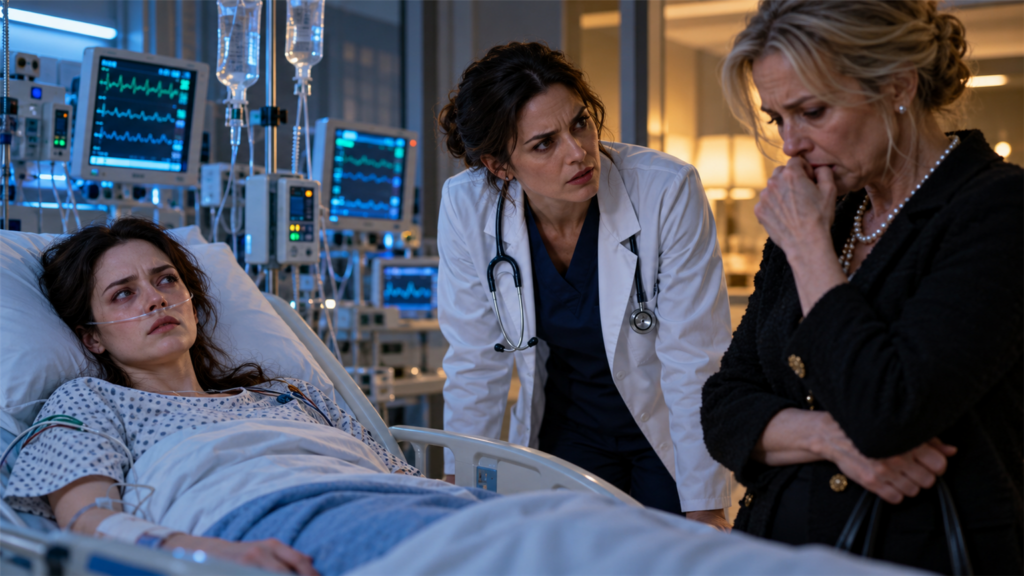
He reached into his coat pocket.
Then he placed a familiar orange prescription bottle on the blanket.
My name was printed across the label.
And the bottle was still nearly full.
I stared at the bottle lying on my hospital blanket.
The label had a tiny blue ink mark near the bottom. I’d made it myself so I wouldn’t confuse it with another prescription.
“Where did you find that?”
Dad swallowed.
“In Vanessa’s locked desk drawer.”
I looked at him.
He couldn’t hold my gaze.
“She took it Sunday,” he said. “She told me you were becoming obsessed with your condition and that she wanted you to calm down before giving it back.”
The monitor beside me beeped steadily.
“You knew?”
He rubbed both hands over his face.
“I saw her put it away.”
“And you let her?”
His eyes filled.
“I thought she’d return it when you stopped arguing.”
I turned toward the window.
Outside, cars moved along the hospital parking lot. Somewhere, a woman was pushing a stroller beneath the trees.
People were going to work, buying groceries, taking their children home.
And I’d almost lost my life because my father had decided keeping his wife comfortable was more important than challenging her.
“Emily, I’m sorry.”
I reached for the water cup on my tray. My hand trembled badly enough that he moved forward to help.
“Don’t,” I whispered.
He stopped.
A few minutes later, I asked him to leave.
The following morning, I told the social worker what he’d admitted. With my permission, the hospital documented the information, including photographs of the bottle and copies of Vanessa’s messages.
My doctors explained that an interruption in treatment could have contributed to the arrhythmia, although they couldn’t determine with certainty that it was the only cause.
I also made a police report about the medication being deliberately withheld. An officer took my statement and explained that investigators would review the evidence and determine whether any offense could be established.
There were no immediate arrests or dramatic confrontations in the hospital hallway.
Just paperwork, interviews, and questions that Vanessa could no longer dismiss with a laugh.
I remained hospitalized for several more days while my cardiac team adjusted my treatment and monitored my rhythm.
Rachel visited every evening.
Sometimes we talked. Sometimes she sat beside me reading while I watched the changing light on the wall.
When I was discharged, I didn’t return to Dad’s house.
I moved into Rachel’s spare bedroom until my apartment was repaired.
Three weeks later, Dad called.
He and Vanessa had separated temporarily. He said the investigation had forced him to confront what he’d ignored for months.
“I keep thinking about that Sunday,” he told me.
“So do I.”
“I should’ve stopped her.”
“Yes,” I said quietly. “You should have.”
He began crying.
I listened without trying to comfort him.
For most of my life, I’d been the one making excuses for the people I loved. I’d told myself that Dad was tired, that Vanessa was difficult, that keeping the peace mattered.
But peace that required me to ignore my own safety wasn’t peace.
It was silence.
Over the following months, I continued my cardiology appointments and returned to work gradually. The investigation remained a separate process, and I let the people responsible for it handle the legal questions.
Dad began counseling. He sent messages asking how I was doing, without demanding that I come home.
I answered some.
Others I left unread.
I wasn’t ready to trust him again simply because he finally understood what he’d allowed.
One Saturday, Rachel helped me unpack the last boxes in my repaired apartment.
At the bottom of one was a small blue pill organizer I’d used since high school. Its lid was scratched, and one corner was chipped, but every compartment still closed.
I washed it carefully and set it beside my bed.
Rachel appeared in the doorway carrying two cups of tea.
“Everything okay?”
I looked at the organizer, then at the woman who had driven me to the emergency room without asking whether I was exaggerating.
“Yeah,” I said softly. “I think it will be.”
That night, I took my medication exactly as prescribed and placed the bottle on my bedside table.
Nobody rolled their eyes.
Nobody told me I was seeking attention.
And when I turned off the light, I remembered something my mother used to say when I was little.
If something hurts, sweetheart, you don’t have to prove it to anyone before asking for help.
For years, I’d mistaken being quiet for being strong.
Now I understood that sometimes the bravest thing a person can do is refuse to stay silent when their life depends on being heard.
