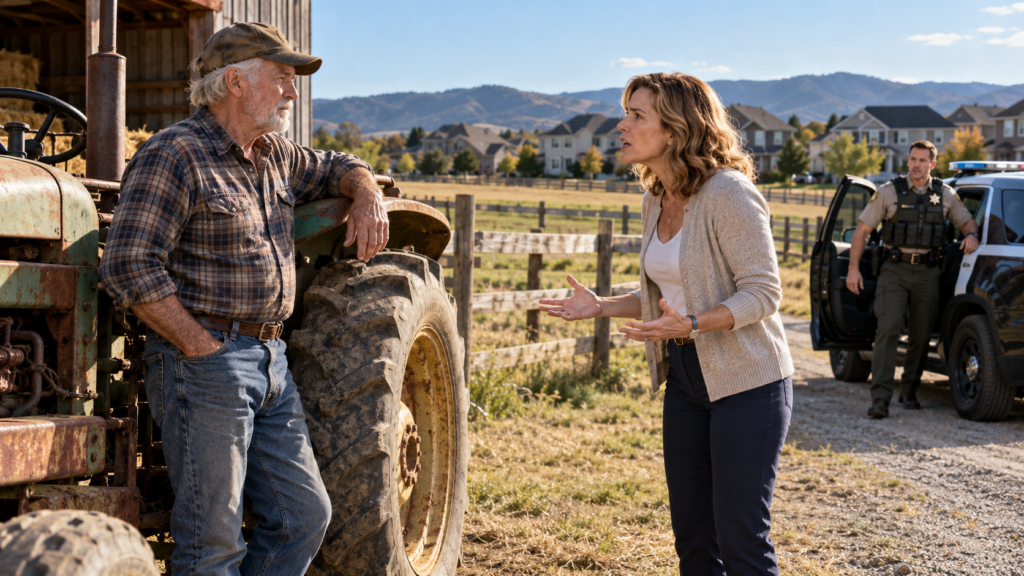
The HOA president called 911 and told police there was an armed squatter threatening her on neighborhood property.
The “squatter” was me.
The property was my thirty-four-acre farm.
And the sheriff she demanded come arrest me had once been my chief deputy.
I didn’t tell her any of that.
Not at first.
My name is Thomas Reed. For twenty-six years, I worked law enforcement in Mason County, North Carolina. I started nights in a patrol car, made detective, then chief deputy, and eventually served two terms as elected sheriff.
When I retired, I wanted nothing more complicated than horses, fence repairs, and enough tomatoes to annoy my wife, Ellen, every August.
We bought Reed Farm years before retirement.
The deed dated back to 1949.
Agricultural zoning.
No restrictive covenants.
No HOA.
Then a developer bought the land east of us and built Sterling Grove Estates—ninety-two houses, landscaped entrances, decorative streetlights, and a homeowners association with strong opinions about mailbox paint.
For years, we coexisted.
Then Victoria Lang moved in.
Within three months she became HOA president.
Within four, she started policing my farm.
The first complaint involved manure.
I was cleaning stalls when she appeared at the fence.
“That pile needs to be screened.”
“Why?”
“It’s visible from my patio.”
“It’s compost.”
“It smells.”
“You moved beside a horse farm.”
She did not appreciate that answer.
A week later she walked past my PRIVATE PROPERTY sign carrying a yellow notice.
“Section Five, Subsection C. Unapproved agricultural equipment visible from community property. Unauthorized livestock structures. Excessive rooster noise before eight a.m.”
I stared at her.
“Victoria, your HOA ends at that fence.”
“It affects Sterling Grove.”
“That doesn’t make my farm part of Sterling Grove.”
She held out the notice.
“Two-hundred-dollar warning assessment.”
I did not take it.
“You cannot fine me.”
“We can place a lien if violations continue.”
That was when I stopped finding her amusing.
“Do not threaten liens against property your association has no authority over.”
“You should speak to our attorney.”
“You should speak to yours.”
I pointed toward the road.
“And you need to leave.”
She did.
But only after telling me, “We’ll see who the county listens to.”
After that came letters.
Barn doors were the wrong color.
My tractor was an “industrial visual nuisance.”
The rooster violated community quiet hours.
A hay trailer was “commercial equipment stored in a residential district.”
Each time, I answered in writing.
Reed Farm is not located within Sterling Grove Estates and is not subject to its declaration.
I kept copies.
Twenty-six years in law enforcement teaches you many things.
One of them is simple.
When someone behaves irrationally, document everything.
The confrontation came on a Tuesday.
My contractor, Lucas Avery, was helping me replace the southern fence.
We had a flatbed loaded with treated posts, wire, and two steel livestock gates.
Victoria arrived so fast her tires threw gravel.
She parked halfway onto my grass.
Then began photographing us.
“Stop work immediately!”
Lucas looked at me.
“Friend of yours?”
“No.”
Victoria marched toward the skid steer.
“These gates have not been approved by the architectural committee.”
I shut down the machine.
“You’ve been told this land is outside your HOA.”
“It borders our community.”
“So does the county road. You don’t control that either.”
Her face reddened.
“You are operating heavy commercial machinery beside residential property.”
“It’s a farm.”
“You’re destroying our property values.”
“Victoria, leave.”
She raised her phone.
“You’re threatening me?”
“No. I am telling you that you are on posted private property after repeated notice.”
I pointed toward the road.
“Leave now.”
Instead, she dialed 911.
On speaker.
“I need police immediately,” she told dispatch. “There’s an aggressive man operating dangerous machinery on HOA property. He’s threatening me and refusing to leave.”
Lucas slowly lowered his water bottle.
I looked at Victoria.
“You know that statement isn’t true.”
She smiled.
Then added into the phone:
“He said he’ll hurt me if I don’t get off the land.”
That changed everything.
I did not argue.
I did not touch her.
I did not even tell her who I used to be.
I simply leaned against the flatbed and waited.
Lucas quietly lifted his phone.
He had been recording since Victoria first walked toward the skid steer.
Nine minutes later, two Mason County patrol units turned onto the road.
Victoria hurried toward them before they stopped.
“He’s right there!” she shouted. “I want him removed and the machinery shut down.”
The first driver’s door opened.
Sheriff Aaron Delgado stepped out.
Aaron had been twenty-four years old when I trained him on night shift.
Years later, he became my chief deputy.
When I retired, voters chose him to replace me.
He looked toward Victoria.
Then toward me.
His eyebrows rose.
“Tom?”
I smiled.
“Afternoon, Sheriff.”
He walked over and shook my hand.
Victoria stopped breathing.
“You know him?”
Aaron turned toward her.
His face became professional again.
“Yes, ma’am.”
He pointed at me.
“That is Thomas Reed.”
He paused.
“The former sheriff of Mason County.”
Victoria stared at me.
Then at the farm.
Then back at Aaron.
And for the first time since she had moved into Sterling Grove, she seemed to realize that speaking with authority and actually having authority were two very different things.
Aaron did not arrest Victoria because he knew me. In fact, he immediately handed the investigation to the second deputy so nobody could accuse him of protecting his former boss.
Deputy Megan Price asked Victoria to repeat exactly what happened.
“He threatened me.”
“What did he say?”
“That he would have me arrested if I didn’t leave.”
Megan looked at her.
“That is different from threatening to hurt you.”
Victoria’s expression changed.
Then Lucas held up his phone.
“I recorded the whole thing.”
The video showed Victoria entering past the private-property sign, demanding work stop, refusing to leave, and telling 911 that I had threatened physical harm even though I never had.
Dispatch confirmed her call had been recorded.
