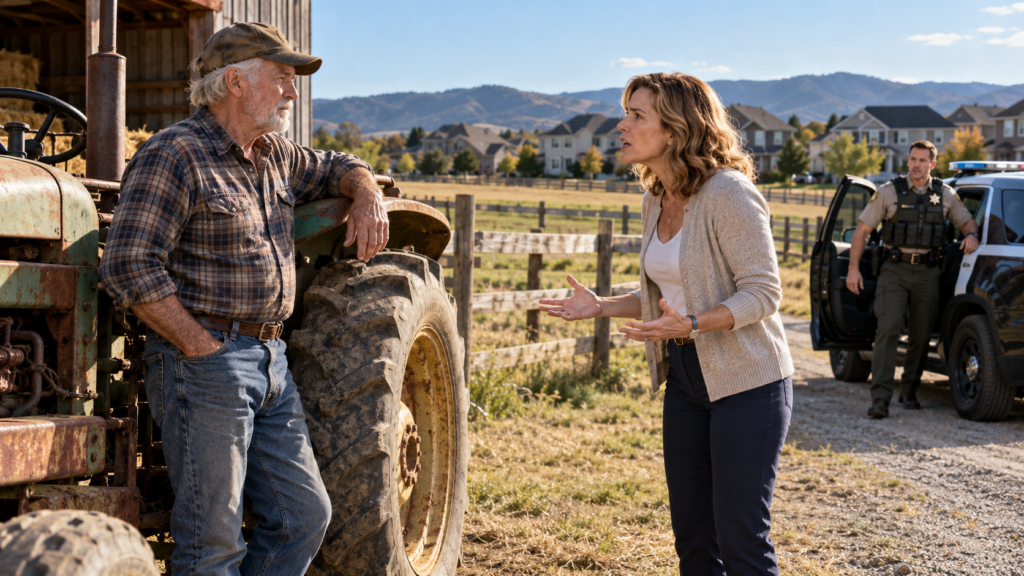
Meanwhile, the criminal case from the 911 call moved separately.
I stayed out of it.
I was the complaining witness.
Nothing more.
The prosecutor reviewed the dispatch recording, Lucas’s video, deputy reports, and Victoria’s refusal to leave after a lawful warning.
Her attorney negotiated the case.
She ultimately resolved the charges through a misdemeanor plea involving false reporting and trespass, along with court-ordered conditions.
No dramatic prison sentence.
No career-ending national scandal.
But there were consequences.
Court costs.
Community service.
A no-trespass order covering Reed Farm.
And a criminal record she had created because she could not tolerate being told no.
One afternoon, Aaron stopped by while I was repairing fence.
He leaned against his patrol SUV.
“You know what bothers me?”
“What?”
“She thought knowing officials would change the facts.”
“She told me she had connections.”
Aaron laughed.
“She called a commissioner after arrest.”
“Of course she did.”
“Commissioner told her to get a lawyer.”
That made me smile.
Good government occasionally works because somebody knows what not to touch.
Aaron looked toward Sterling Grove.
“People keep saying she got arrested because she called the cops on a former sheriff.”
“That’s not what happened.”
“I know.”
“She got arrested because she refused to leave after being warned and because the evidence contradicted what she told dispatch.”
Aaron nodded.
“I wish people understood that part.”
So did I.
My former title had made the moment dramatic.
It did not give me extra property rights.
If I had been a plumber, teacher, mechanic, or retired bus driver, Reed Farm would still have been outside Sterling Grove.
The deed would have said the same thing.
Victoria’s mistake was not choosing the wrong retired sheriff to bully.
Her mistake was believing an HOA title created authority over anyone she could see from her patio.
Months passed.
Things quieted down.
Sterling Grove elected a new president named Rebecca Miles.
Rebecca was an engineer.
At our first conversation, she stood outside my gate.
That alone impressed me.
“May I come in?”
“Sure.”
She waited for me to open it.
Simple.
Respectful.
Almost revolutionary.
She carried no violation notice.
No clipboard.
Just a folder.
“We need to talk about the shared drainage ditch near the eastern fence.”
“Actual shared issue?”
She smiled.
“Actual shared issue.”
Part of Sterling Grove’s stormwater system discharged near the boundary.
Heavy rain had begun eroding soil on both sides.
The HOA needed permission for surveyors to inspect part of my property.
Rebecca brought maps.
Insurance documents.
A proposed access agreement.
Dates.
Scope.
Restoration terms.
I read everything.
Then signed.
That was cooperation.
The same farm.
The same HOA.
The same boundary.
Completely different result.
Because Rebecca asked for permission instead of manufacturing jurisdiction.
The drainage work took three weeks.
Contractors entered through the gate.
Signed in.
Stayed within the marked corridor.
Repaired the disturbed ground.
Then left.
No police.
No lawsuits.
No screaming.
Just adults handling a shared problem.
Ellen watched the final truck leave.
“Imagine that.”
“What?”
“They asked.”
“I know.”
“And the world survived.”
“Barely.”
She laughed.
The rooster crowed from behind the barn.
Still before eight.
Sterling Grove survived that too.
One morning, nearly a year after Victoria called 911, I found an envelope in my mailbox.
Properly stamped this time.
Inside was a short handwritten note.
Not from Victoria.
From Denise Parker.
She had planted new native flowers in her rain garden.
The new board approved them.
At the bottom she wrote:
I finally read the rules myself.
That sentence meant more to me than Victoria’s arrest ever had.
Because that was the real lesson.
Organizations become dangerous when members outsource all understanding to the loudest person in the room.
HOAs are not governments.
But neither are they automatically illegitimate.
They are private associations governed by recorded documents, contracts, statutes, procedures, and defined property boundaries.
Inside those boundaries, properly adopted rules may have real consequences.
Outside them, the president is simply another neighbor.
Victoria never understood the transition.
She crossed my fence carrying the authority of Sterling Grove in her head.
The moment her shoes touched Reed Farm, none of that authority came with her.
Only her responsibilities as an ordinary citizen did.
Do not trespass.
Do not make false statements to emergency dispatch.
Do not file claims against property you do not control.
Do not confuse confidence with jurisdiction.
A few months later, Lucas came back to finish another fence section.
Same flatbed.
Same steel gates.
He looked toward Sterling Grove.
“No red blazer?”
“Haven’t seen one.”
“Almost disappointing.”
“Speak for yourself.”
We worked until sunset.
Before leaving, he leaned against the truck.
“You know, when those cruisers showed up, I thought we were screwed.”
“You were fine.”
“I didn’t know that.”
“You were on private property doing lawful work.”
“Yeah, but she sounded convincing.”
That stopped me.
Because he was right.
Victoria had sounded convincing.
That was the weapon.
Not the clipboard.
Not the title.
Certainty.
She knew the vocabulary.
Violation.
Lien.
Architectural review.
Community standards.
Emergency.
Trespass.
She used real words in places where they did not apply.
That is often enough to frighten people into compliance.
Until someone asks the simplest question:
Show me where your authority comes from.
The deed.
The covenant.
The statute.
The recorded boundary.
The vote.
The actual rule.
If the answer is only, “Because I’m president,” there is probably more reading to do.
I still live on Reed Farm.
Thirty-four acres.
Two horses.
Five cows.
One rooster who remains completely indifferent to HOA quiet hours.
Sterling Grove is still next door.
Their houses did not lose value because my barn remained red.
Nobody’s life collapsed because my tractor was visible from the road.
The new board sends a polite email before contractors need access near the boundary.
I usually say yes.
Because being firm about property rights never required me to stop being a neighbor.
It only required both sides to understand where one property ended and the other began.
Sometimes Aaron still teases me.
“Need the sheriff?”
