“What letter?” I asked.
Dad looked at me, his eyes filling.
“The one I should have given you sixteen years ago.”
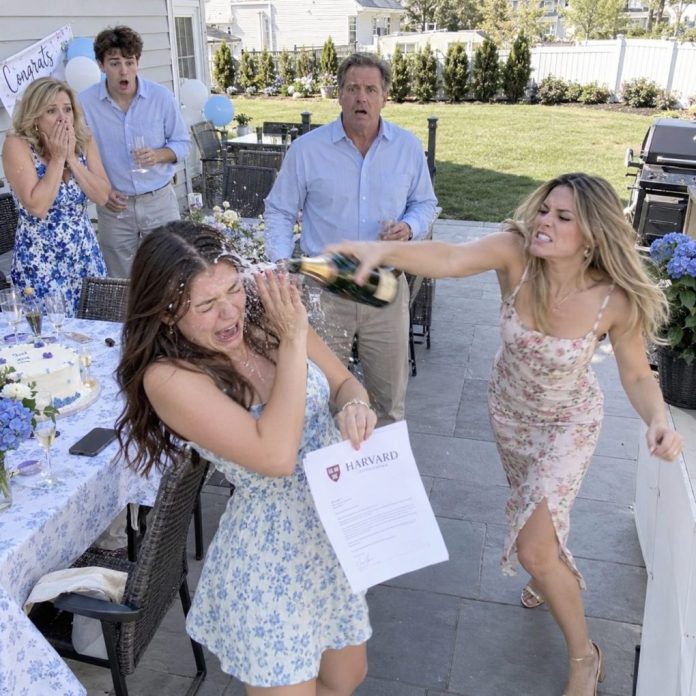
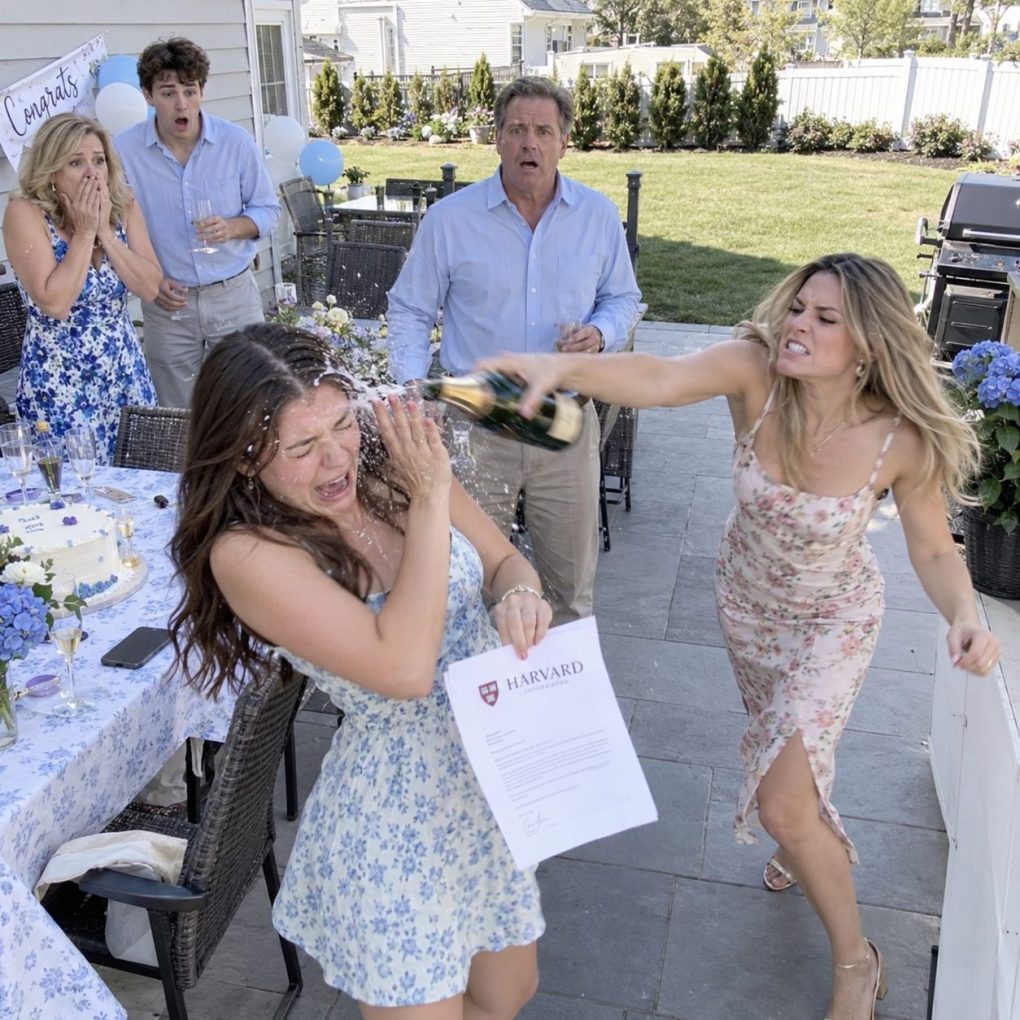
“Congratulations!” I said, holding out my Harvard acceptance letter to my older sister, Vanessa. I had imagined this moment for four years. I thought she might hug me, maybe even tell me she was proud.
Instead, she picked up a champagne bottle and smashed it against my face.
The sound was sharp enough to silence the entire dining room.
I stumbled backward, knocking over a chair. Something warm ran down my cheek and onto the white dress I had bought for graduation. My acceptance letter slipped from my fingers, landing beneath the table.
Vanessa stood over me, breathing hard.
“You think you’re better than me now?”
My mother rushed forward. For one foolish second, I thought she was coming to help.
“Vanessa, sweetheart, put that down,” she whispered.
Not a word to me.
My father remained beside the fireplace, his champagne glass halfway to his mouth.
“Dad?” I managed.
He looked at the blood spreading across my collar.
Then he looked away.
My name is Emily Carter. I’m twenty-two, and for as long as I can remember, my family has treated my sister like something precious and me like something inconvenient.
Vanessa received a new car for her sixteenth birthday. I got a grocery-store cake and a reminder that money was tight.
When she dropped out of college, Mom called it a difficult season. When I earned a full scholarship, Dad asked whether I was showing off.
Still, I kept trying.
That afternoon, I had brought my Harvard acceptance letter to our family graduation dinner because some stubborn part of me believed they might finally be happy for me.
Instead, I was lying on the floor while my mother begged Vanessa to calm down.
“Someone call 911,” my cousin Rachel shouted.
Mom grabbed her arm.
“Don’t make this a bigger situation than it is.”
Rachel pulled away and called anyway.
Twenty minutes later, I was inside an ambulance, pressing gauze against my cheek.
At the emergency department, a physician named Dr. Harris examined the cuts around my eye and ordered imaging to check for deeper injuries.
A nurse asked whether I had any previous facial injuries.
“Not that I remember,” I said.
She glanced at the intake form my mother had filled out.
“Your mother mentioned an old injury from childhood.”
I frowned.
“What injury?”
The nurse hesitated.
“Let me get the doctor.”
An hour later, Dr. Harris returned with my chart and an older record retrieved from the hospital’s electronic archive.
“Emily,” he said carefully, “there’s something in your childhood medical history that doesn’t match what you’ve told us.”
He turned the screen toward me.
The record contained my name, my date of birth, and an emergency admission from when I was six.
Under the section labeled Cause of injury, someone had written three words.
Suspected nonaccidental trauma.
And the person identified in the accompanying social-work note was my mother.
For several seconds, I stared at the screen without speaking.
I remembered being six. I remembered a yellow bedroom, a stuffed rabbit with one missing eye, and my mother telling me I had fallen down the stairs.
What I didn’t remember was the hospital.
Dr. Harris explained that the old record described a head injury, bruising, and a social worker’s concern that the explanation given by my parents didn’t match the injuries.
“Was my mother accused of hurting me?” I asked.
“The note documents a concern,” he answered. “It doesn’t establish who caused the injuries. But you deserve to know what’s in your record.”
He also explained that the childhood case had been referred to child protective services. The hospital file didn’t contain the agency’s final findings.
I looked at the date.
October 14.
My sixth birthday.
That was the year Vanessa received a new bicycle while I spent three days in bed, supposedly recovering from the flu.
I had always wondered why Mom refused to discuss that birthday.
Now I understood why the subject made her face change.
When my parents arrived at the hospital, Vanessa wasn’t with them.
Mom entered first, carrying her designer purse and wearing the same pearl necklace from dinner.
“Oh, Emily,” she said, glancing at my bandaged cheek. “Look at what happened to you.”
I watched her carefully.
“Did I fall down the stairs when I was six?”
Her expression barely changed, but her fingers tightened around the purse strap.
“What?”
“On my birthday. October fourteenth.”
Dad stopped near the doorway.
Mom gave a small, irritated sigh.
“Why are you bringing up ancient history?”
“Because my hospital records say someone suspected I was hurt deliberately.”
Dad lowered himself into the visitor’s chair.
Mom’s voice sharpened.
“Doctors make mistakes. You were always clumsy.”
I turned toward Dad.
“Is that true?”
He stared at the floor.
“Dad?”
Mom stepped between us.
“Your sister could be facing serious charges because of what happened tonight. We need you to explain that it was an accident.”
I looked at the stitches beneath my eye.
“She hit me with a bottle.”
“She lost control for one second.”
“And when I was six?”
Mom’s mouth tightened.
“Enough.”
Dr. Harris had already asked a hospital social worker to speak with me about the assault and the historical record. Rachel had also sent me a message saying she’d witnessed everything at dinner and would tell the police what she saw.
I turned my phone toward Mom.
“Rachel is giving a statement.”
For the first time, Mom looked frightened.
Dad stood.
“Linda,” he said quietly, “we cannot keep doing this.”
She spun toward him.
“Don’t you dare.”
He reached into his jacket and removed a folded piece of paper.
“I kept the letter,” he whispered.
Mom went completely still.
“What letter?” I asked.
Dad looked at me, his eyes filling.
“The one I should have given you sixteen years ago.”
Dad unfolded the paper with hands that trembled so badly he had to flatten it against his knee.
