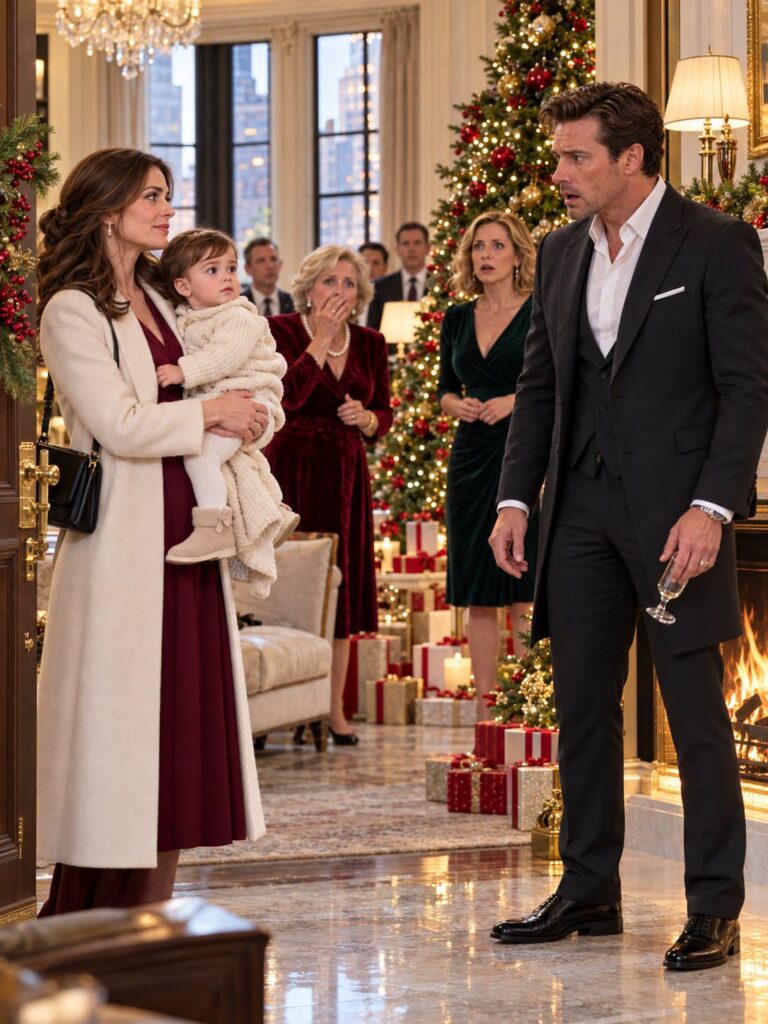
Margaret looked at him.
“I’m just—”
“I know what you’re doing,” she said, not unkindly. “I just want you to know that I know.”
Ethan took a slow sip of wine.
“You always imagine motives where there aren’t any.”
“No. I imagine motives where my brother spends three weeks choosing stationery for an invitation to his ex-wife.”
“I chose nothing. Priya handled it.”
“You addressed the envelope yourself.”
Ethan looked toward the fireplace.
Margaret smiled faintly.
“You want Clara to walk in here and see that you’re happy.”
“I am happy.”
“Then why does she need to see it?”
He had no answer prepared for that.
Fortunately, the doorbell rang.
Eleanor Caldwell called from the hallway.
“I’ll get it.”
Every muscle in Ethan’s body tightened.
Margaret saw.
She said nothing.
Voices carried from the foyer.
His mother’s warm greeting.
A woman answering.
Then silence.
Not ordinary silence.
The kind that forms when somebody opens a door and reality enters before anyone is ready for it.
Ethan set down his glass.
Clara appeared beneath the archway.
For two years, he had imagined this moment differently.
He imagined her looking tired.
Regretful, maybe.
He pictured her noticing the new art, the restored woodwork, the flowers flown in from Holland.
He imagined one small hesitation in her expression that would tell him she understood what she had lost.
Instead, Clara looked better than he remembered.
Not younger.
Freer.
Her chestnut hair fell just above her shoulders. She wore a simple navy dress beneath a camel coat, no dramatic jewelry, no effort to impress anyone.
She was smiling.
And she was carrying a baby.
Ethan’s first thought was embarrassingly primitive.
Someone else.
His second was worse.
How quickly?
Then the baby turned.
The entire room narrowed.
She could not have been more than fifteen months old.
Dark hair.
Round cheeks.
Gray-green eyes.
And a tiny vertical crease between her brows because she was examining a room full of strangers and apparently did not approve.
Ethan knew that expression.
His mother had photographs of him making it before he could walk.
Then the child turned farther.
A shallow dimple appeared in her left cheek.
Ethan’s wineglass slipped against the mantel.
Margaret caught it before it fell.
Nobody spoke.
Clara looked directly at him.
“Merry Christmas, Ethan.”
His mouth went dry.
“Whose baby is that?”
Margaret closed her eyes.
“Excellent opening, Ethan.”
Clara did not react.
She shifted the child higher on her hip.
“This is Sophie.”
Eleanor had gone completely pale.
The baby reached for the gold chain around Clara’s neck.
Ethan stared.
“How old?”
Clara’s expression changed.
She knew exactly what he was calculating.
“Fifteen months.”
Two years since the divorce.
Six weeks between the final decree and the day she could have known.
Pregnancy.
Birth.
Fifteen months.
The arithmetic arrived before courage did.
“No.”
Clara’s eyes hardened slightly.
“That’s an interesting first response.”
Ethan walked closer.
He looked at Sophie again.
The dimple.
The eyes.
The straight dark brows.
Even the way she watched him without smiling.
His mother whispered:
“Oh my God.”
Ethan looked at Clara.
“Is she mine?”
“Yes.”
The word was quiet.
It destroyed the room.
Somewhere in the kitchen, a timer began ringing.
Nobody moved to silence it.
Ethan felt as if his body had remained standing while everything inside it dropped several floors.
“You have a daughter.”
Clara’s expression sharpened.
“We have a daughter.”
Margaret quietly took her children into the adjoining room.
Drew followed.
Eleanor remained.
She looked from Sophie to Clara.
Then to Ethan.
“You knew?”
Clara nodded.
“Since six weeks after the divorce.”
Ethan’s voice came out harsher than he intended.
“And you said nothing?”
Clara stared at him.
Then something almost like disbelief crossed her face.
“I told you.”
That stopped him.
“No, you didn’t.”
“Yes.”
“When?”
“Twice before she was born.”
“I never heard a word.”
“I know.”
His anger faltered.
Clara continued.
“The first time, I sent a certified letter to your office.”
“I would have seen it.”
“You didn’t.”
“How do you know?”
“Because your general counsel answered.”
Ethan went still.
Eleanor sat down.
Clara’s voice remained calm.
“Your attorney wrote that all post-divorce personal matters had to go through counsel and that you did not wish to reopen direct communication.”
Ethan remembered the instruction.
Not the letter.
The instruction.
Eight weeks after the divorce, furious at receiving one message from Clara about tax documents and another about furniture still in storage, Ethan had told Priya and his attorneys:
Anything from Clara goes through legal. I don’t want surprises.
He had meant emotional surprises.
He had built an administrative wall around a wound.
Apparently the wall worked.
“What did your letter say?”
Clara looked at him.
“That I was pregnant.”
His stomach turned.
“You put that in writing?”
“Yes.”
“And my lawyer—”
“Asked whether I was making a financial claim.”
Ethan shut his eyes.
“Jesus.”
“I said no.”
His eyes opened.
“Why?”
“Because I wasn’t calling about money.”
“She was my child.”
“She still is.”
“You had no right to decide I wouldn’t know her.”
For the first time, Clara’s composure cracked.
“No.”
Her voice was sharper.
“I had no right to make that decision permanently.”
Ethan stopped.
She continued.
“And you had no right to make yourself unreachable and then behave as though I chose your silence for you.”
That landed.
Hard.
Eleanor looked away.
Clara took a breath.
“I tried again when I was seven months pregnant.”
“How?”
“Your private email.”
Ethan stared.
“I never received it.”
“You did.”
“No.”
Clara pulled out her phone.
She searched briefly.
Then held up an old message.
SENT.
The address was his.
The subject line:
There is something you need to know before the baby comes.
Underneath was an automated forwarding notice from his executive office.
Your communication has been received and routed according to Mr. Caldwell’s correspondence preferences.
Ethan knew those preferences.
He had designed them himself.
Anything from flagged personal senders went to Priya’s archive unless specifically marked legal or urgent.
