The first time he visited her Brooklyn apartment, Ethan brought a stuffed elephant worth nearly five hundred dollars.
Clara looked at the label.
“No.”
“What?”
“She has stuffed animals.”
“This one is handmade.”
“She does not care about artisanal stitching.”
Sophie was sitting on the floor chewing a cardboard box.
Ethan looked at her.
Then at the elephant.
“Point taken.”
He returned it.
The next week, he brought bananas.
Clara approved.
He learned Sophie liked blueberries but crushed them into furniture.
She hated socks.
She woke at 5:40 in the morning.
She called every dog “Bear.”
She had Clara’s stubbornness and Ethan’s complete lack of patience with closed doors.
He learned diapers.
Badly.
He learned bath time.
Worse.
He learned how to sit on the floor doing nothing except stacking blocks because presence, unlike a business acquisition, had no measurable quarterly return.
That was perhaps why it mattered.
Three months later, Ethan asked Clara the question he had avoided.
“Did you hate me?”
They were sitting in her kitchen after Sophie fell asleep.
Clara considered it.
“For a while.”
“And now?”
“No.”
He looked disappointed enough that she smiled.
“Hate takes energy.”
“That’s reassuring.”
“It isn’t meant to be.”
He looked around the small apartment.
Warm lamps.
Children’s drawings from Clara’s niece taped to the refrigerator.
A chipped ceramic bowl filled with fruit.
He remembered the penthouse.
Glass.
Stone.
Perfect silence.
“I invited you at Christmas because I wanted you to be jealous.”
Clara blinked.
Then laughed.
“I know.”
“You knew?”
“Margaret told me the moment I arrived.”
“Traitor.”
“She loves you.”
“That’s apparently how my family betrays me.”
Clara smiled.
Ethan became serious.
“I wanted you to see how well I was doing.”
“I saw.”
“And?”
“You looked lonely.”
He winced.
“That obvious?”
“To me.”
Silence.
Then Clara said:
“I wasn’t trying to punish you by having a good life, Ethan.”
“I know that now.”
“Good.”
A year passed.
Ethan did not become Father of the Year.
He missed one pediatric appointment because of a delayed flight and spent two days furious with himself.
Clara told him:
“You’re allowed to make mistakes.”
“I missed it.”
“You called. You apologized. You came the next day.”
She looked at him.
“The problem was never that you were busy.”
“What was it?”
“You used being busy as permission to make everyone else wait indefinitely.”
That sentence changed him more than most business advice ever had.
He began delegating.
Not because Clara demanded it.
Because Sophie learned to run.
And once she could run, she started launching herself at the front door every time he arrived.
“Daddy!”
The first time she said it clearly, Ethan stopped in the hallway.
Clara watched him.
“You all right?”
“No.”
Sophie crashed into his knees.
He picked her up.
“Yes.”
Then looked at Clara.
“I am.”
He did not ask Clara to remarry him.
Not for a long time.
He understood eventually that discovering Sophie did not undo the divorce.
The baby was not a bridge he was entitled to cross.
She was a person.
Clara deserved to decide separately what Ethan meant to her.
Two and a half years after that Christmas, Ethan and Clara attended Sophie’s preschool holiday show.
Their daughter played a snowflake.
She forgot every movement and waved directly at them for the entire song.
Afterward, the three walked outside beneath light December snow.
Sophie rode on Ethan’s shoulders.
Clara slipped one hand through his arm.
He looked at her.
“You know what I thought would happen that Christmas?”
“Yes.”
“You’d regret leaving me.”
“I know.”
“I was an idiot.”
“That has been established.”
He smiled.
Then:
“Do you regret it?”
Clara looked ahead.
“No.”
The answer hurt.
Then she squeezed his arm.
“I think leaving was the only reason we had any chance of becoming better people.”
Ethan absorbed that.
“And now?”
Clara stopped walking.
Sophie played with his hair.
Clara looked at him.
“Now I think you finally know the difference between being needed and being present.”
He did.
They married again eleven months later.
Not at a Caldwell hotel.
Clara refused.
They used Margaret’s backyard.
Thirty-two guests.
Sophie carried the rings in a basket, dropped them halfway down the aisle, then announced loudly:
“Daddy lost them.”
Everyone laughed.
Ethan did too.
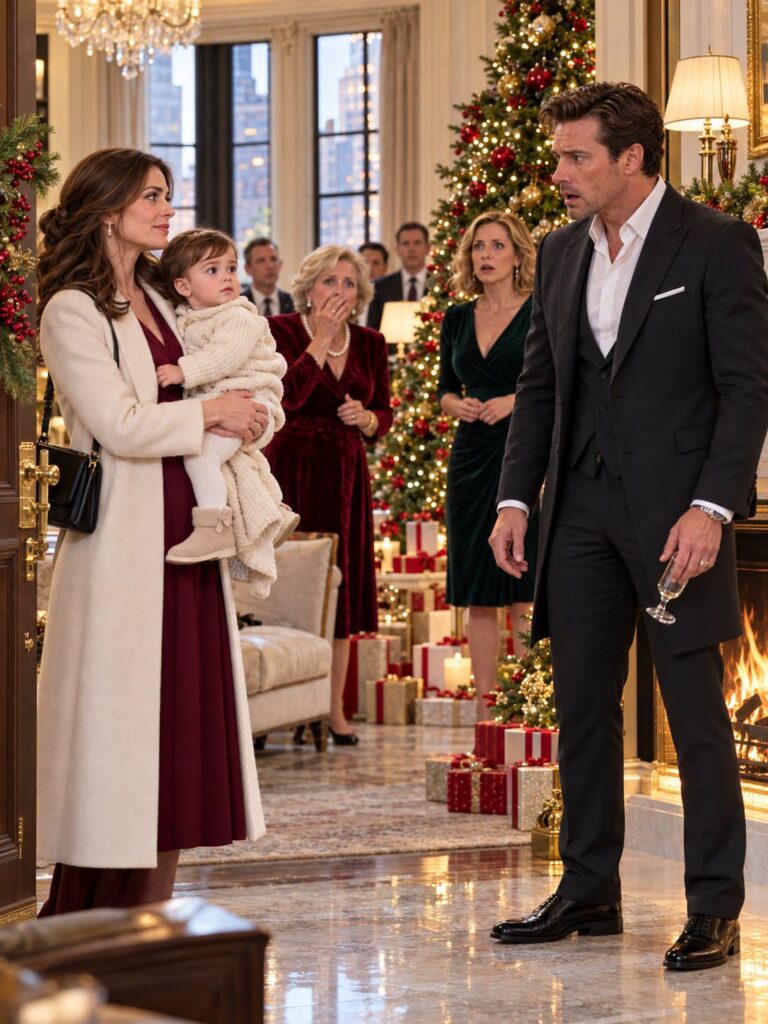
Years afterward, the Caldwell family still told the story about the Christmas Eve when Clara arrived carrying a baby and Ethan Caldwell finally became speechless.
Margaret liked the dramatic version.
The billionaire expecting to impress his ex-wife.
The door opening.
The baby with his eyes.
His entire face collapsing.
Clara preferred a simpler interpretation.
Ethan had spent years positioning everything.
Companies.
Hotels.
People.
Even divorce.
He believed careful distance could protect him from anything he did not want to feel.
Then a fifteen-month-old girl walked through his mother’s front door and destroyed the strategy by looking exactly like him.
But Ethan remembered something else most clearly.
Not the shock.
Not the paternity test.
Not even Sophie calling him Daddy.
He remembered Clara saying:
How many closed doors was I supposed to knock on?
For the rest of his life, whenever someone he loved came to him with something difficult, Ethan tried to remember that question.
Because sometimes abandonment does not look like physically leaving.
Sometimes it looks like making yourself so unavailable that another person eventually stops trying to reach you.
He had done that to Clara.
He nearly did it to his daughter before ever meeting her.
The second chance was not that Sophie existed.
The second chance was that Clara allowed him to know her.
Everything after that had to be earned.
And on every Christmas that followed, when Sophie ran through the Caldwell house leaving toys beneath the chandelier and fingerprints across Ethan’s perfect glass walls, he never once asked anyone to clean them immediately.
Some evidence of love, he learned, should be left where everyone can see it.
The End.
