“Sometimes people confuse certainty with authority.”
I thought about that.
Garrett had stood beside Olivia and announced that I no longer owned my home.
He had changed the locks.
Thrown my belongings outside.
And claimed the paperwork gave him control over everything.
But his confidence couldn’t make an unauthorized transfer valid.
And his anger couldn’t turn my grandmother’s legacy into something I had willingly surrendered.
I looked at Richard.
“Thank you for coming.”
He smiled.
“Of course.”
I took a breath.
“You helped me keep the house.”
He shook his head gently.
“We helped you protect your rights.”
I looked down.
He continued.
“You were the one who refused to accept what Garrett was telling you.”
For several seconds, I sat quietly.
Then I nodded.
He was right.
The moment that changed everything wasn’t when Richard arrived.
It was when I stopped treating Garrett’s certainty as proof that he had the authority he claimed.
I asked questions.
Sought advice.
Reviewed the documents.
And refused to let humiliation force me into surrendering something I hadn’t agreed to give away.
That’s what my grandmother had wanted for me.
Not merely a house.
The ability to choose.
Today, when I walk through the rooms, I still remember the marriage that once filled them.
The Christmas mornings.
The anniversary dinners.
The arguments.
The ordinary evenings when Garrett and I watched television on the sofa.
Those memories don’t disappear simply because the marriage ended badly.
Some were happy.
Some were painful.
All belonged to my past.
But they no longer define the house.
The rooms belong to the life I’m living now.
The garden is mine to care for.
The kitchen is filled with people who respect me.
And the porch is once again a place where I can sit quietly without wondering whether someone will tell me to leave.
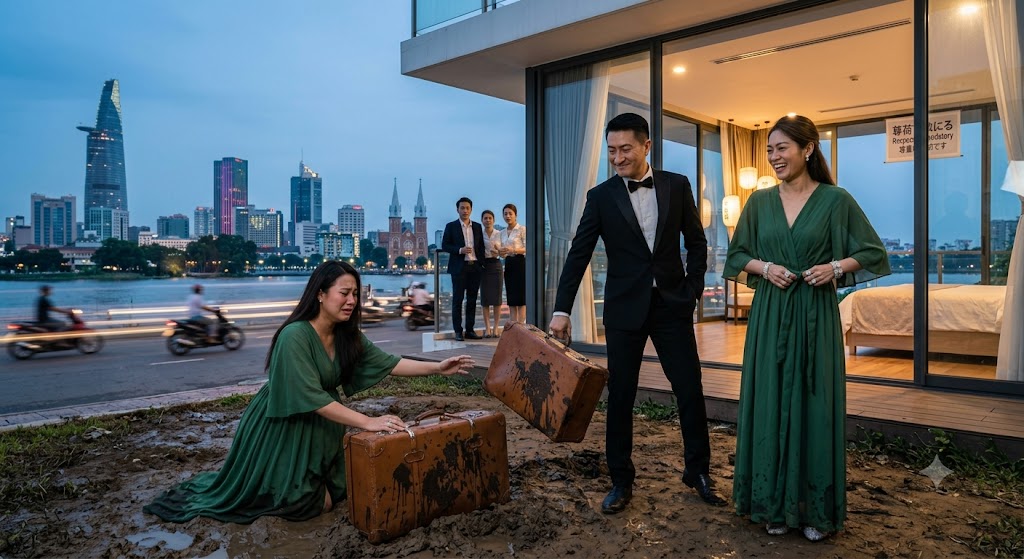
Sometimes I think about the afternoon Garrett threw my suitcases into the mud.
I remember the heavy thud.
The ruined clothing.
Olivia tightening the belt of my champagne-colored robe.
The neighbors watching from across the street.
And the way Garrett smirked when he told me I had five minutes.
For a long time, that memory made me angry.
Now it reminds me of how close I came to believing someone else’s version of my rights.
Garrett wanted me frightened.
He wanted me to feel helpless.
He wanted the witnesses to see him as the person who controlled the property.
Instead, those witnesses saw what he actually did.
And when Richard arrived, Garrett discovered that a confident declaration couldn’t replace valid records or informed consent.
He had spent years avoiding Richard because Richard asked questions Garrett didn’t want to answer.
That afternoon, the questions finally caught up with him.
The deed.
The notarial irregularities.
The pending financing.
The business entity.
And the fact that I had never authorized the transfer.
What Garrett called ownership turned out to be a claim he couldn’t support through the proper process.
But the most important thing I recovered wasn’t the deed.
It was the confidence to make decisions without apologizing for protecting myself.
I could grieve my marriage and still challenge the documents.
I could acknowledge Garrett’s legitimate contributions during our years together without accepting an unauthorized transfer.
I could feel sorry that his business failed without making my grandmother’s home responsible for saving it.
And I could forgive parts of our history without inviting him back into my life.
Those truths took time to understand.
But they changed the way I saw everything.
The last time I opened my grandmother’s wooden box, I found the old brass key beside her letter.
I held it for several minutes.
Then I walked to the front door.
Slipped it into the restored lock.
And turned it.
The door opened easily.
For a moment, I stood on the threshold.
Then I looked toward the driveway.
There was no mud.
No luggage.
No Garrett.
No Olivia.
Only a quiet afternoon in Westerville, Ohio, and the home my grandmother had trusted me to care for.
I smiled.
Because I finally understood something Garrett never had.
A home isn’t simply a possession you can claim by raising your voice.
It is a place where people should feel safe, respected, and free to make choices about their own lives.
Garrett thought changing the locks meant he’d won.
He thought throwing my belongings outside would make me disappear.
He thought a document bearing my name was enough to take away everything my grandmother left me.
And when I asked whether he wanted to make those claims in front of witnesses, he laughed.
“Everything belongs to me now.”
He didn’t know Richard was already on the way.
He didn’t know the transaction had been discovered.
And he didn’t know I’d begun protecting my rights before he ever dragged the first suitcase across the driveway.
But what mattered most wasn’t that I’d been prepared.
It was that I finally stopped allowing someone I loved to turn my generosity into an obligation.
I had shared that house because I wanted to share my life.
Garrett mistook that invitation for ownership of my choices.
He was wrong.
And when he tried to force me out, I didn’t need to scream or beg to prove it.
I needed the truth, the records, and the courage to let the proper process unfold.
An diesem Samstag gab Garrett mir fünf Minuten, um das Haus meiner Großmutter zu verlassen.
Jahre später lebe ich immer noch dort.
Die Hortensien blühen jeden Frühling.
Die Veranda vorne ist friedlich.
Und der alte Messingschlüssel steckt noch an meinem Schlüsselbund.
Nicht als Trophäe.
Zur Erinnerung.
Der Mann, der mir einst sagte, alles gehöre ihm, gehört nicht mehr, ist kein Teil meines Lebens.
Aber die Frau, von der er glaubte, sie verschwinden zu lassen, ist immer noch hier.
Und diesmal, wenn ich meine Haustür schließe, tue ich es, weil ich es will.
Nicht, weil mir jemand gesagt hat, ich gehöre nicht mehr dazu.
