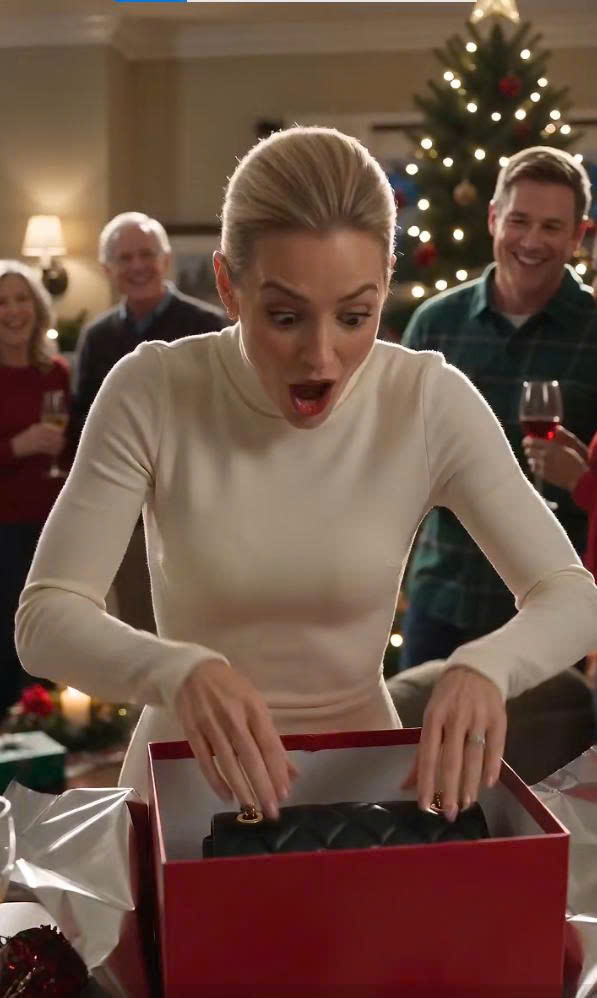
“No,” I said. “But I’m calm.”
Tyler didn’t call. Not on New Year’s Eve. Not on New Year’s Day.
Not when my card was declined and the whole town knew about it. I picked up my phone to call him a dozen times. I put it down a dozen times.
I had given him an hour on Christmas. I could give him a week. On the fourth of January, a Monday, at seven in the morning, my doorbell rang.
I opened the door. My son was standing on the porch in the snow. He hadn’t shaved.
He looked like he hadn’t slept since Christmas. He was holding a cardboard box. I knew that box.
“Brooke had it in the hall closet,” he said. “Behind the vacuum. I found it Friday, when I was packing.” He held it out. “There’s a note on top. In your handwriting.”
I didn’t take it. I didn’t need to. I knew what the note said.
For your tree, Ty. These were always yours. Love, Mom. 12/15.
“The fifteenth,” Tyler said. “That was a Tuesday. Aunt Darlene comes over every Tuesday.” He looked at me, and his eyes were red. “You were there. Weren’t you? You came to the door. You heard them.”
“Yes,” I said.
“What did you hear?”
I told him. All of it. The phone.
The funeral. The care account. Willow Ridge, and creamed corn at four o’clock.
He stood on my porch in the snow and listened to every word, and when I was done, he set the box of ornaments down very carefully on the porch swing and pressed both hands over his face.
“I’m sorry,” he said through his fingers. “Mom. I’m so sorry.”
“Come inside,” I said. “It’s cold.”
He came inside. He sat at the kitchen table in the chair that used to be Walt’s, and I made him eggs, because I didn’t know what else to do, and he didn’t eat them.
Then he took out his phone.
“There’s more,” he said. “Brooke’s tablet syncs to my phone. Her messages. She forgot. Or she never knew. She doesn’t read the settings on anything.” He slid the phone across the table. “I read all of them Friday night. Everything since Thanksgiving.”
I scrolled. Brooke and Darlene. Hundreds of messages.
The Saturday after Thanksgiving: She’s going to give it to the school, Brooke. To strangers. We have to do something before it’s gone. A week later: Kessler says we need proof she’s unstable. Something on video. In front of witnesses.
In early December: Get Ty to agree to the no-gift thing. Tell him it’s a boundary. He’ll love that word. And then, on Christmas night, at 9:14 p.m.: Darlene: She didn’t cry. Not once. Useless.
Brooke: Can we use it? Darlene: Kessler says we cut it. Just use the part with the eviction and the bag. Nobody will ever see the rest. I read that one twice.
Then I scrolled back up to June. There was a photo Brooke had sent Darlene. My bank statements.
Spread out on my own kitchen table. This table. The day Brooke had come over and cried about her credit cards.
She’d taken the picture while I was in the other room getting her a box of tissues. Look how much she’s got sitting there, Brooke had written underneath. Just sitting there. I put the phone down.
“Exhibit C,” I said.
“What?”
“Nothing.” I folded my hands on the table. “Tyler, do you understand what these are?”
“Yes,” he said.
“Do you understand that if you give these to Ruth, she’s going to use them? In court? Against your wife?”
My son looked at me for a long time. He has his father’s eyes. I’d never noticed it as much as I did that morning.
“I signed a note in June,” he said. “At Ruth’s office. For twenty-two thousand dollars. I didn’t even read it. I just signed where Brooke pointed.” He shook his head. “I’ve been signing where Brooke points for three years, Mom. I’m a grown man, and I didn’t read three pages.” He pushed the phone across the table toward me. “I’ll read them now.”
The hearing was on the twelfth of January, in Courtroom B of the Ashworth County Courthouse in Dunmore. It’s a small room. Wood paneling.
A flag. A water cooler that gurgles at the worst possible moments.
Judge Lorraine Haskett is in her sixties, with short gray hair and a cardigan under her robe, and she had a reputation, Ruth told me in the hallway, for reading every page of every filing twice.
“She’ll like you,” Ruth said.
Brooke and Darlene sat at the petitioners’ table with Grant Kessler. He was younger than I’d expected. Expensive suit.
A tan in January. Brooke wore a soft gray sweater and no jewelry, and she didn’t look at me once. Darlene looked at me the whole time.
Behind me, in the first row, sat Ray and Patty, and Caleb in a clip-on tie, holding his tablet in both hands like it was a Bible. Next to him sat Kayla Moss. Tyler sat in the back row, alone.
Brooke didn’t know yet why he’d come. Kessler went first. He was good.
I’ll give him that. He talked about grief. He talked about how often widows make “rash financial decisions in the first year.”
He talked about the twenty-two thousand dollars, and the truck, and the purse, and the hundred and fifty thousand, and the scholarship for “unrelated third parties.” Then he played Exhibit F. Darlene’s four minutes.
I watched myself on the courtroom screen. Did you get my good side? Thank you, Brooke. I will.
I watched my son walk out of my house. When it was over, Kessler let the silence sit.
