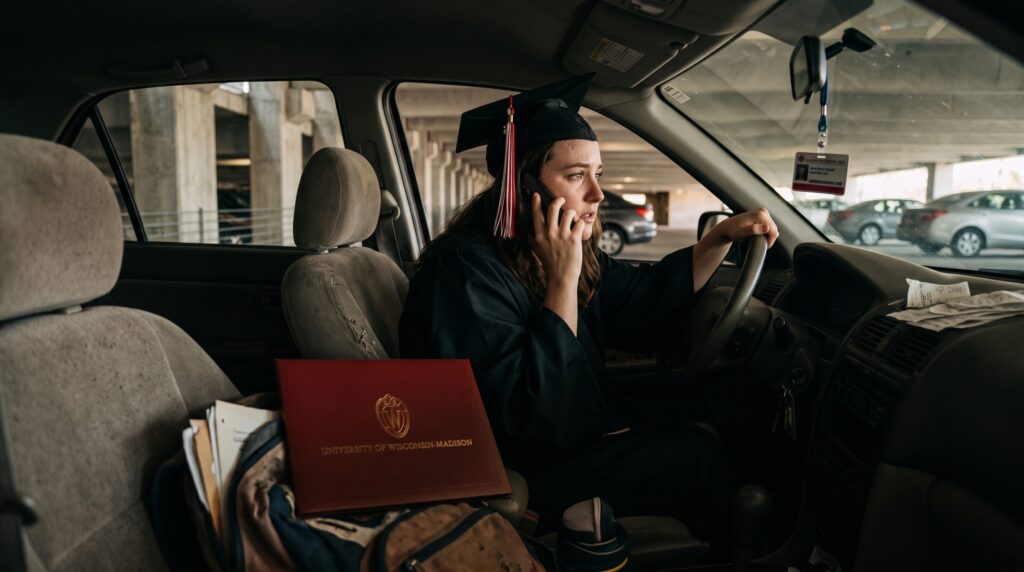
When they called my name, I stood up, walked to the stage, and shook the dean’s hand. There was applause. Friends from my cohort, some classmates I’d studied with through four years of auditing theory and tax law and financial accounting, people who had actually shown up.
Someone near the back shouted my name, and it made me laugh briefly, genuinely.
I walked back to my seat holding the diploma cover, and the moment I sat down, my phone buzzed three times in rapid succession.
The message from my father was four words.
“Call us right now.”
I turned the phone face down.
I sat through the rest of the ceremony. I applauded when other names were called. I tried to stay inside the moment, to give myself at least that much.
But underneath everything, something was already curdling because I knew, I already knew, this wasn’t about concern for me.
The timing of it. The flat urgency in those four words. I’d seen that version of my father before, and it had nothing to do with my welfare.
After the ceremony, after the photos with classmates and the brief, genuine hugs that carried me through the last of the adrenaline, I sat in my car in the parking structure with the engine off, cap and gown still on, diploma cover on the passenger seat.
28 missed calls on my screen.
I called back.
My father answered on the first ring. He didn’t say congratulations. He didn’t ask how the ceremony went. He launched directly into it.
Jade’s checking account was overdrawn by more than $3,000. Her rent payment had bounced. Her landlord was threatening to start eviction proceedings if he didn’t receive the money within 48 hours.
They needed me to transfer $3,200 immediately, plus another $400 to cover the overdraft fees.
“You’ve been working,” my father said. “You’ve got savings. Jade needs you right now.”
My mother’s voice in the background:
“It’s family, Cordelia. This is what family does.”
I sat there in my cap and gown in a parking structure and stared at the diploma cover on my passenger seat, and I said no.
The silence on the other end lasted about 2 seconds.
Then my father told me I was being selfish. My mother said Jade was spiraling and I had an obligation.
I said I was hanging up, and I did.
I drove home. I made myself a cup of tea and sat on my secondhand couch and let myself feel whatever I needed to feel.
What I felt mostly was a very deep and very old tiredness.
The thing about being the invisible child in a family is that you spend years collecting small evidence, logging it somewhere behind your sternum, telling yourself it doesn’t add up to what it obviously adds up to.
I had been doing that accounting for a long time.
I remembered being 12 years old and placing second at a regional spelling bee. I had practiced for months.
My parents had planned to come, but that morning my mother called and said they were staying for Jade’s dance recital. She had a solo. It was important.
I took the bus home with my second place ribbon.
And when I showed my mother, she said:
“That’s great, honey, but you should have seen Jade up there. She was incredible.”
And the way her face lit up when she said it. The same face that registered my ribbon like a minor weather report.
I remembered being 15 and badly twisting my ankle during a field hockey game. My coach called my mother. She arrived an hour later, looked at the ankle, told me to walk it off, said I was tough, and left.
Two months after that, Jade turned her wrist slightly wrong during cheerleading practice. My mother took her to the emergency room, bought her a strawberry milkshake, let her sleep in my parents’ bed for a week.
When I pointed out the difference, my mother said:
“She’s more sensitive than you are.”
As if sensitivity were something I was being denied on purpose, and the remedy was simply to feel less.
My 17th birthday came and went without acknowledgement until my parents remembered 3 days later and handed me a $25 drugstore gift card with the price still on it.
I thanked them.
That same year, they rented out a local event haul for Jade’s 15th birthday. 40 guests, a custom cake shaped like a makeup palette, a new laptop wrapped in pink ribbon.
My father gave a little toast. My relatives snapped photos. I helped carry the leftover cake to the car.
When I was accepted to Wisconsin on an academic scholarship, the news was received with what I can only describe as polite relief.
My father said:
“Good. That saves us a lot.”
No hug, no phone calls to relatives.
The following month, Jade got a small sponsorship deal from a boutique in our town, maybe $200 worth of product, and my mother posted about it on Facebook with the caption:
“So proud of our girl. Watch out, world.”
14 relatives commented. Three called to congratulate her.
I had told myself for four years that graduation day to what would be different, that it was the kind of milestone that cut through everything else. The kind of thing that made people show up.
I had held that belief so carefully, nursed it through every difficult semester. It was the story I told myself when things got hard.
Just get through this, and then they’ll see.
The morning after graduation, my phone buzzed with a bank fraud alert.
Someone had attempted to transfer $3,000 and sended $600 at from my checking account to an external account registered in my mother’s name. The transaction was still pending.
