The room went very quiet.
Jade’s face shifted through several expressions in quick succession.
My father started.
“Cordelia, this isn’t—”
“I spent a few hours this week pulling public records,” I said. “I’m an accountant. This is actually what I do.”
I looked at Jade.
“I’m not trying to humiliate you. I’m telling you what someone should have told you a long time ago, before you built a pitch around a supplier that can’t fulfill orders.”
I reached into my bag and set a single printed page on the table.
It was a simple financial summary. 6 months of revenue trajectory, a growing client list, a savings account rebuilt from zero.
I hadn’t brought it to impress them.
I brought it so they could see that I was not, in fact, the emergency fund they’d been treating me as for my entire life, that I was a person with my own financial life, my own growth, my own story, one they had never once asked about.
“I am not available for this,” I said. “I am not the person you call when things fall apart. I’ve built something of my own, and I’m not going to hollow it out to fill a gap that shouldn’t be mine to fill.”
My mother’s eyes filled.
Jade said:
“You’re destroying our family, Cordelia.”
I stood up, picked up my bag, and put on my coat.
I looked at my sister, and I felt something complicated. Not contempt, not pity, something more like grief.
She had been given everything and still didn’t have enough because what she’d been given was the wrong thing.
I felt sad for her in the way you feel sad for someone who was handed a map to the wrong destination and told it was treasure.
“I didn’t destroy anything,” I said. “I just stopped pretending the damage wasn’t already there.”
I walked out.
The Indianapolis air hit me like cold water, and I stood on the front porch for a moment just breathing it in.
Then I got in my car and drove north.
The news about Jade’s subscription box came to me weeks later through a cousin’s text.
The fulfillment company she’d been counting on couldn’t meet the terms she’d promised her pre-sale customers. She was sitting on more than 600 unfulfilled orders and a personal loan she’d taken out without telling my parents.
My parents had apparently used part of their home equity line to try to help cover it. The whole thing had unraveled before it ever launched.
My mother called one afternoon.
Her voice was tired in a way I hadn’t heard before.
She said:
“We put so much into helping Jade and it fell apart. I don’t know what we did wrong.”
There was a long pause.
I let it sit there.
Then I said:
“You treated one of your children like she was the whole world and the other one like she was furniture. That’s what you did wrong. I’m not going to pretend that didn’t happen just because things got hard for you.”
She didn’t have an answer.
We sat in silence for a few seconds, and then I said I had to go, and I hung up.
I stood at my kitchen window looking out at the street below.
I didn’t feel victorious. I didn’t feel anything sharp or satisfying.
I felt tired.
And then, slowly, something that was quieter than happiness but more durable.
A year out from graduation, my apartment in Lincoln Park had become mine in the way that a place becomes yours only after time passes and small things accumulate.
A plant that had survived a whole winter. A coffee mug I liked unreasonably much.
A reading chair by the window I’d bought secondhand and reupholstered myself on a Saturday afternoon with Clem’s help and a lot of swearing.
My diploma was in a simple black frame above my desk.
I’d placed it at eye level, not for display, not for anyone who came over, but so I would see it every morning when I sat down to work.
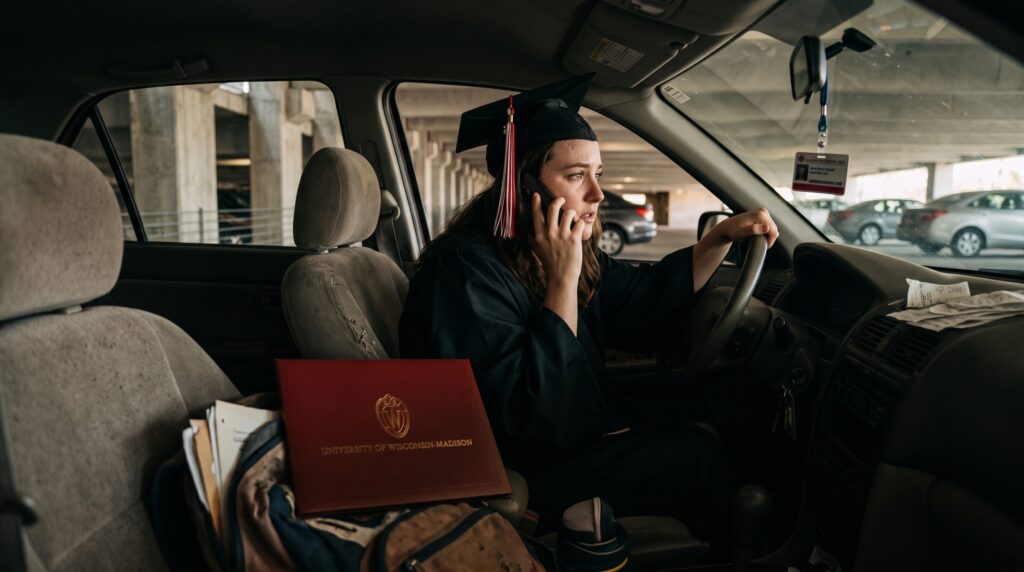
I wanted to remember not the day of the ceremony, which had been one of the most painful days of my life, but the four years of work beneath it.
Every early morning and late night, every shift and every sacrifice, all of that was real, and it was mine, and nobody could reach in and take it.
I had a small dinner party that spring.
Six people around my kitchen table. Clem, Felix from work and his partner, a woman named Juno from my running group, and a neighbor I’d met in the elevator and somehow become real friends with over the course of a winter.
I cooked a pasta I’d been practicing for months.
We opened wine and talked about work and books and embarrassing things that had happened to us in our 20s.
And the laughter in my apartment that night was the loudest it had ever been.
At one point, I looked around the table and thought:
“This is what I was looking for. Not exactly this. Not this specific table or these specific people, but this feeling: being seen without conditions. Being asked how I was and having the question means something. Being somewhere that my presence was wanted, not just my utility.”
I don’t think much about what I lost anymore. I think about what I found.
To anyone listening today who has ever felt invisible in the family you grew up in. Who has ever worked yourself hollow and still felt like you weren’t enough? Who has ever sat alone at something that was supposed to be celebrated?
I want you to hear this.
Your worth is not determined by how much you’re willing to give up.
The people who actually love you will not ask you to bleed for them. They will not need you to shrink.
