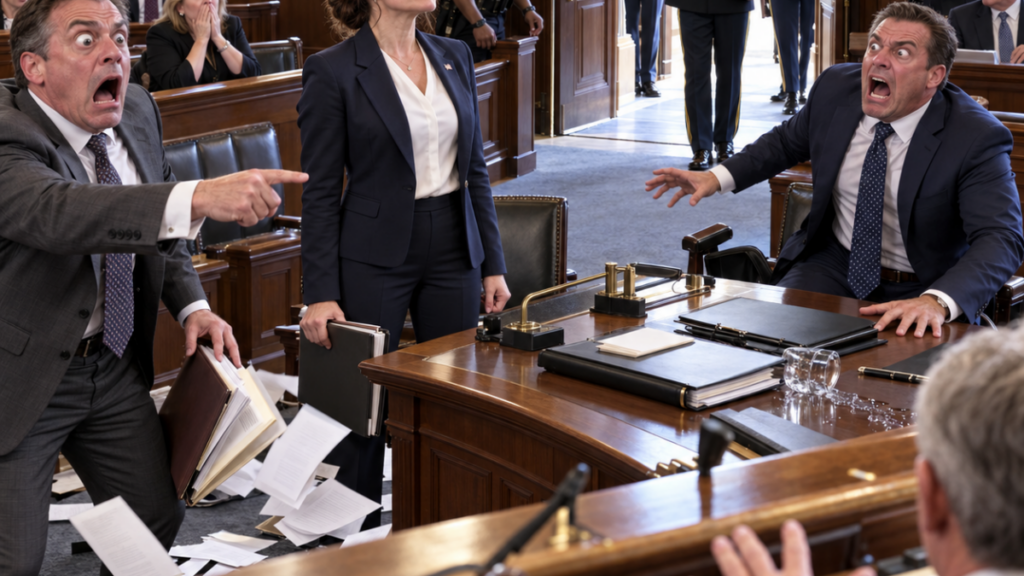
For three seconds, neither of us moved.
Then Adrian lowered his hand.
I lowered mine.
“Ma’am,” he said.
“Colonel.”
Behind me, a chair creaked.
I did not look at Matthew.
Richard recovered first.
Men like Richard always recovered first.
He stood halfway and offered his courtroom smile.
“I’m afraid we haven’t been introduced.”
Adrian turned.
“Colonel Adrian Hayes. Judge Advocate General’s Corps.”
Judge Mercer removed her glasses.
“Colonel, I was not informed that the Department of Defense would participate in this proceeding.”
“No, Your Honor. The timing was deliberate, and I apologize for the inconvenience.”
He stepped toward the bench.
“The Department is not participating in custody, divorce, or the division of property beyond the federal rules governing military benefits. Those remain matters for this court.”
Richard’s shoulders seemed to relax slightly.
Then Adrian continued.
“We are here regarding controlled military records submitted into a civilian proceeding, apparent unauthorized attempts to access a federal retirement account, and a sworn declaration bearing a signature a qualified examiner has concluded was traced.”
Silence settled over the room.
“Those issues extend beyond this court’s jurisdiction.”
Richard stood.
“Your Honor, I object to the implication—”
“Mr. Voss,” Judge Mercer said, “you may object when there’s an evidentiary question before me.”
He sat.
Adrian glanced briefly toward me.
“The Department has authorized counsel to address the federal matters raised by Mrs. Grant’s counterclaim and related filings.”
That was when I looked at Matthew.
He had one hand frozen halfway toward his tie.
The color had disappeared from his face in uneven patches.
For eight months, he had always known what to say.
Now he looked at Richard.
Richard did not look back.
Evelyn began with the children.
Not military records.
Not federal accounts.
Not forged signatures.
The children.
Mrs. Flores testified that Matthew’s email concerning my supposed emotional instability was the only message of its kind she had ever received from him. She stated that in six years she had never observed me behaving unpredictably at school.
Ben’s pediatrician confirmed I had brought him to twelve of his last sixteen appointments and that three of the remaining visits had been rescheduled because Matthew forgot them.
Sophie’s debate coach described me driving students through a thunderstorm to a Saturday tournament and remaining until the final round.
None of it was dramatic.
That was the point.
Then Evelyn displayed a text exchange between Matthew and an old college friend.
Matthew: If I get primary custody, the retirement issue gets much easier.
Friend: Man, that’s cold.
Matthew: It’s math.
Judge Mercer read it twice.
Her expression did not change.
Her pen moved.
Dr. Avery testified next.
He enlarged my authentic signature beside the one on the declaration.
He identified the traced strokes, the unnatural hesitation, and the pen lift.
Richard objected.
Overruled.
He objected again.
Overruled.
The second objection came out slightly higher than the first.
Then one of Adrian’s civilian attorneys called a retirement specialist to explain what portions of military retired pay could legally be divided.
The testimony was gloriously dull.
Formulas.
Dates.
Service overlaps.
Federal limitations.
Matthew’s requested amount exceeded what the applicable framework supported. Several benefits he had listed were not divisible at all.
He had not understood the system.
He had simply identified a stream of money attached to me and decided it should become attached to him.
Then came the access logs.
Fourteen unauthorized logins.
Five from the home network.
Two visits to the survivor-benefit section.
The attempted banking change.
The LLC linked to Matthew’s sister’s maiden name.
Nobody spoke.
Richard rose again.
I will give him this: he did not retreat.
He walked to the center of the courtroom and looked directly at me.
“Mrs. Grant, you want this court to believe that after twenty years of military service, leadership, and discipline, you somehow became the victim of a scheme inside your own home without noticing it?”
It was a strong question.
If I said yes, I looked foolish.
If I insisted I was strong enough to detect everything, he could imply nothing happened.
Eight months earlier, I might have tried to explain.
Instead, I looked toward Judge Mercer.
“No, Mr. Voss.”
He waited.
“I expect the court to read the evidence.”
Nobody laughed.
Nobody needed to.
Richard stood for another second, then returned to his table.
Judge Mercer folded her hands.
“Mr. Grant, take the stand.”
Matthew crossed the courtroom like a man walking over thin ice.
He swore the oath.
The judge questioned him herself.
“Did you record your wife during marital disagreements?”
“Yes, Your Honor. For my protection.”
“Did you record the entire disagreements?”
Matthew glanced at Richard.
“No.”
“When did you normally begin recording?”
A long silence.
“After they started.”
“Did you tell your daughter that her mother was unstable?”
His mouth tightened.
“I told Sophie I was concerned.”
“That was not my question.”
Matthew’s eyes dropped.
“I may have used the word.”
Behind me, I heard Sophie inhale sharply.
Judge Mercer looked at the financial exhibits.
“When did you first consult Mr. Voss?”
“A few months before filing.”
“Bank records show your retainer was paid nine months before filing.”
Matthew said nothing.
The judge lifted the printed text exchange.
“If I get primary custody, the retirement issue gets much easier.”
Her voice remained level.
“Did you write this?”
“Yes.”
“What did you mean?”
Matthew rubbed his thumb against the witness-box rail.
“Just that finances would be simpler.”
“Mr. Grant, I have presided over family matters for nearly two decades. Concerned parents ask what arrangements protect their children. They do not normally begin by calculating how custody strengthens their position against a pension.”
Matthew looked at me.
For the first time since January, there was no rehearsed expression on his face.
No injured husband.
No patient father.
No strategic calm.
Only fear.
I did not enjoy it.
That surprised me.
I had imagined that if the truth ever became visible, I would feel triumph.
Instead, I felt grief.
