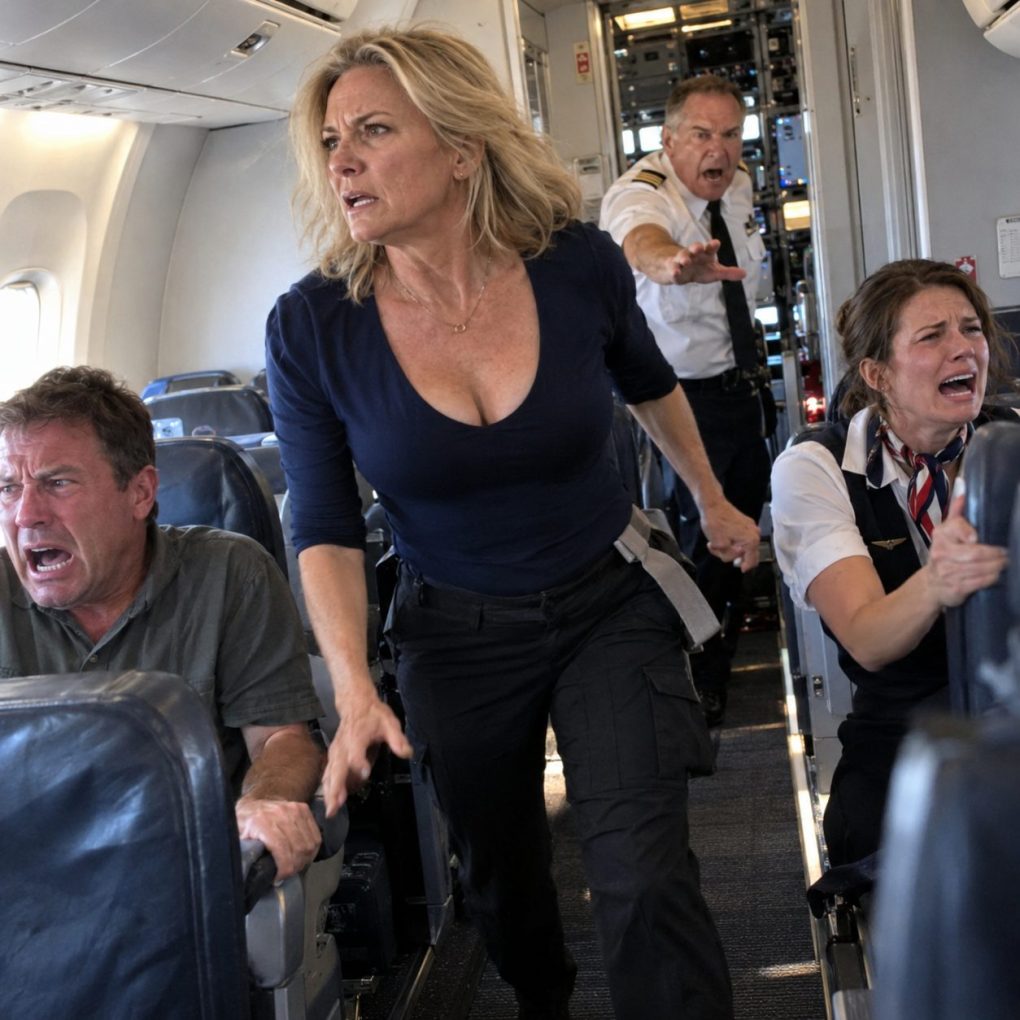
The captain’s voice trembled. Around me, 187 people heard the death sentence.
A little girl sitting opposite her mother held onto her sleeve.
“So that means we’re about to have an accident?”
I unbuckled my seatbelt.
The flight attendant held onto my arm before I reached the aisle.
“Madam, please have a seat.”
“Tell the captain that there is a pilot sitting in seat number fourteen.”
“He has a co-pilot.”
“And they are facing a problem that neither of them has ever encountered before.”
The floor seemed to tilt. A drinks cart slammed against a door latch. Somewhere behind us, a man began to pray.
I kept my seat reclined until the plane reached a certain altitude.
That slow roll. A brief adjustment. Then the nose of the plane plunged down again.
I know that rhythm.
Thirty-two years ago, I felt it firsthand with smoke in my eyes and blood splattered in my shoes.
“What is your name?” the waiter asked.
“Margaret Hayes. Former flight instructor. Prior to that, served in the Air Force.”
Her expression changed.
“What should I say to him?”
“Tell him that Phoenix is here.”
She stared intently, then reached for the intercom.
I spent decades refusing to answer by that name. Now, it’s the only thing that can get me through the cockpit door.
A little while later, she led me forward.
The captain glanced back. He was younger than I’d imagined, perhaps around forty, with a faint wrinkle on his chin.
His co-pilot pointed to a screen.
“Each time we try to fix it, it just makes the problem worse.”
“Then don’t resist in the old way anymore,” I said.
The captain’s eyes sharpened.
Have you seen this before?
“Yes.”
“Where?”
“Flight 406. Pennsylvania. Thirty-two years ago.”
His hands were frozen.
There are reasons why pilots remember that accident. And there are reasons why I’ve never mentioned it.
He looked at me as if I had just stepped out of a photograph.
Then he pulled out an old photograph from the side of his travel bag.
A plane is on fire. A woman kneels beside a child.
I
“Before you touch anything,” he whispered, “tell me why you let my mother stay in the house.”
The captain recognized my face. He knew about the accident. But the photograph he carried only captured a single moment—and we were running out of time to confront everything outside that frame.
The plane crashed before I could answer.
His co-pilot noticed the movement first. The captain put the photo away and returned to working with both hands.
“Later,” he said.
“Yes,” I replied. “If we can get one.”
His name tag reads DANIEL MERCER.
Mercer
For thirty-two years, I remembered his mother’s first name: Helen. I tried to forget everything else.
The copilot, Luis Ortega, gave me a quick account of what had failed and what they had already tried. I had retired eighteen months earlier from this aircraft type. The displays were familiar. The way the airplane resisted them was worse than familiar.
“I can help assess it,” I said. “You’re still the captain.”
Daniel nodded.
We worked together, checking the indications against the airplane’s actual movement. Nothing was simple. Some responses were delayed; others barely registered. Every small gain cost altitude.
Outside, the Pennsylvania countryside rose toward us.
Air traffic control cleared the airspace and directed us toward the nearest suitable runway. Emergency crews were already moving.
“How long?” Daniel asked.
“Long enough to keep working.”
He glanced at me.
“That’s what you told me back then.”
The words opened a door I had kept shut.
A boy pinned beneath a seat. One sneaker missing. A woman calling from farther back.
I had been an off-duty airline pilot on Flight 406, years after leaving the Air Force. After the crash, I had crawled back through the broken fuselage.
I had brought Daniel out.
I had come out without Helen.
“You were eight,” I said.
“I remember more than people think.”
Another warning sounded.
Luis spoke sharply, pulling us back to the cockpit.
We found a limited response we could work with. Daniel held it while Luis coordinated with the ground. I watched the changing indications and called out what mattered.
The shaking eased.
Then Daniel said, “There’s an envelope in my bag. From the foundation.”
The foundation had invited me to Pittsburgh to speak about aviation safety. I had accepted only after they promised there would be no cameras.
“You sent the invitation?”
“I wanted an answer.”
“You arranged this?”
“The invitation,” he said. “Nothing else.”
His voice cracked.
“My father died last month. I found something he kept from me.”
We were still losing altitude.
“What?”
“A letter from my mother. Written before that flight.”
I looked at him.
“And a statement you gave investigators.”
The runway appeared ahead, small and impossibly far below.
Then Luis went still.
“We’re not going to reach it.”
Daniel turned toward me.
“Phoenix,” he said, “what did you land on the first time?”
“A closed airfield,” I said. “But we don’t need the same place. We need somewhere we can actually reach.” Luis relayed that to the controller. Seconds stretched while Daniel held the airplane as steady as its damaged controls allowed. Then the controller gave us another option: an old municipal field several miles short of the airport. Its remaining runway served an industrial property now. It was shorter, with no promise of a clean approach. But it was beneath us, and someone on the ground was already trying to clear it.
Daniel studied the view ahead. “I see it.” There were buildings off one end and trucks near the pavement. We could not wish ourselves higher. We could only use what remained. Daniel made the decision, Luis handled the radio and landing checks, and I kept watching for the changes we had learned to recognize. Behind the cockpit door, the flight attendants were getting everyone ready. Their voices carried forward, firm and clear. Nobody back there knew their captain was flying beside the woman he had spent his life trying to forgive.
