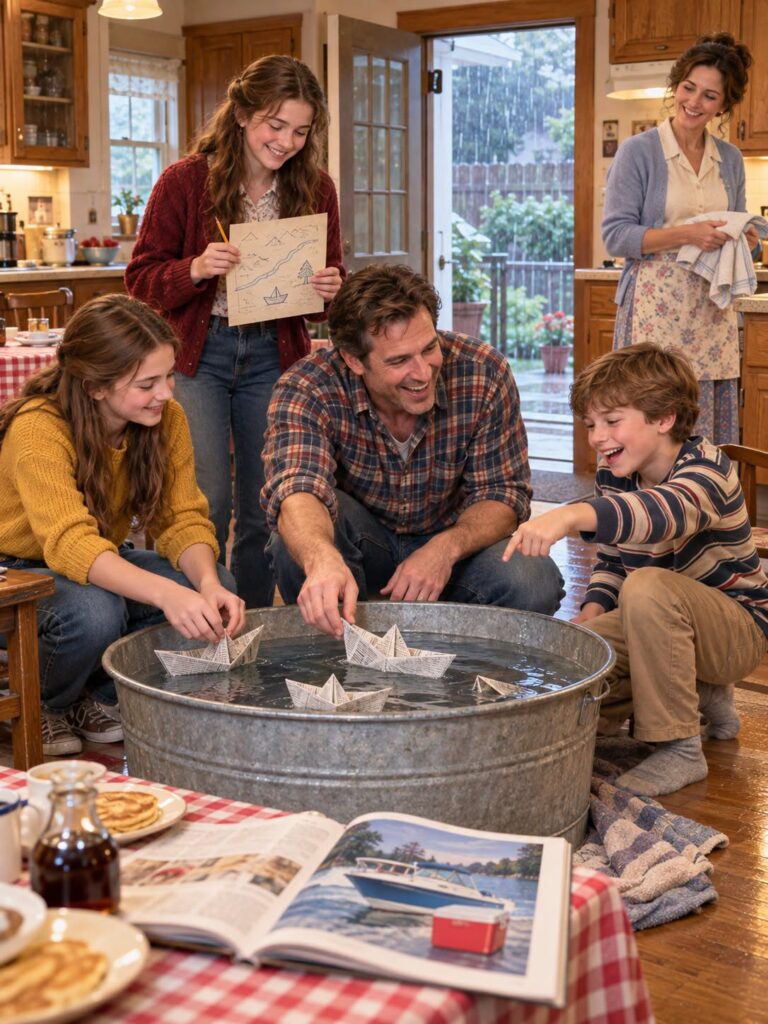
The catalogue arrived on a Tuesday, and by Wednesday our family had decided we needed a boat.
It was not a real decision. Nobody in our house had a place to keep a boat, money for a boat, or any practical reason to own one. We lived in a small house in western New York with a narrow driveway, a damp basement, and a garage already full of rakes, paint cans, snow shovels, old bicycles, and one lawn mower my father insisted was “still perfectly good” even though it started only when treated like a stubborn farm animal.
But the catalogue showed a family standing on a dock beside a shining blue motorboat, and that was enough to unsettle us.
The boat was beautiful in the way catalogue things were always beautiful. It looked untouched by weather, gasoline, scratches, payment plans, arguments, or mosquitoes. The father in the picture wore white shorts and sunglasses. The mother had a scarf tied around her hair, though nobody we knew wore scarves near lake water unless the wind had already won. Two children stood barefoot on the dock holding fishing poles, smiling as if fish had been invented that morning for their personal amusement. Near the stern sat a red cooler with a white lid.
That cooler was what caught my attention.
My sister Janet wanted the boat. My younger brother, Mark, wanted the trailer. I wanted the cooler. Mother said the catalogue was for winter coats and kitchen appliances. Father said it had become more interesting than that.
He was sitting at the kitchen table when he said it, one hand around a coffee mug, the catalogue open beside his elbow. Outside, rain tapped steadily against the windows. The house smelled like meatloaf, wet wool, and the faint metallic odor from the radiator in the dining room. We were supposed to be doing homework, setting the table, and generally behaving like children who understood the seriousness of weeknights.
Instead, we gathered around the catalogue.
Father tapped the boat picture with one finger.
“If people are going to print such pictures,” he said, “they ought to expect questions.”
Mother looked over from the stove. “The question is why you’re looking at boats in a catalogue that came because I ordered towels.”
“A fair question,” Father said. “But not the only one.”
Janet leaned over the table. “Could we really get it?”
“No,” Mother said.
“Possibly,” Father said at the same time.
Mother turned around.
Father added, “In a strictly imaginary sense.”
That was how most of Father’s best ideas began. Not with permission, exactly, but with a door left open just wide enough for nonsense to walk through.
For three rainy evenings, we planned the imaginary purchase. The catalogue remained on the kitchen table like an official document. After dinner, once the plates had been cleared and the dishes were soaking, Father would open it to the boat page and we would resume our serious work. We chose a name for the boat first, because Father said a boat without a name was just a floating bill.
Janet wanted to call it The Sea Queen.
Mark wanted Thunder Shark.
I suggested The Red Cooler, which everyone rejected except me.
Mother, from the sink, said, “Call it Paid For, because that’s the only boat I’d allow in this family.”
Father wrote that down on the back of an envelope.
Then we argued about who would steer. Janet claimed she should because she was oldest. Mark said he should because he was “better at turning things,” which was based entirely on the fact that he had recently learned to ride his bicycle around the maple tree without falling. I said steering sounded less important than managing the cooler, and therefore I would accept that responsibility. Father said he would be captain because someone had to make difficult decisions, such as whether to dock for ice cream.
Mother said captains generally knew where they were going.
That led to the question of where we would go.
We named three lakes. The first was too far away. The second required a road Father disliked because, according to him, it had been designed by someone “with a grudge against tires.” The third was close enough to imagine but not close enough for a casual Saturday. We discovered, after ten minutes of argument and one road atlas, that none of the lakes was convenient enough for the easy life the catalogue had promised.
“The people in the picture don’t seem worried about distance,” Janet said.
“The people in the picture also have clean children,” Mother said.
This was true. None of us in real life looked like catalogue children for more than six minutes after leaving the house.
On Thursday evening, Father drew a boat on the back of the envelope where Mother had suggested the name Paid For. His drawing looked like a shoe with a flag. Janet improved the bow, which made it look slightly less like footwear and more like something that might survive shallow water. Mark added a fishing rod taller than the mast, though the boat had no mast before that moment. I drew the cooler near the back, carefully making it red even though I had to press hard with a dull pencil and explain that red was being implied.
Mother said again that she was not participating.
Then she took the pencil and drew the shoreline.
It was the best part of the drawing. She added trees, a small dock, a hill in the distance, and a little curved line to show water touching land. She did it casually, as if she were correcting a grocery list, but once she was finished the whole picture changed. The boat no longer floated in empty imagination. It had somewhere to be.
Father looked at the envelope and nodded.
“Excellent,” he said. “Now it’s a vacation.”
