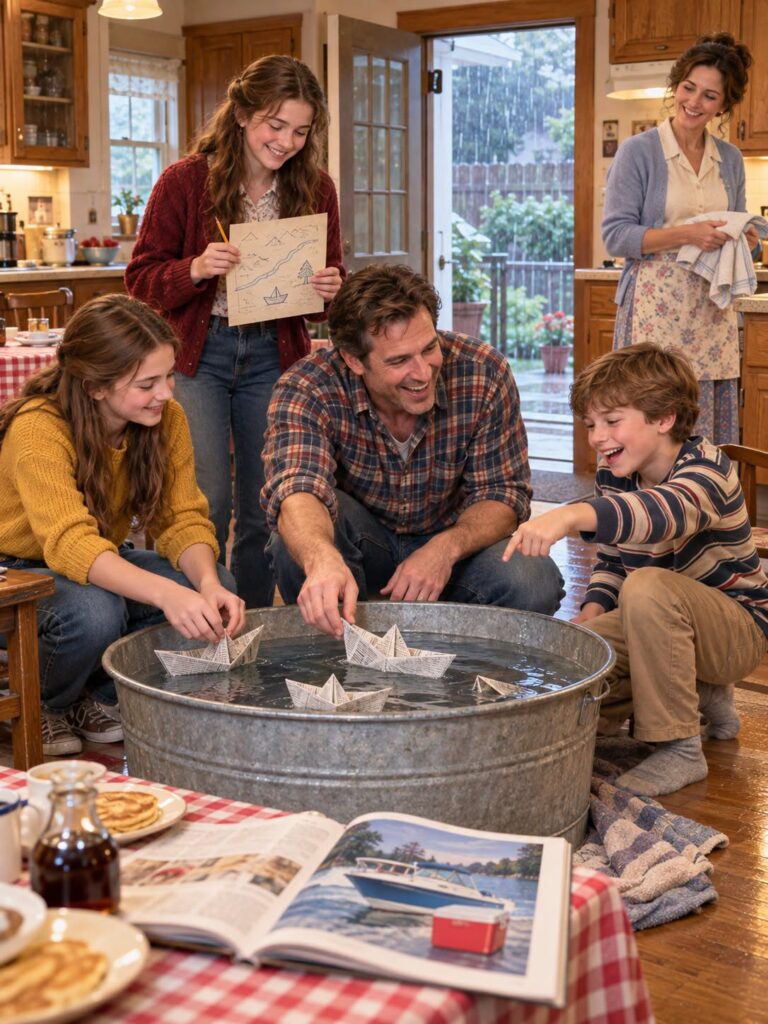
Saturday arrived cold and wet. The kind of wet that did not fall dramatically but simply existed everywhere. The windows were fogged at the edges. The backyard had become soft enough to hold footprints. The gutters dripped steadily. The sky looked low and gray, as if someone had pulled an old blanket over the neighborhood.
The boat stayed in the catalogue.
No one was surprised.
Mother made pancakes, which softened the disappointment considerably. Father said a boating family needed a strong breakfast. Mark asked whether imaginary boats required real syrup. Father said that was the law. Janet asked if we could still decide what lake we were going to. I brought the catalogue to the table, careful not to get batter on the page.
We moved the imaginary dock from one lake to another while eating pancakes. Father said the first lake had better fishing. Janet said the second lake looked more elegant, though none of us had actually seen it. Mark said the third lake might have turtles. I said turtles were irrelevant unless they had coolers. Mother poured coffee and said she had never heard so much discussion from people who owned neither boat nor lake.
At noon, Father announced that a family with no boat could still have a boating day.
This was the sort of sentence that made Mother pause before answering.
“What does that mean?” she asked.
“It means,” Father said, already standing, “we adapt.”
He went to the basement and came back carrying the old galvanized washtub we used for soaking muddy shoes and occasionally washing the dog, though the dog had never agreed to the system. Father set it in the middle of the kitchen floor and filled it with water from the sink. Then he gathered newspaper, tore it into squares, and began folding paper boats.
Mark immediately wanted the largest one. Janet wanted hers folded properly because, according to her, a boat made badly would embarrass the family. I tried to make one with a separate paper cooler, but it became soggy before it reached the water.
Father opened the back door so we could hear the rain.
“There,” he said. “Atmosphere.”
This was not the same thing as owning a shining blue motorboat.
We knew that.
It was also funny enough to keep us there.
The paper boats sank quickly. The first went down almost at once, tipping sideways and surrendering like it had seen the future. Mark blamed the newspaper. Janet blamed the folding. Father blamed the captain. Mother brought towels and said the whole crew had failed to check the weather.
We laughed harder than the situation deserved.
Then we made more boats.
Some lasted longer. One of Janet’s made it nearly two minutes, which she treated as proof of superior seamanship. Mark tried to create waves by blowing across the water and accidentally sent his own boat nose-first into the side of the tub. Father declared it a maritime incident. I placed my damp paper cooler aboard a vessel that sank under its weight within ten seconds.
“Equipment,” Father said solemnly, “must be properly secured.”
Mother stood with the towels under one arm, pretending disapproval while smiling into her coffee.
By evening, the catalogue was dry and the envelope drawing had become a map. We had added arrows, invented roads, renamed the lake twice, and marked a place where we would stop for sandwiches if we ever managed to leave the driveway. Father taped the envelope to the refrigerator, right between a school notice and a recipe Mother had clipped from a magazine.
We never bought a boat.
Of course we didn’t.
By the next week, the catalogue was back in the stack with the others. School started again. Rain gave way to colder weather. The lawn mower refused to start one last time before winter. Mother eventually ordered the towels she had wanted in the first place. Life returned to its ordinary shape.
But the boat stayed with us.
Not physically. Not in any useful way. We had no dock, no trailer, no shining blue motorboat, and no need to learn how to back anything down a ramp. But it stayed in the family language, which is where the best imaginary things usually live.
Years later, whenever someone mentioned a lake, Father would ask whether we had brought the cooler. If a vacation plan became too complicated, Mother would say, “Check the weather before launching.” When Janet bought her first car, Mark said it needed a trailer hitch for Thunder Shark. When I packed for college, Father looked at my overstuffed suitcase and said, “You remembered everything except the red cooler.”
We all knew what he meant.
The boat became shorthand for a certain kind of happiness. The kind that costs nothing because it never actually happens. The kind that begins with a picture in a catalogue and ends with a family standing around a washtub in the kitchen while rain falls through an open door. The kind you do not recognize as important at the time because it looks too much like foolishness.
My father died many years later, after a short illness that made him impatient with doctors and sentimental about nothing, at least not where anyone could see. While cleaning out his desk, we found old receipts, insurance papers, sharpened pencils, a pocketknife, and an envelope folded into a book. On the back was a drawing of a boat that looked like a shoe with a flag. Janet’s improved bow was still there. Mark’s ridiculous fishing rod reached nearly off the page. Mother’s shoreline curved around the water. Near the stern, faint but unmistakable, was my red cooler.
None of us spoke for a moment.
Then Mark said, “We should have bought the cooler.”
Mother, older by then but still able to correct nonsense with perfect timing, said, “We did. Just not the one in the catalogue.”
She was right.
