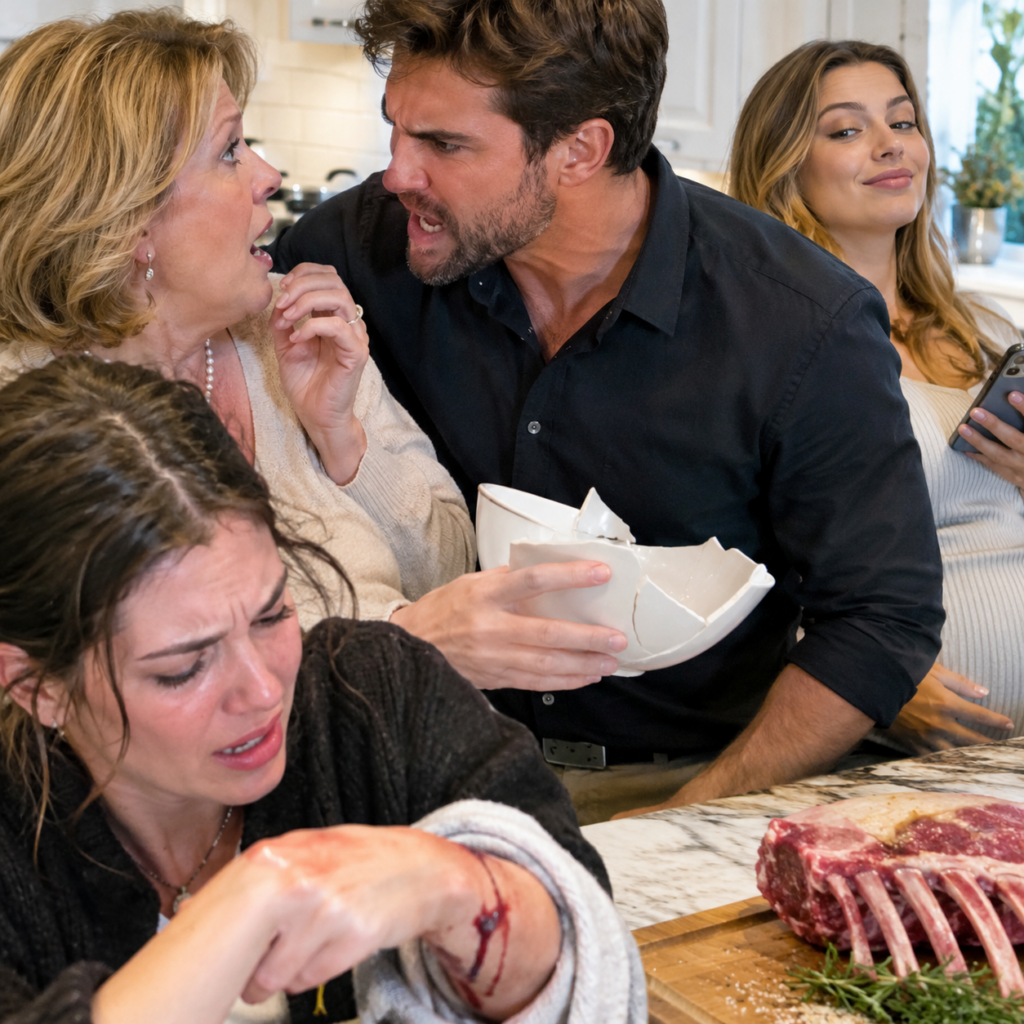
“I’m not the one who threw a bowl at someone.”
Then he took me outside.
And for the first time in months, I felt as though I could breathe.
The emergency clinic was only fifteen minutes away, but the drive felt endless.
Ethan kept glancing at my hand.
“I’m sorry,” he said.
I stared out the passenger window.
“Please don’t.”
He gripped the steering wheel.
“Don’t what?”
“Don’t apologize just because you’re frightened by what happened.”
His jaw tightened.
“That’s not why I’m apologizing.”
“Then why?”
“Because I should have stopped it before it got this far.”
I turned toward him.
He continued speaking, his voice heavy.
“I knew Mom was crossing boundaries. I knew Nicole was taking advantage of you. I heard the things they said. I saw how exhausted you were every time I came home.”
“Then why didn’t you do anything?”
The question came out more quietly than I intended.
Ethan flinched.
I had asked him variations of that question before, but I had never asked it so directly.
He was silent for several seconds.
“Because I kept telling myself it would get better,” he finally admitted.
I looked down at the towel wrapped around my palm.
“And when it didn’t?”
“I told myself they were going through a difficult time.”
“And when I told you I couldn’t take it anymore?”
His eyes remained on the road.
“I told you to be patient.”
“Yes.”
The word hung between us.
I thought about the nights I had cried alone in our bedroom while Ethan slept beside me.
I thought about the way I had started avoiding the kitchen whenever Patricia was home.
I thought about how I had stopped inviting my friends over because I never knew what Nicole might say or do.
I thought about how a house I had once loved had become a place where I measured every word before speaking.
“You know what hurt the most?” I asked.
Ethan swallowed.
“What?”
“It wasn’t that they treated me badly.”
He glanced at me.
“It was that I knew you could see it, and you kept asking me to make it easier for them.”
His face crumpled.
“I know.”
“No, Ethan. I don’t think you do.”
I took a breath.
“Every time your mother insulted me, I had to decide whether to defend myself and risk another argument or stay quiet so you wouldn’t have a difficult evening. Every time Nicole demanded something, I had to decide whether to refuse her or spend the next two days listening to your mother tell everyone how selfish I was.”
My voice trembled.
“And every time I asked you to stand up for me, I felt as though I was asking you to choose between your family and me.”
Ethan’s eyes shone.
“You shouldn’t have had to ask.”
“No. I shouldn’t.”
We arrived at the clinic.
Ethan parked and came around to open my door.
I let him help me out, but I didn’t let him take my injured hand.
Not yet.
At the reception desk, he explained what had happened.
When the nurse asked whether I felt safe returning home, I hesitated.
It was a simple question.
Yet I realized I had spent so long trying to keep everyone else comfortable that I had forgotten how to answer questions about my own safety.
“I will,” I said slowly. “My husband has asked them to leave.”
The nurse looked at Ethan.
“Has the person who injured you left the property?”
“Not yet,” Ethan admitted. “We’re arranging that now.”
She nodded and guided me toward the treatment room.
The cut needed cleaning and stitches.
While the nurse worked, Ethan sat beside me, staring at the floor.
He didn’t try to fill the silence with excuses.
He didn’t tell me his mother hadn’t meant it.
He didn’t remind me that she was getting older or that Nicole was pregnant.
For once, he simply stayed.
When the nurse finished dressing my hand, she gave me instructions for keeping the wound clean and told me to seek further care if I noticed increasing redness, swelling, worsening pain, or other signs of infection.
Ethan thanked her.
Then we walked outside.
The evening air was cool against my face.
Ethan stopped beside the car.
“I want to tell you something,” he said.
I waited.
“I have been a coward.”
I looked at him.
He rubbed his hands over his face.
“I kept calling it patience because that sounded better than admitting I was afraid of upsetting my mother. I kept telling you that family should forgive each other because I didn’t want to confront the fact that my mother was hurting you.”
He took a shaky breath.
“And I let you carry the cost of my fear.”
For a long moment, I couldn’t answer.
Those were the words I had needed to hear for years.
Not an explanation.
Not a defense.
An acknowledgment.
But acknowledgment was only the beginning.
“Ethan,” I said, “I don’t know what happens next.”
He nodded.
“I understand.”
“I love you. But I cannot go back to the way things were.”
“You won’t have to.”
“You cannot promise that everything will change overnight.”
“I know.”
“And I won’t be responsible for managing your mother’s feelings about the consequences of her own actions.”
He looked directly at me.
“You won’t be.”
I studied his face.
I wanted to believe him.
But trust, once damaged, does not return simply because someone finally says the right thing.
“Then show me,” I said.
He nodded again.
“I will.”
Neither of us knew how much that promise would cost him.
Or how much it would reveal.
When we returned home, the first thing I noticed was the silence.
The kitchen lights were still on.
The broken bowl remained scattered across the floor.
The lamb sat untouched on the cutting board.
But Patricia and Nicole were no longer in the kitchen.
Their voices drifted from the upstairs guest room.
