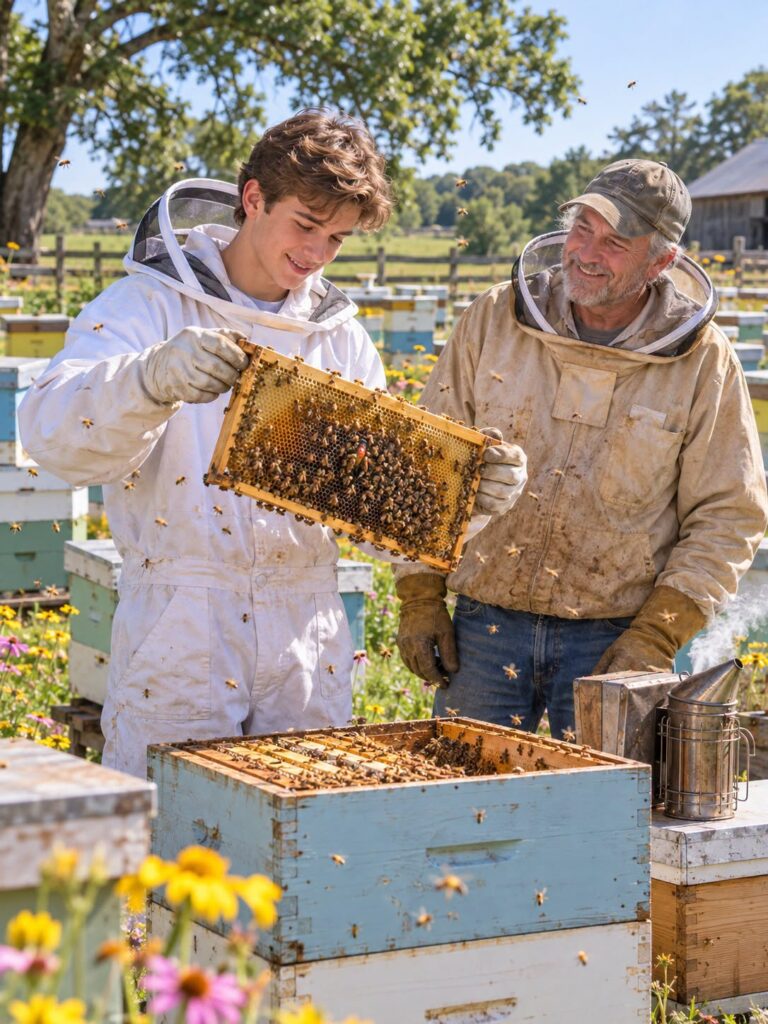
Tyler’s hands were shaking before I even got the smoker lit. First day. Standing at the edge of the bee yard, looking at forty hives like they might come after him personally.
I’ve kept bees on this land twenty-six years. Started with two hives my grandfather left me. Built it up slow since then. Forty hives now, some years a little more depending on how the splits go. Enough to keep me busy most mornings before the sun’s even fully up. The bee yard sits behind the old red barn, past the blackberry canes and the rusted tractor I keep telling myself I’ll fix one day. In June, the clover comes up thick and white across the lower field, and the whole place hums before the sun clears the trees.
The community program sent Tyler out for the summer. Court-ordered work hours. Something about a fight at school that got out of hand. Details I never asked for, and he never offered. Just showed up on my porch the first Monday in June looking like he’d rather be anywhere else. Arms crossed the whole time I explained the basics, barely making eye contact, jaw set hard like he’d already decided I was another adult getting paid to be disappointed in him.
I told him bees can tell when you’re scared. Not in some mystical way. Just chemistry. The way your body puts off different signals when you’re tense versus calm. Bees pick up on that same as dogs do.
He said that sounded made up.
I told him he could believe what he wanted, but he’d see soon enough.
First few weeks, he flinched at everything. Every hum near his ear, every bee landing on his sleeve. Quick jerky movements. Slapping at air. Stepping back too fast. Got him stung twice in the first ten days, both times avoidable if he’d just held still. The first sting landed on his wrist. The second on the back of his neck, after he jerked away from a bee that had only been walking across his veil.
He cursed both times.
I didn’t lecture him about it. Just scraped the stinger out, handed him an ice pack, and kept working. Lectures don’t do much for a kid already braced against the world. They just give him something else to push back on.
So I let him watch.
Gave him small tasks that didn’t put him too close to trouble. Carrying frames. Mixing sugar water. Cleaning out old equipment in the shed. Scraping propolis off hive tools. Stacking supers in the shade. Slow work, most of it, the kind that doesn’t feel like it’s teaching you much until later, once it adds up.
Tyler didn’t talk much those first days. If he answered, it was usually one word. Yeah. No. Fine. Sometimes not even that. But he showed up. Every morning he was supposed to be there, he came walking up the gravel drive in the same black hoodie, even when the heat got bad enough to make the air shimmer over the pasture.
Around week four, something started shifting. Not dramatic, nothing you could point to exactly. He started moving slower without me telling him to. Started watching the bees instead of flinching from them. Started noticing when a hive was restless before I said anything. He stopped standing outside the yard like it was enemy territory and started stepping in like he belonged there, not confident exactly, but less ready to run.
I asked him about it one afternoon while we were sitting on overturned buckets under the shade of the barn, drinking water from plastic bottles gone warm in the truck.
“Why the change?” I asked.
He looked at me sideways. “What change?”
“You know what change.”
He picked at the label on his bottle for a while. “I don’t know exactly.”
I waited.
Finally, he said something about the sound they made when things were calm. Steady and even. Almost like one long breath. Versus the sound when something was wrong, sharper, more urgent, like the whole hive was tightening at once. Said he’d started being able to tell the difference without really trying to learn it.
I told him that was a real thing. Took most people years to pick up on. If they ever did at all.
He looked down, like praise embarrassed him worse than criticism.
By week six, I let him open his first hive on his own. Me standing back a few feet, ready to step in if he needed it. It was one of the calmer colonies in the middle row, good temperament, strong brood pattern, not too crowded. Still, a hive is a hive. Forty thousand living things do not care about your court order or your reputation.
Tyler worked slow, deliberate. A puff of smoke at the entrance. Wait. Lift the outer cover. Another little puff under the inner cover. Wait again. No rushing. No banging frames. No dropping tools. Checking frames one at a time, the way I’d shown him, but with something extra I hadn’t taught him.
A kind of patience that didn’t seem forced.
Found the queen on his second frame.
Pointed her out to me quiet, like he didn’t want to spook her by talking too loud.
I stepped closer and looked. There she was, long-bodied and golden, moving through the workers like she owned every inch of comb beneath her feet. Tyler’s finger hovered near the frame, steady as fence wire.
I told him most beginners take months to spot a queen reliable. He’d done it his second week handling a hive solo.
He didn’t say much to that. Just kept working. Checking the rest of the frames. Moving with a steadiness that looked nothing like the kid who’d flinched his way through June.
Word got around some, the way it does in a small town. His mother stopped by one afternoon in a dented blue sedan, still wearing the name tag from the grocery store where she worked. She stood beside the fence a while before coming over to the porch. Looked tired in the way people look when tired has become part of their face.
