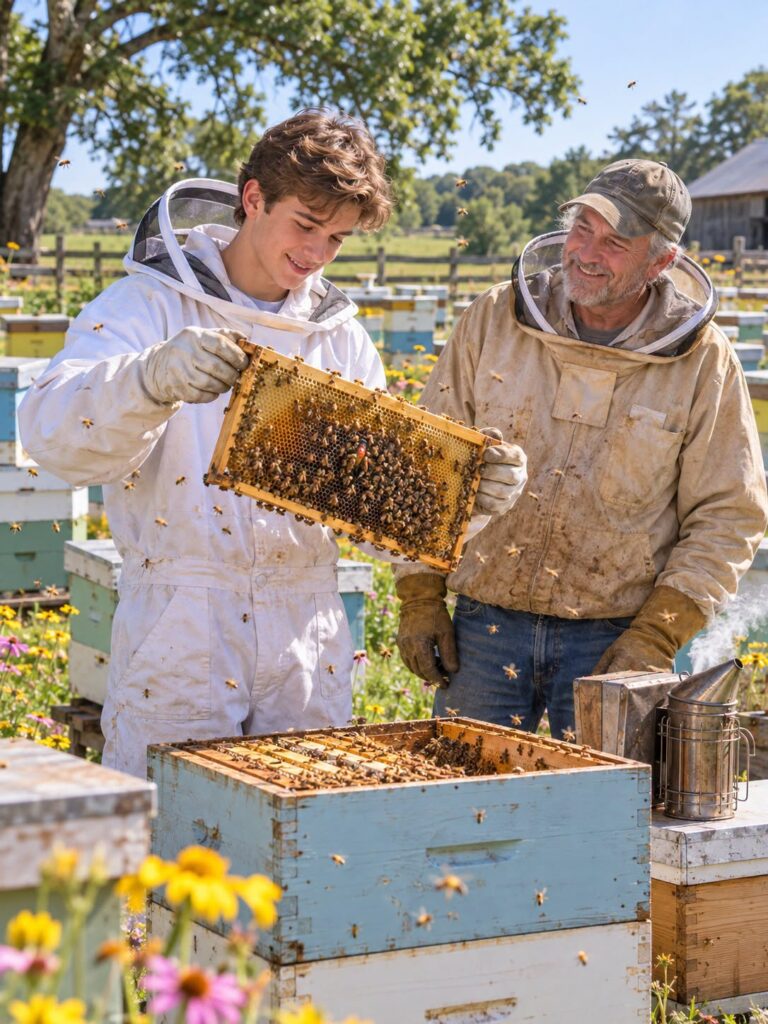
She said the school counselor mentioned Tyler seemed different lately. Calmer. Less likely to get pulled into whatever nonsense the other kids started. Said she hadn’t gotten a call from the school in almost two months, longest stretch in years, near as she could remember.
I told her I didn’t know about all that. Just knew he was good with the bees. Better than good, actually. Had an instinct for it I don’t see often. Not even in people who’ve kept bees for years.
She asked did that surprise me, given his reputation.
I told her reputations are mostly about what people expect from you. Not about what you’re actually capable of. Some kids get labeled trouble so early they never get the chance to be anything else. Not because they couldn’t. Just because nobody bothered looking past the label.
She didn’t say much to that. Just nodded, watching Tyler work a hive across the yard. Moving calm and sure among forty thousand bees that could have stung him a hundred times over, if he’d given them reason to.
By the end of summer, Tyler had worked every hive on the property at least once. Handled two swarm captures without flinching. Started asking questions that told me he’d been reading up on his own time. Things I hadn’t taught him yet. Wanted to know about queen rearing, about overwintering strategies most beginners don’t even think to ask about for years. Wanted to know why one colony built burr comb like they had something to prove and another kept everything neat as a church pantry.
His court hours finished up in August.
I asked would he want to keep coming out on weekends. Paid this time. I could use the extra hands come fall harvest. Told him the pay wasn’t much, farm rates, but it was honest work and steadier than most jobs a sixteen-year-old could find around here.
He said he’d have to check with his mom, but he figured she’d say yes.
Last Monday of his court hours, I watched him work the far row of hives by himself while I handled paperwork on the porch. Moved through six hives in about an hour. Calm and steady. No flinching, no jerky movements. Nothing left of that kid who showed up shaking at the edge of the yard back in June.
I finished my paperwork, looked up. He was already moving to the seventh hive, smoker in hand. Working it the way I’d taught him. Except better now. Except his own.
That fall, Tyler came back every Saturday.
Rain or heat, didn’t matter. He helped pull honey supers, strain wax, stack jars, and haul boxes heavy enough to make grown men complain. At the farmers market, he stood behind the table in a clean shirt, answering questions from old ladies who wanted to know whether wildflower honey was better for tea than clover. First few times, he barely spoke. By October, he was explaining nectar flow and crystallization like he’d been born with a hive tool in his hand.
One Saturday, a boy from his school walked past the booth with two other kids and laughed.
“Didn’t know you were a farmer now, Tyler.”
Tyler looked up.
For one second, I saw the old reaction move through him. Shoulders tightening. Jaw setting. That spark in his eyes that said he knew how to make a problem worse before anyone could stop him.
Then he took one slow breath.
Same way he did before opening a hive.
“Nah,” he said. “Beekeeper.”
The boys laughed and walked on.
Tyler watched them go, then turned back to a woman buying three jars of honey.
“Sorry about that,” he said. “You want light or dark?”
That was the moment I knew the bees had taught him something no lecture ever had.
Not how to be gentle exactly.
How to be steady.
There is a difference.
Winter came early that year. Cold rain first, then sleet, then a hard freeze that turned the pasture white and quiet. We wrapped hives, checked stores, reduced entrances, and did what beekeepers always do once the work is done: stood around worrying anyway.
Tyler worried more than he admitted.
He’d text me at night sometimes.
You think hive 12 has enough weight?
Or:
Wind’s bad tonight. Should we check the straps tomorrow?
I always answered.
Sometimes with real information. Sometimes with, Go to sleep.
In March, when the first warm spell came through and the bees started flying again, Tyler was there before I was. I found him standing by the fence, hands in his jacket pockets, watching the first workers come out and circle in the pale morning sun.
“Looks like most made it,” he said.
“Most,” I answered.
We lost three colonies that winter. That happens. Doesn’t make it feel any better. Tyler took it hard, especially hive 12, the one he’d worried over most. He stood beside the empty box for a long time after we opened it.
“I should’ve caught it,” he said.
“Caught what?”
“I don’t know. Something.”
I closed the hive. “You can do everything right and still lose one.”
He didn’t answer.
I said, “Bees teach you that too.”
That spring, Tyler’s school counselor called me, asking if I’d be willing to write something for his file. Said Tyler was applying to a summer agricultural program through the county extension office. I wrote that he was reliable, observant, careful under pressure, and better with living things than most adults I knew.
I didn’t mention the fight.
I didn’t mention court hours.
Those were not lies. Just old frames from a hive he no longer lived in.
Tyler got into the program.
His mother cried when she told me. Tyler pretended not to care, but he carried the acceptance letter folded in his back pocket for three days.
