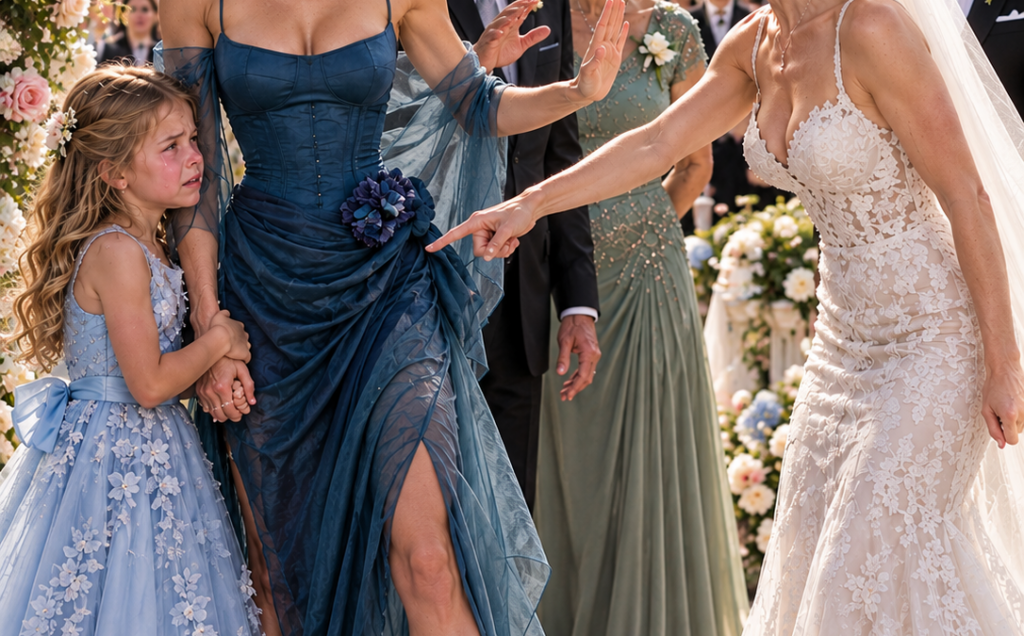
The photographer also ended his work with her. Vanessa demanded that he remove every image she considered unflattering. She threatened his business if he refused. He canceled the editing contract under its provision for abusive client behavior, kept the raw photographs in case they were needed in legal proceedings, and refunded the portion covering work he had not completed.
The original images remained intact. Vanessa could complain about how they looked. She could not make the photographer’s camera tell the story she preferred. She posted an angry review. His public response said he would not discuss a private event involving a minor. That restraint drew more attention to what she was trying to explain away.
Other guests began talking about the day. A bridesmaid said Vanessa had shouted at her before the ceremony because her nail polish was too pearly. A cousin described her insulting the catering manager in front of the staff. Grant’s aunt told my father she had nearly left before dinner, after hearing Vanessa snap at Lily twice before the family photographs.
Those accounts did not replace what happened in the courtyard. They made the familiar explanation of wedding pressure harder to use as though it answered every concern. My parents had spent years treating Vanessa’s anger as something other people needed to accommodate. Now they were encountering people who would not do it.
I learned about these developments without making them the subject of every day in our house. Lily still had evenings to get through. A public argument about her aunt was not what she needed at the dinner table.
I found a child therapist, Dr. Hannah Ellis. She wore silver-rimmed glasses and spoke gently enough that Lily could take her time answering. During the first appointment, my daughter did not want to discuss the wedding. She drew houses and cats and an enormous purple dragon. Dr. Ellis let her draw. She did not turn the pictures into an immediate demand for an explanation. I appreciated seeing an adult allow Lily’s pace to matter.
I had been giving my daughter reassurance since that afternoon in Charleston. It was difficult to accept that reassurance alone could not make the memory behave as though it had never happened. I wanted her to say she believed me when I told her she had done nothing wrong. I also knew that needing her to say it would put another expectation on her. So I took her to the appointments and let the work take the time it took.
After the second session, we were driving home when she asked whether Aunt Vanessa was going to jail. “I don’t know,” I said. “Probably not. But there will be consequences.”
She looked down for a moment. “Is Grandma mad at me?”
I found a nearby parking lot, pulled in, and turned off the engine. I wanted her to see my face when I answered. “Grandma makes her own choices,” I told her. “You did nothing wrong at the wedding, and you haven’t done anything wrong by telling what happened.”
Lily studied her hands. “She didn’t help me.”
“No,” I said. I let the answer stand before adding anything else. “She didn’t.”
I had always tried to preserve some gentler explanation of my parents for Lily. In that parked car, a gentler explanation would have required denying something she had seen herself. Her grandmother had gone toward Vanessa. Lily knew it. Asking her to overlook that would leave her alone with a memory the adults around her refused to acknowledge. I stayed beside her in the quiet. There was no sentence I could add that would make her grandmother’s decision different.
The investigation continued. An officer contacted me for a follow-up interview, spoke with the pediatrician, and asked for a copy of Nicole’s recording. I answered what I could. The photograph of Lily’s cheek, the medical documentation, and the recording described the same event from different places. My family had kept asking me to make the incident smaller. The people reviewing it were checking what had happened. Eventually, Vanessa was charged with misdemeanor assault.
The evening after the charge was filed, Dad came to my house. I saw him through the doorbell camera, standing on the porch in his navy windbreaker. He looked older than I remembered. I opened the door and left the security chain in place.
“Emily, this is getting ridiculous.” I waited. He said Vanessa had made a terrible mistake. He said I was destroying her marriage and reputation, perhaps even her career.
“Those consequences started when she hit Lily,” I said.
“She was under a lot of pressure.”
“So was my daughter.” His expression tightened. He told me I always took things too far. I held grudges. I refused to let things go.
Through the narrow opening, I could see him trying to return us to an argument we had been having in different forms for years. “When I was twelve, Vanessa cut up my science fair project because she wanted the dining table for her sleepover,” I said. “You told me to be the bigger person.”
He shifted on the porch. “When I was seventeen, she spread a rumor at school that my first-choice college had rejected me. You said she was insecure.” I did not have to search for those memories. I had spent enough time being asked to minimize them. “She announced her engagement at my baby shower. You said she was excited. Now she’s hurt my daughter, and you’ve come here to tell me my response is the problem.”
He looked at the chain, then back at me. “She’s your sister.”
“Lily is my daughter.”
He had no answer ready for that. I closed the door. Inside, I stood for a moment with my hand still on it. Dad had looked tired, and seeing him that way hurt. I had not stopped caring about him because I refused his request.
