Then I withdrew money from my retirement savings.
I didn’t resent a penny.
I thought I was protecting my granddaughter.
For seven years, I sent that money every January without asking for receipts, reviewing her needs, or questioning how it was spent.
I trusted Mark.
Or perhaps I trusted my own desperate need to believe Emma was safe.
Every other Saturday, Emma and I had our special afternoon together.
I’d pick her up, buy her ice cream at Dolly’s Dairy Bar, and take her to Riverside Park.
She always ordered strawberry swirl.
It had been Laura’s favorite, too.
I told Emma stories about her mother while we sat beneath our oak tree.
How Laura used to sing terribly off-key.
How she was afraid of geese.
How she once spent an entire summer collecting coins to buy a bicycle, then gave half the money to a classmate whose house had burned down.
Emma listened as though each memory was a precious gift.
Those Saturdays became the best hours of my life.
Then came the afternoon she asked me to stop sending money.
At first, I thought she was repeating something she’d overheard.
But when I asked why, she looked frightened.
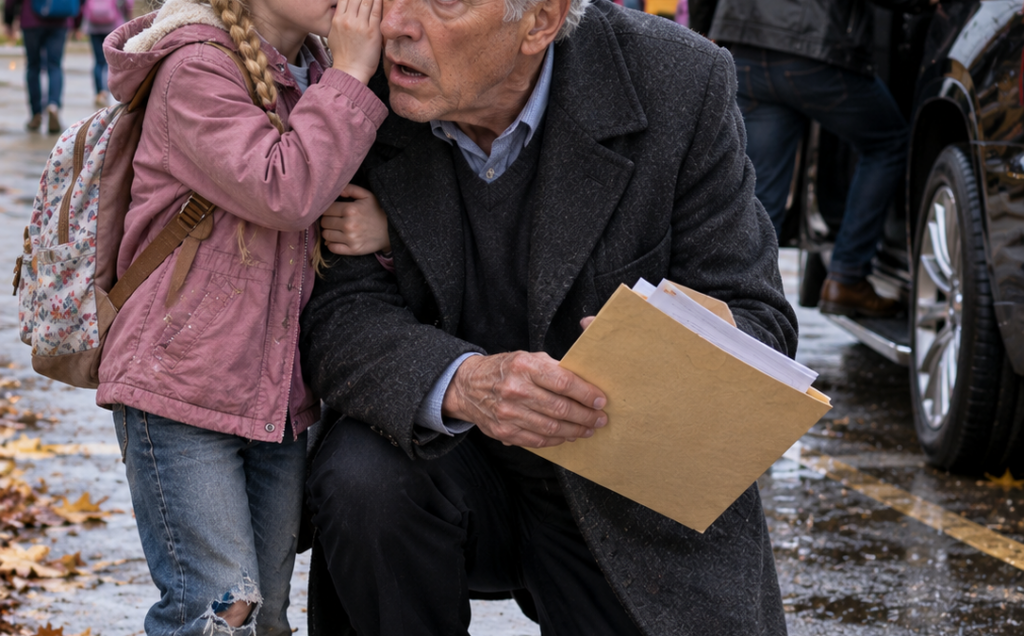
“Daddy says if you stop paying him, we’ll lose our house.”
My stomach tightened.
“He told you that?”
She nodded.
“He says if we lose the house, somebody might take me away.”
I took her hand.
“Emma, you would never be left alone. Do you understand? You always have me.”
She looked toward the parking lot again.
“He needs me, Grandpa.”
“What do you mean?”
She barely moved her lips.
“He says without me, the money stops.”
I felt something cold settle inside my chest.
“Has your father been frightening you?”
She nodded, then quickly looked down.
“I can’t tell you everything. He’ll get mad.”
“Sweetheart, you can tell me anything.”
She swallowed.
“Follow him Thursday.”
Before I could ask another question, Mark’s black pickup rolled into the parking lot.
It was almost thirty minutes early.
Emma instantly released my sleeve.
She wiped her eyes with the back of her hand and forced a smile.
Watching a seven-year-old put on a cheerful expression to hide fear is something no grandparent should ever have to witness.
Mark climbed out of his truck wearing an expensive leather jacket.
“Hey, George! How’s my favorite father-in-law?”
He laughed.
I tried to smile.
He swung Emma into his arms and kissed her cheek.
Then he looked at me.
“You feeling okay? You look pale.”
“Just getting old.”
He grinned.
“Well, take care of yourself. January will be here before we know it.”
He gave me a friendly slap on the shoulder.
I watched him drive away.
For the first time, I noticed that the tires on his truck looked brand-new.
Emma’s sneakers, meanwhile, had holes near both toes.
That night, I began remembering things I’d dismissed.
Emma had worn the same winter coat for nearly two years.
She often arrived at my store hungry.
Once, she’d asked if she could take a sandwich home for the following day because there wasn’t much food in the refrigerator.
Mark had recently purchased a fishing boat.
His girlfriend, Kristen, drove a luxury SUV.
And my granddaughter had been doing her homework without a proper desk.
The next morning, I called my oldest friend, Hank Doyle.
Hank had spent thirty-two years as an Indiana state trooper before retiring.
He knew Mark, Laura, and my family.
When I told him what Emma had said, his face changed.
“George,” he said, “there’s something I’ve wanted to discuss with you for years.”
I stared at him.
“What?”
“Laura’s accident.”
The room seemed to grow colder.
Hank explained that he’d reviewed some of the publicly available details after her death.
He hadn’t been assigned to the investigation, and he wasn’t claiming to know what happened.
But several details had troubled him.
The location.
The severe fire.
The absence of a documented forensic identification in the information the family had been given.
“Eleanor had questions, too,” he said.
I looked away.
“I wouldn’t listen to her.”
Hank leaned forward.
“George, we don’t know anything yet. But if Emma is frightened, that’s reason enough to act.”
He urged me to contact child protective services and arrange for Emma’s immediate welfare to be assessed.
He also promised to introduce me to a detective he trusted.
But before that appointment, we needed to understand what Emma meant about Thursday.
On Wednesday afternoon, I visited Mark’s house with two bags of groceries.
Kristen answered the door.
She looked surprised.
“George? Mark isn’t home.”
“That’s all right. I brought some things for Emma.”
The kitchen was cluttered with takeout containers and dirty dishes.
When I opened the refrigerator, I found beer, condiments, and almost nothing resembling a proper meal.
I put away the groceries I’d brought.
Then I went to Emma’s room.
She sat cross-legged on a narrow bed, completing homework on her lap.
The bedroom had almost no furniture.
When she saw me, her expression brightened for a second.
Then she glanced toward the hallway.
“Grandpa?”
I smiled gently.
“Just checking on my favorite girl.”
She gave me a small, frightened shake of her head.
I understood.
Not here.
Not now.
I kissed her forehead.
Then I returned to the kitchen.
“Kristen,” I asked casually, “does Mark still meet clients on Thursdays?”
Her expression tightened.
“Sometimes.”
“Where?”
“Some place out near Pine Hollow. His sister has a care home around there.”
“Gail?”
“Yeah. He goes there pretty regularly.”
I thanked her and left.
Outside, I sat in my car for several minutes, trying to steady my hands.
I knew Mark had a sister named Gail.
She was a practical nurse, or had been years earlier.
I hadn’t seen her since Laura’s funeral.
And I couldn’t explain why the thought of her suddenly frightened me.
Thursday morning, Hank and I drove toward Pine Hollow.
We weren’t there to confront anyone.
