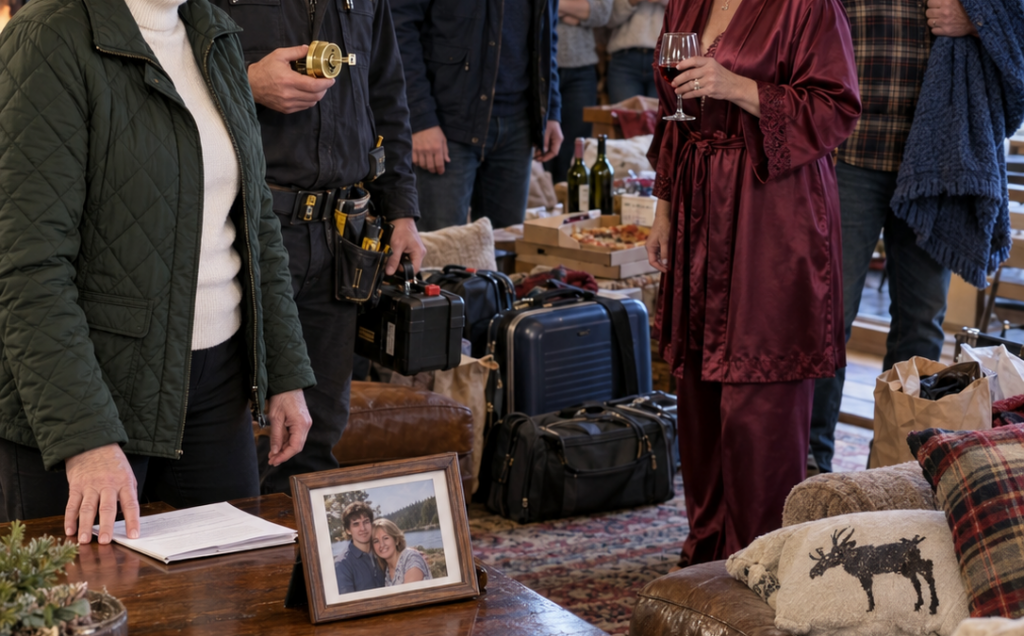
Jason stopped automatically signing documents placed in front of him.
Relatives stopped repeating Sarah’s version once Larry shared the screenshots.
For the first time, being louder did not allow Sarah to control the story.
Evidence was louder.
Three weeks later, Brenda arrived at my townhome carrying a cardboard box.
I opened the door.
Did not invite her in.
Inside the box were two wineglasses.
A linen runner.
One of my serving spoons.
And a small ceramic bird.
I stared.
The bird had sat on the cabin windowsill for years.
I had not even realized it was missing.
“I took it,” Brenda said.
“Why?”
Her mouth trembled.
“I liked it.”
She looked down.
“And I thought it wouldn’t matter.”
I lifted the bird.
One wing had a tiny chip.
My mother bought it when Jason was a baby.
“It mattered.”
Brenda nodded.
“I know.”
“No.”
I looked at her.
“You know there were consequences.”
Her eyes lowered.
“That is not necessarily the same as understanding.”
For once, she did not argue.
There was an envelope in the box.
Money for the wine.
Cleaning.
Chipped plate.
Locksmith.
I did not forgive Brenda at the door.
I also did not humiliate her.
“Thank you for returning what belongs to me.”
Then I closed the door.
That was enough.
Part 5: The cabin finally gets tenants who understand that using a home is different from claiming it
By early autumn, I rented the cabin.
A school librarian named Ellen and her husband Mark signed a two-year lease.
They asked questions before moving anything.
Requested permission before hanging shelves.
Told me immediately when a faucet began dripping.
Normal tenant behavior.
A week after they moved in, Ellen sent me a photograph.
The cherry table stood where it always had.
A bowl of apples in the center.
The blue blanket was folded across the sofa.
The ceramic bird sat again on the windowsill.
Chip and all.
The cabin looked lived in.
But it did not look claimed.
There is a difference.
Jason began coming to my townhome for dinner on Thursdays.
At first, he overcorrected.
“Can I open this cabinet?”
“Do you want me to reimburse you for the chicken?”
“Should I bring my own coffee?”
One evening, I finally put down my fork.
“You do not need to become a stranger to prove that you respect me.”
He looked embarrassed.
“I don’t know the right amount anymore.”
“The right amount of what?”
“Need.”
That stopped me.
He was afraid that asking me for anything would make him like Sarah.
I reached across the table.
“Need is not entitlement.”
He looked at me.
“Asking is not taking.”
His eyes dropped.
“What if you say no?”
“Then you hear no.”
A small smile appeared.
“That simple?”
“That hard.”
We both laughed.
The sound felt easy.
That had been missing for months.
My grandchildren visited more too.
I kept adult details away from them.
They knew their parents were living separately.
They knew the new house had fallen through.
That was enough.
One Saturday, while we were baking muffins, one of them asked:
“Grandma, will the cabin be ours someday?”
Jason was standing by the sink.
He went completely still.
I looked at the child.
“Maybe.”
A pause.
“Maybe not.”
“Why?”
“Because things are not the same thing as love.”
The child considered this.
Then reached for another blueberry.
Jason turned toward the sink and wiped his face with a dish towel.
I pretended not to notice.
That winter, Ellen sent me a photograph of snow over the dock.
Then another message.
We found something in the old table drawer.
It has your name on it.
Two days later, an envelope arrived.
My mother’s handwriting.
I sat at my kitchen table for a long time before opening it.
The letter had been written decades earlier when my parents transferred the cabin into my name.
Most of it was practical.
The loose porch board.
The downstairs pipes that sometimes froze.
Which neighbor kept an emergency key.
Then the final lines stopped me.
Do not save this place so carefully that you forget to live in it.
A house is useful while it shelters people.
It becomes dangerous when people begin believing love gives them ownership.
Leave your children whatever brings you peace, not whatever makes them expect your death.
I read the lines three times.
Then laughed while crying.
My mother never knew Sarah.
She knew people.
Part 6: My mother’s old letter makes me change an estate plan everyone had quietly assumed was already settled
When Jason came over that evening, I handed him the letter.
He read the final lines twice.
Then sat down.
“So the cabin was never supposed to prove who loved whom.”
“No.”
“What was it supposed to be?”
I smiled.
“A house.”
He laughed once.
Then wiped his eyes.
“What are you going to do with it?”
“Keep renting it.”
“And someday?”
I looked at him.
“I changed my estate plan.”
His body went still.
I expected fear.
Maybe surprise.
Maybe:
What do you mean?
Instead, he nodded.
“Okay.”
I waited.
“You don’t want to know?”
He inhaled.
“No.”
That answer gave me more peace than almost any apology he had offered.
I told him anyway.
If I still owned the cabin when I died, it could be sold.
Part of the proceeds could fund education trusts for the grandchildren.
The rest of my estate would first protect my own care.
Housing.
Health.
Independence.
No guaranteed cabin for Jason.
No promised furniture for Sarah.
No future inheritance anybody could build into a current mortgage plan.
Jason listened.
Then said:
“Good.”
I raised an eyebrow.
“Good?”
“You spent your whole life making sure you would never become a burden.”
His voice softened.
“Maybe the rest of us should make sure you’re allowed to be a person.”
I looked at my son.
I had thought boundaries would teach him to respect my possessions.
They taught him something deeper.
That I still belonged to myself.
