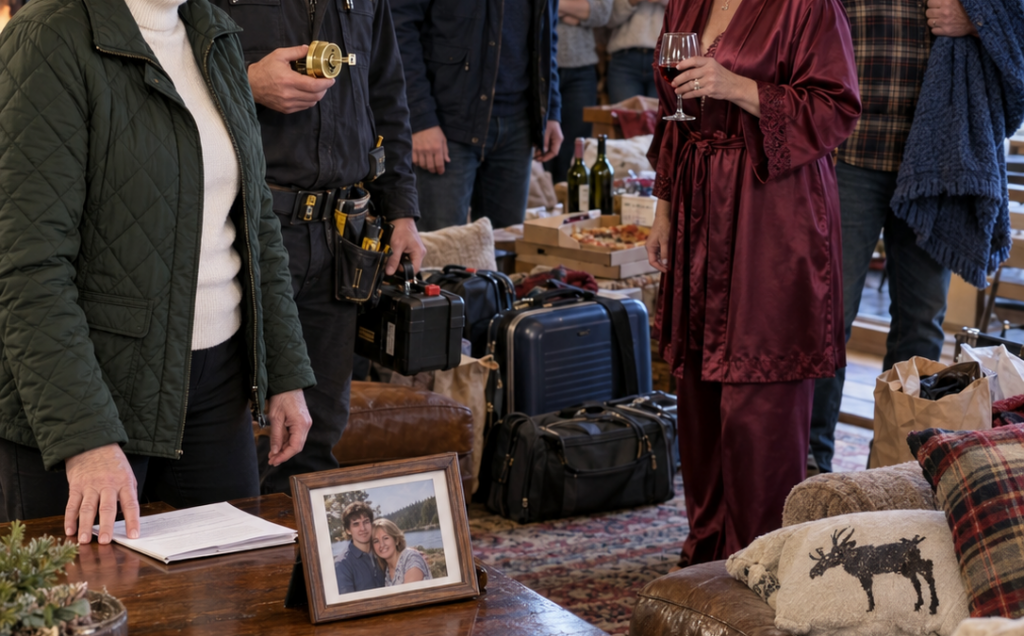
That is the part aging families sometimes get wrong.
People begin discussing inheritances too early.
Mom’s house.
Dad’s cabin.
Grandma’s jewelry.
Future money.
Eventually becomes emotionally translated into:
Our house.
Our cabin.
Our furniture.
Our money.
All while the person who owns those things is still alive.
That does something ugly to relationships.
A parent becomes an estate before becoming a person.
I did not want that anymore.
I wanted Jason to visit because he wanted to see me.
Not because he needed to remain in good standing for a future asset.
I wanted my grandchildren to enjoy the cabin if I invited them.
Not inspect it as future property.
I wanted the freedom to sell.
Rent.
Keep.
Spend.
Change my mind.
Grow older without apologizing for using the resources I had spent decades building.
Jason understood.
Maybe not perfectly.
But enough.
Part 7: The boundaries that damaged Sarah’s plans begin repairing the relationship between my son and me
The months that followed were not magically easy.
Jason was separated from his wife.
He was grieving a marriage even though he had chosen to step away.
Those two facts could coexist.
Some Thursdays he came to dinner angry.
Other times exhausted.
Sometimes he defended Sarah in small ways.
“She wasn’t always like this.”
I never argued.
Maybe she was not.
People rarely become unbearable in one afternoon.
Patterns grow.
So does tolerance.
Jason started recognizing his own contribution to that growth.
He had confused conflict avoidance with kindness.
Whenever Sarah overstepped, he tried preserving peace by asking someone else to bend.
Usually me.
If I objected, I became the difficult one.
If Sarah objected, everyone worked around her.
That system rewarded whoever created the most discomfort.
Once Jason saw it, he started noticing the same habit elsewhere.
At work.
With friends.
Even with his children.
One evening, he told me:
“I say yes too quickly.”
“You always have.”
He smiled.
“You could have mentioned that earlier.”
“I did.”
He laughed.
“Fair.”
Our relationship changed through small things.
He called without needing money.
I asked him to help move a heavy planter, and he came without treating it like proof I was dependent.
He borrowed a tool.
Returned it.
Once he asked if I could watch the grandchildren because he had an appointment.
I said no.
I had plans.
He paused.
Then:
“Okay.”
No guilt.
No questions.
No:
What plans?
No:
But I need you.
Just okay.
It sounds ridiculous that such an ordinary response felt important.
But respect often looks ordinary once you have lived without enough of it.
We began rebuilding from there.
Part 8: Years of entitlement end with one simple question at the door of a house that is finally just a house again
The following spring, I drove back to the mountains.
Not because something was wrong.
Not because anybody had taken anything.
Ellen and Mark were visiting family and had invited me to use the cabin for the weekend.
Trees were bright green.
The lake flashed through the trunks.
When I opened the front door, the house smelled faintly of cedar and coffee.
The cherry table caught the afternoon sun.
The ceramic bird sat on the windowsill.
I stepped onto the porch.
Listened to the water.
A few minutes later, a car came up the gravel drive.
Jason got out.
Two grocery bags in his hands.
I had invited him.
That mattered.
He did not have a key.
That mattered too.
He climbed the porch steps.
Stopped at the doorway.
Then asked:
“Can I come in?”
I smiled.
“Yes.”
He lifted the bags.
“I brought dinner.”
“What kind?”
“The kind you don’t cook.”
“My favorite.”
We ate at the old cherry table.
The same table Brenda had photographed as possible future furniture.
The same table where strangers had left pizza boxes.
Now Jason and I argued about whether the bread needed more butter.
Nobody mentioned wills.
No discussion of property.
No inheritance.
He told me about work.
I told him about my garden club.
Later, we carried tea onto the porch.
The lake changed from blue to charcoal.
Frogs called from the reeds.
My blue blanket rested over my knees.
For a long time, neither of us spoke.
The silence felt comfortable.
Jason finally looked at the cabin.
“Mom?”
“Yes?”
“I used to think this place meant you would always take care of me.”
I waited.
He turned toward me.
“Now I think it means you taught me how to take care of myself.”
My throat tightened.
I reached across the space between our chairs.
Took his hand.
His fingers closed around mine.
No promises.
No debt.
No future ownership.
Just a mother and her son beside a quiet lake.
In a house that belonged to one of us.
During a moment that belonged to both.
That was what Sarah and Brenda had never understood.
Ownership did not make me love Jason more.
Changing the estate plan did not make me love him less.
Property was property.
Love was love.
Need was not entitlement.
Asking was not taking.
And hearing no did not mean rejection.
The cabin eventually taught all of us something I wish we had understood earlier.
You can share a home without surrendering it.
Help someone without owing them every future favor.
Love your children without planning your death around their expectations.
You can be generous and still own the word no.
I once believed keeping peace meant avoiding conflict.
Now I know peace built on one person’s silence is not peace.
It is permission.
The morning I found Brenda drinking my wine, she believed I had interrupted her stay.
By the time I returned with the locksmith, she understood whose house it was.
But that was only the surface lesson.
The deeper one took longer.
Jason learned that silence is still a choice.
Sarah learned that intended gifts are not possessions.
Brenda learned that liking something does not make it hers.
And I learned that protecting my independence did not make me selfish.
