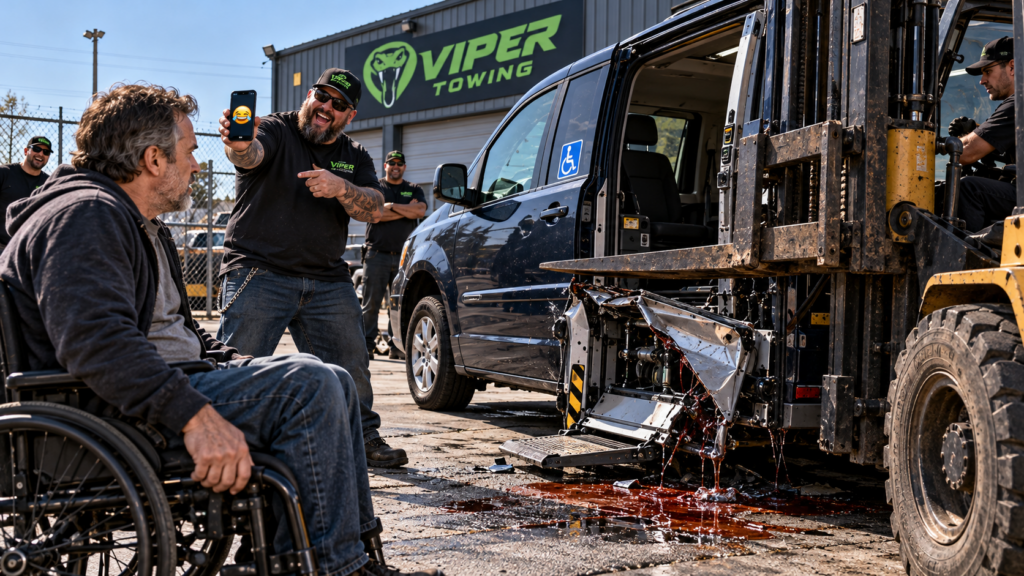
At 6:12 on an October morning, I looked down from my apartment balcony and saw an empty handicapped parking space.
My van was gone.
Not just any van.
A dark-blue Ford Transit built around my wheelchair, my hands, and the fact that I could no longer simply climb into another vehicle and drive away.
Lowered floor.
Zero-effort hand controls.
Electronic wheelchair lock.
And an eighty-thousand-dollar hydraulic side lift that represented more money than I had once put down on a house.
Without that van, I wasn’t inconvenienced.
I was trapped.
My name is Arthur Pendleton. Years earlier, a spinal cord injury put me in a wheelchair. I learned to rebuild my life around ramps, transfer boards, accessible entrances, and the constant calculation of whether the next place I needed to go would actually let me get through the door.
The van changed that.
It gave me independence back.
And at 3:14 that morning, somebody stole it.
I knew the exact time because I had a security camera pointed toward my parking space.
When I pulled up the recording, a matte-black tow truck with neon-green flames backed into frame.
The company name on the door was impossible to miss.
VIPER TOWING.
The driver never walked around the van.
Never checked the dashboard.
Never examined the disability placard hanging clearly from the rearview mirror.
He dropped the wheel lift under the rear tires and pulled away.
My Transit was front-wheel drive.
It was locked in park.
On the video, the front tires stayed frozen while the truck dragged them across the asphalt.
The microphone captured the sound.
Rubber screaming.
Metal straining.
Then a violent pop from somewhere beneath the front end.
I called police.
An officer eventually arrived, watched part of the footage, and told me towing disputes were often handled as civil matters unless there was clear evidence of criminal conduct.
He gave me an incident number and suggested I contact the tow yard.
That answer did nothing to solve my immediate problem.
Accessible rides were scarce.
I finally paid seventy-five dollars for a specialized shuttle to take me to the industrial outskirts of Albuquerque.
Viper Towing sat behind chain-link fencing topped with barbed wire.
Through the fence, I spotted my Transit.
Its front end sat strangely low.
The man running the place introduced himself as Chuck Vance.
Everybody called him Big Chuck.
He was broad, tattooed, grease-stained, and amused by everything I said.
“Apartment manager ordered a sweep,” he told me. “No resident sticker, vehicle gets hooked.”
“My disability placard was visible.”
“My driver didn’t see it.”
“You dragged a front-wheel-drive van in park.”
Chuck shrugged.
“Sounds like something for your insurance.”
Then he told me the release fee was fifteen hundred dollars.
Cash.
I stared at him.
“That’s not happening.”
His smile vanished.
“Then it sits here.”
I asked for the tow authorization.
He refused.
I asked for his insurance information.
He refused that too.
Then he leaned close enough that I could smell coffee and cigarettes.
“You either pay me, or storage keeps adding up. Eventually I use whatever lien rights the law gives me and deal with the vehicle from there.”
“I have video of the tow.”
“Congratulations.”
“The mobility lift alone cost eighty thousand dollars.”
He looked over at my van.
Then back at me.
“Sounds expensive.”
I told him I would challenge the tow and pursue damages.
That should have been the end of the conversation.
Instead, Chuck decided he needed to demonstrate who controlled the yard.
He shouted toward one of his employees.
“Gary! Move the blue van to overflow.”
A heavy forklift started across the lot.
My stomach dropped.
“That vehicle has a wheelchair lift under the passenger side. Do not put forks beneath it.”
Chuck crossed his arms.
Gary lowered the steel forks anyway.
They slid beneath the exact section I had warned them about.
Metal screamed.
The van jerked upward.
The aluminum lift housing folded under the weight.
A hydraulic line burst.
Red fluid sprayed beneath the passenger door and spread across the concrete.
I shouted for them to stop.
They didn’t.
The forklift carried my van several yards, then lowered it far too quickly.
The Transit hit the ground with a crash hard enough to rock the suspension.
Something inside the lift assembly snapped.
Chuck laughed.
Not nervously.
Not accidentally.
He laughed because hurting the van had become part of winning the argument.
I sat there staring at the puddle of hydraulic fluid.
The rage went out of me.
What replaced it was colder.
Chuck pulled out his phone.
“Give me your number so I can make sure your account is updated.”
I gave it to him.
Seconds later, my phone buzzed.
Unknown number.
One message.
A laughing emoji.
I looked up.
Chuck held his own phone in the air.
“There’s your receipt.”
His drivers laughed.
“Like I said, Arthur. Sue me.”
I saved the message.
Then I photographed everything I could see from the customer area.
My damaged van.
The hydraulic fluid.
The forklift.
The employees.
The yard.
When the accessible shuttle finally returned, I left without yelling.
That night, I backed up the security footage in three places.
Saved Chuck’s text.
Saved the tow records I had.
Then I began looking for someone qualified to explain exactly what Viper Towing had done mechanically.
That search led me to Hector Delgado.
Hector specialized in adaptive vehicle systems.
When I said “Viper Towing,” he stopped talking.
Then he asked one question.
“Black trucks with green flames?”
“Yes.”
His jaw tightened.
“Chuck Vance.”
“You know him?”
“Five years ago, he towed my grandmother’s Buick from a medical plaza.”
Hector looked toward the floor.
“She was on dialysis. By the time we sorted out the notices, the car was gone.”
Then he looked back at me.
“Take me to your van.”
Two days later, Hector inspected the Transit.
He photographed the damaged transmission components.
The crushed mobility lift.
The bent structural reinforcement.
The severed control linkages.

Seine Verlobte dachte, die Demütigung des Dienstmädchens würde sie mächtig erscheinen lassen, aber sie hatte nie damit gerechnet, dass er seinen Mantel ausziehen würde.
Die Vorhänge der Terciopelo des Herrenhauses von Marchetti schlossen sich als Sudarios über dem großen Salon an und umhüllten das goldene Licht der Kristallfenster. Adeline Croft passte sich gerade dem…