Accessibility is expensive in ways most people don’t notice until somebody takes it away.
Eventually, court-supervised disposition of Viper assets began.
Hector assisted with valuation.
Public notice went out as required.
Potential buyers inspected equipment.
Tow companies showed up.
Repair shops.
Independent operators.
Fleet buyers.
Chuck’s famous black wrecker drew the most attention.
Hector stood near it during inspection day.
He didn’t touch the microphone and become some revenge-crazed auctioneer.
He didn’t need to.
A competitor from across town examined the truck and said, “Never thought Chuck would let this thing go.”
Hector answered, “He didn’t.”
Word spread.
On sale day, assets were sold through the authorized process.
The proceeds were applied according to law.
My judgment was satisfied.
Fees were paid.
Other legitimate interests were handled.
Whatever remained followed the rules rather than my emotions.
That was enough.
Viper Towing did not survive.
Without key equipment, with litigation expenses mounting and its reputation damaged, the business eventually closed.
The sign came down.
The lot emptied.
The green-flamed trucks disappeared one by one.
Chuck stopped being king of his dirt fortress.
And then something happened I hadn’t expected.
I stopped caring about him.
For months, Chuck had occupied too much space in my head.
Every accessible ride reminded me of him.
Every transfer into a shuttle.
Every time I looked at the empty parking space.
Every time somebody said, “Sorry, we don’t have an accessible vehicle available.”
Then the judgment money arrived.
I didn’t buy something flashy.
I went straight to Hector.
“I need another van.”
He grinned.
“Now that is a project worth talking about.”
We ordered a newer Ford Transit chassis and designed the conversion from the floor up.
This time, I understood every component.
The lowered floor structure.
Wheelchair docking position.
Electronic hand controls.
Secondary manual overrides.
Lift geometry.
Protection around vulnerable hydraulic components.
Hector insisted on documenting every service point so future mechanics wouldn’t have to guess what they were looking at.
Three months later, the van was ready.
Metallic silver.
Clean interior.
A new hydraulic platform that rose smoothly without a single shudder.
Hector stood outside the shop with the key fob.
“Moment of truth.”
I rolled onto the platform.
Pressed the control.
The lift raised me into the cabin.
No struggling.
No asking someone for help.
No scheduling a shuttle.
Just a soft mechanical hum.
I locked the chair into the driver position.
Placed my hand on the control.
Started the engine.
For several seconds, I didn’t move.
Hector leaned through the open door.
“You okay?”
“Yeah.”
I wasn’t.
Not exactly.
I had forgotten what independence sounded like.
Apparently, it sounded like an engine idling.
I drove around Albuquerque for almost two hours.
No destination.
I stopped for coffee simply because I could.
Went to a bookstore.
Drove toward the Sandia foothills.
Then, without planning to, I found myself heading toward the old Viper lot.
The gates were chained.
The office trailer was gone.
Dry weeds moved across the dirt.
One rectangular patch of concrete remained where my blue Transit had once sat bleeding hydraulic fluid.
I pulled onto the shoulder.
For a moment, I expected some huge emotional release.
Triumph.
Closure.
Maybe anger.
Instead, I felt tired.
Chuck had lost his business.
I had lost months of independence.
Nobody truly wins that equation.
But accountability still mattered.
Because without it, Chuck would have done the same thing to somebody else.
Maybe another disabled driver.
Maybe an elderly woman.
Maybe a young parent already choosing between rent and a release fee.
Predatory systems survive because each victim believes fighting back will cost more than surrendering.
Sometimes it does.
That’s why records matter.
My balcony camera mattered.
The parking documentation mattered.
The photographs mattered.
Hector’s appraisal mattered.
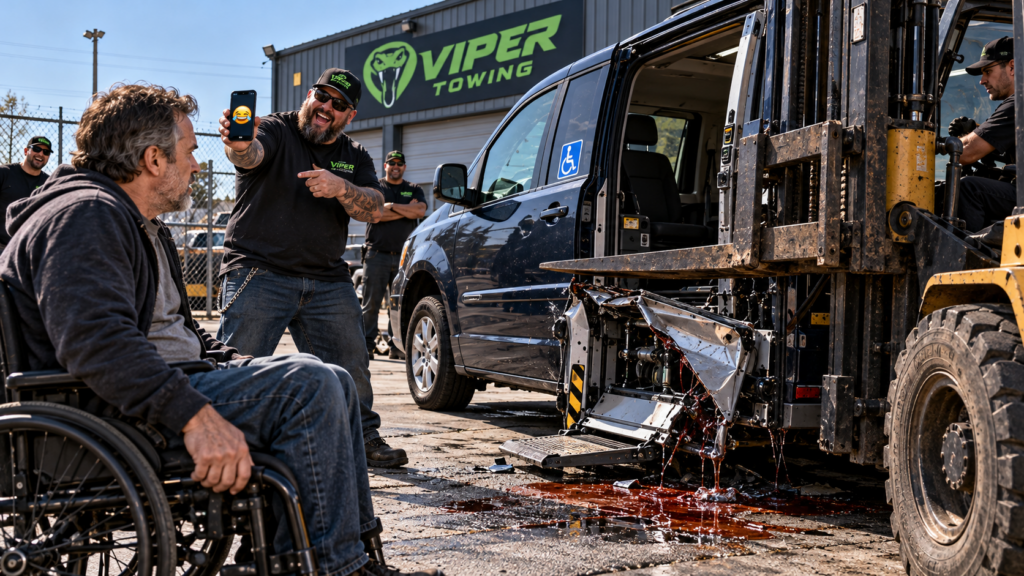
The laughing emoji mattered.
Not because one piece of evidence was magical.
Because together they made it difficult for arrogance to rewrite what happened.
I also learned something about authority.
The police officer who first responded wasn’t the final word.
Chuck wasn’t the final word.
I wasn’t the final word either.
There were procedures.
Courts.
Motions.
Judgments.
Enforcement rules.
Slow, frustrating machinery.
But machinery nonetheless.
Chuck’s biggest mistake wasn’t towing the wrong van.
It wasn’t even destroying the lift.
His biggest mistake was believing inconvenience would make me disappear.
He saw a wheelchair and assumed dependence.
He mistook dependence on accessible equipment for weakness.
Those are not the same thing.
Every wheelchair user already solves a hundred small engineering problems before breakfast.
Doors.
Curbs.
Bathrooms.
Transportation.
Reach distance.
Weather.
Battery life.
Surfaces.
People parking where they shouldn’t.
Adaptation becomes ordinary.
Chuck gave me one more problem.
A very expensive one.
So I treated it like the others.
Document.
Understand.
Find the correct tool.
Keep going.
A few weeks after getting the new van, I returned to Hector’s shop for an adjustment to the hand controls.
His grandmother’s old Buick came up.
“You ever wish you had fought Chuck back then?” I asked.
“Every day.”
“Would it have changed anything?”
He considered that.
“Maybe not.”
Then he looked at my van.
“But helping you changed something.”
That stayed with me.
Justice isn’t always getting the exact past back.
His grandmother never got her Buick.
My original Transit never became whole again.
The months without it did not return.
But Chuck’s behavior finally produced consequences.
And the next person he might have targeted never had to meet him behind that chain-link fence.
Today, my silver Transit sits in the same handicapped space outside my apartment.
I still have the balcony camera.
Actually, I installed a second one.
Some lessons are worth redundancy.
Every morning, I transfer into my chair and pass the window.
Most days, I don’t even check the parking lot anymore.
I know the van is there.
That quiet certainty is something I used to take for granted.
Not anymore.
Chuck once sent me a laughing emoji because he believed destroying my mobility equipment proved he had power.
I kept the screenshot.
Not framed.
Not displayed.
