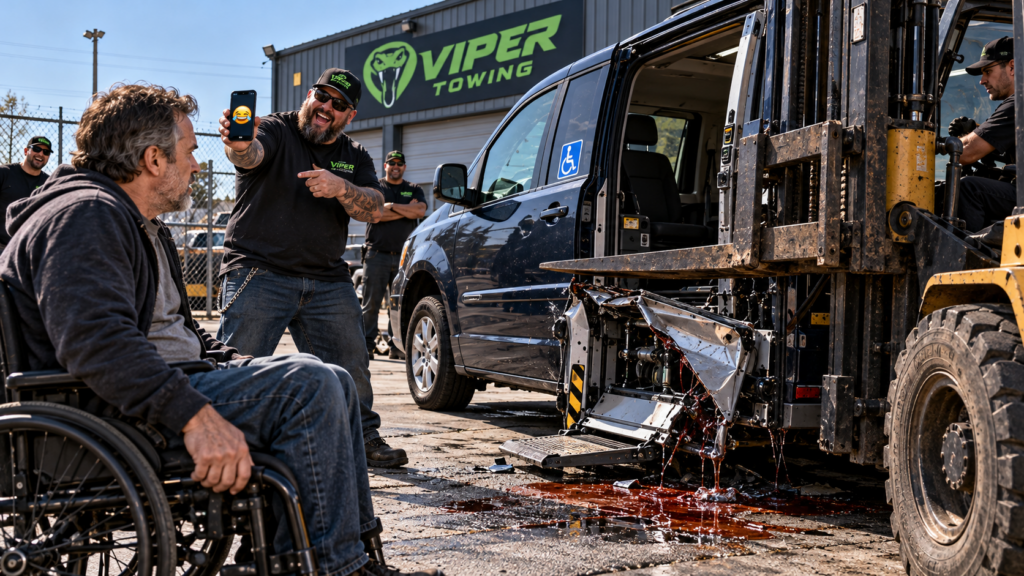
Then he crawled out from beneath the van covered in dust.
“Arthur, this is not an eighty-thousand-dollar problem anymore.”
“How bad?”
“With the drivetrain damage, lift system, structural work, controls, and proper adaptive replacement?”
He paused.
“Your van may be economically totaled.”
Chuck had wanted me to sue him.
So I did.
And thirty days later, the man who laughed while my independence leaked onto his concrete received the first piece of paper that should have scared him.
He threw it away.
That was the mistake that eventually cost him Viper Towing.
The morning of the levy was cold enough that I could see my breath as the accessible shuttle pulled onto the industrial road.
I had imagined that day too many times.
In some versions, Chuck screamed.
In others, he begged.
Sometimes I pictured myself delivering a speech so devastating that everybody in the yard stopped working to hear it.
The real thing was quieter.
And better.
A sheriff’s civil enforcement deputy named Miller met us nearby.
He reviewed the court documents one final time with my attorney’s representative and Hector, who was there as a licensed recovery and appraisal professional assisting with the inventory and disposition process.
Miller made one point very clear.
“This is not revenge.”
Nobody argued.
“We enforce exactly what the writ authorizes. Nothing more.”
That mattered to me.
Because the difference between Chuck and me had to remain larger than which side currently possessed the paperwork.
Chuck had treated authority like permission to humiliate people.
I wanted the law followed even when it benefited me.
The convoy reached Viper Towing shortly after eight.
Several trucks were still in the yard.
Employees stood near the dispatch trailer drinking coffee.
Chuck was beside the same matte-black heavy wrecker with green flames.
The moment he saw the sheriff’s vehicle, his expression changed.
Then he saw me.
The anger returned.
“You.”
Miller stepped forward before Chuck got too close.
“Mr. Vance, I’m here on a civil enforcement order issued by the court.”
Chuck pointed toward me.
“He’s trespassing.”
“No, sir.”
“This is private property.”
Miller held up the paperwork.
“And I am executing a lawful order concerning assets located on this property.”
Chuck stared at the pages.
Then he laughed.
It wasn’t the same laugh from the day he crushed my lift.
This one sounded thinner.
“Over his stupid van?”
“My stupid van?” I repeated.
Chuck looked at me.
I opened my folder.
“You were served with the lawsuit.”
He said nothing.
“You ignored it.”
Nothing.
“You were notified of the judgment.”
His jaw tightened.
“You ignored that too.”
“I don’t owe you anything.”
“The court disagrees.”
I held up the certified judgment.
“One hundred fifty thousand dollars.”
His face changed.
Just slightly.
Then he recovered.
“Good luck getting it.”
Miller answered before I could.
“That’s why I’m here.”
For the first time, Chuck looked genuinely uncertain.
The deputy explained the process.
Certain non-exempt assets identified under the writ would be inventoried and secured pursuant to the court order.
Chuck could challenge anything he believed was exempt or improperly included through the legal process.
What he could not do was move, conceal, damage, or interfere with property once it had been lawfully placed under levy.
Chuck glanced at the trucks.
“No.”
“Mr. Vance—”
“No. Those are mine.”
He moved toward the black wrecker.
Miller stepped between him and the cab.
“Do not touch the vehicle.”
Chuck stopped.
“This is my business.”
“And this is a court order.”
“You’re shutting me down over a wheelchair van?”
That sentence did something to me.
Not because it was cruel.
Because even then, Chuck still didn’t understand what he had taken.
“It wasn’t just a van.”
He looked at me.
“It was how I bought groceries without scheduling a service three days ahead. How I got to medical appointments. How I visited my family. How I went anywhere without asking somebody else to move me.”
Chuck rolled his eyes.
That told me enough.
I closed the folder.
“You never had to understand. You only had to not destroy it.”
Miller instructed the employees to remain calm while the authorized inventory proceeded.
Hector began documenting the heavy wreckers.
Flatbeds.
Forklift.
Office equipment.
Tools.
Vehicles actually belonging to Viper Towing.
Not customers’ cars.
That distinction mattered enormously.
Anything belonging to third parties was identified separately and protected from the judgment process.
Real enforcement is paperwork before spectacle.
Serial numbers.
Titles.
Ownership records.
Lien searches.
Photographs.
Asset values.
Hector was almost disappointingly professional.
Almost.
When he reached the black wrecker, he paused beside the green flames.
“This one familiar?”
I smiled.
“A little.”
Chuck heard him.
“Don’t touch my truck.”
Hector looked toward Miller.
The deputy confirmed the vehicle had been identified within the authorized levy.
Only then did Hector attach the inventory tag.
Chuck looked as though someone had punched him.
“That truck is worth more than the judgment!”
“Then the process accounts for value,” Miller said. “This is not a free-for-all.”
That was another thing the fantasy version of revenge gets wrong.
A creditor does not simply become king of somebody else’s property.
Assets are handled through procedures designed to satisfy the judgment, costs, lawful claims, and any surplus as required.
I didn’t suddenly own Viper Towing.
I held a judgment.
The law did the rest.
Chuck finally called an attorney.
I wish I could say his lawyer abandoned him instantly after hearing the facts.
He didn’t.
Lawyers do their jobs.
Chuck challenged the default judgment.
He argued improper notice.
The court reviewed the service.
It had been valid.
He argued the damage amount was excessive.
Hector’s documentation survived scrutiny.
He argued his employee—not Chuck personally—had damaged the van.
Then my attorney produced the video, witness accounts, and Chuck’s text sent immediately after the incident.
The laughing emoji looked absurd on a courtroom screen.
Yet it was probably the most expensive emoji Chuck ever sent.
His motion failed.
The levy continued.
Viper Towing could no longer operate normally with key equipment tied up in enforcement.
Chuck eventually stopped fighting every individual asset and shifted toward trying to settle the judgment.
By then, legal costs had increased.
He offered a fraction.
I declined.
Not because I needed to destroy him.
Because his offer still treated what happened as a bargaining trick.
My van had been totaled.
For months, I had depended on specialized transportation.
I missed spontaneous dinners.
Canceled appointments.
Paid fares other people never had to think about.
