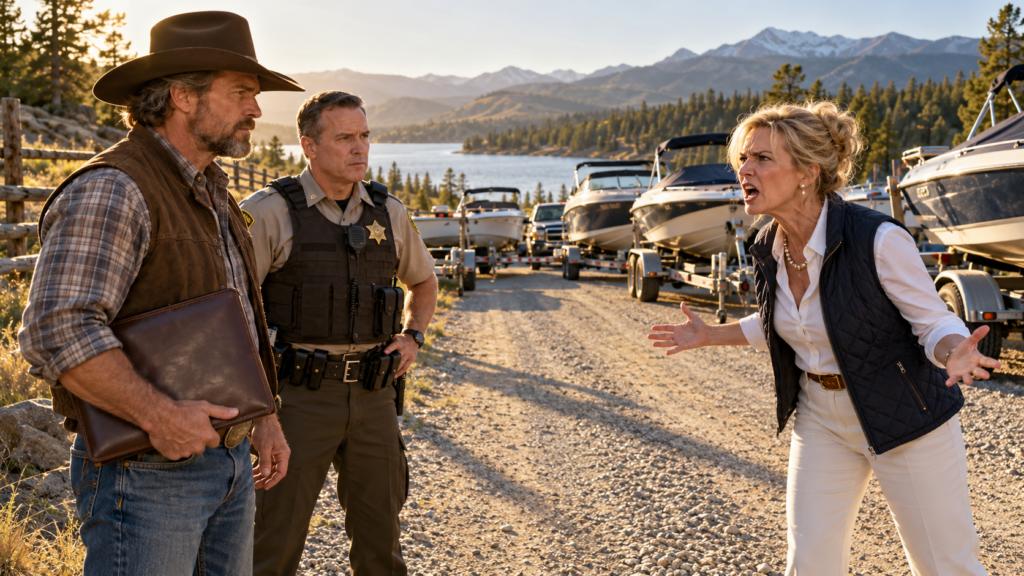
At 7:06 on the busiest Saturday of summer, two sheriff’s trucks blocked the only road leading to a $6 million marina.
Boat trailers backed up nearly half a mile.
Parents climbed out holding coolers.
Children stood beside trucks wearing life jackets.
Marina employees gathered near the fuel dock, staring toward the entrance.
And every person in that line thought I had shut them out.
I stood beside an old fence holding a leather folder.
Then HOA president Caroline Whitmore arrived.
Her white SUV hit the shoulder so hard gravel sprayed against the deputy’s truck.
“What exactly do you think you’re doing?” she shouted.
Sheriff Lucas Grant looked up from the survey spread across his hood.
“Morning, Ms. Whitmore.”
“You cannot close Harbor Point Marina.”
“No one closed the marina.”
She pointed toward the barricade.
“You blocked the only road.”
“We’re maintaining a civil standby.”
Then she saw me.
“Thomas Avery.”
I nodded.
“Caroline.”
“You need to tell them to open this road.”
“I agree.”
Relief flashed across her face.
Then I added:
“Nobody should obstruct access to property they don’t own.”
Her expression froze.
“What does that mean?”
I looked down the gravel lane leading toward the docks.
“The marina belongs to Harbor Point.”
I tapped the folder under my arm.
“The road doesn’t.”
Six months earlier, I knew nothing about any of this.
My wife had died after thirty-six years of marriage, and I wanted silence more than anything.
So I bought 8,900 acres of Kentucky pasture, timber, and shoreline several miles outside town.
I had spent thirty years investigating complex insurance claims.
Fire losses.
Property disputes.
Commercial fraud.
The job taught me one habit I never lost:
Read everything.
So before buying the ranch, I read every deed.
Every title exception.
Every survey.
Every easement.
Closing took months.
When it was done, I knew the boundaries better than most owners know their own driveways.
For the first few weeks, life was exactly what I wanted.
Coffee before sunrise.
Fence repairs.
Old barns.
Long drives across land where nobody needed anything from me.
Then I explored the eastern parcel.
A gravel road cut through my property toward Lake Hartwell.
Within fifteen minutes, I saw eight trucks towing boats.
Then a fuel tanker.
Then two golf carts.
Then a service van marked:
HARBOR POINT MARINA.
I pulled over and checked my survey.
The road sat entirely inside Parcel Nine.
My parcel.
I assumed there had to be an easement.
There wasn’t one listed in my title report.
That bothered me more than the traffic.
Over the next week, I watched the road.
Morning.
Afternoon.
Weekend.
Same pattern.
Dozens of vehicles every hour.
Everyone drove with the confidence of people who had been told they had every right to be there.
Then Caroline Whitmore found me.
She introduced herself as president of Harbor Point Estates.
“I assume the previous owner explained how the access works.”
“What access?”
She gestured toward the road.
“The marina corridor.”
“Who owns it?”
Her smile tightened.
“Harbor Point has maintained it for years.”
“That’s maintenance.”
“Our residents depend on it.”
“That’s reliance.”
“We’ve invested heavily in improvements.”
“That’s investment.”
I waited.
“Who owns the road?”
She folded her arms.
“Some things have been settled through long-standing community use.”
That answer told me more than she intended.
Because people who own property usually say:
We own it.
They don’t say:
People have used it for years.
A few days later, Harbor Point security stopped me on my own road.
The guard was polite.
Embarrassed, even.
“This route is restricted to marina members.”
“I own the land beneath your truck.”
He looked startled.
“I was told the HOA controls the road.”
“Controls or owns?”
He had no answer.
That afternoon, I received a certified HOA notice demanding that I remove survey stakes because they “interfered with community traffic.”
No deed cited.
No easement.
No recording number.
Just authority assumed on paper.
I called Sheriff Lucas Grant.
He drove out the next morning.
I showed him the title.
Survey.
Parcel map.
He studied everything.
“This looks civil.”
“It is.”
“Don’t block anything yet.”
“I wasn’t planning to.”
“Don’t remove the markers either.”
He handed the documents back.
“Let the records decide.”
That was exactly what I intended.
I hired attorney Natalie Brooks and surveyor Owen Price.
Three days later, we were inside the county records office with decades of plats spread across a table.
The road was easy.
Every legal description placed it inside my ranch.
The access rights were harder.
Finally, the county clerk found an old marina expansion file.
Inside was a temporary construction-access agreement.
Heavy equipment could cross the ranch while Harbor Point built additional docks.
Specific purpose.
Specific term.
Expiration date:
Eight years earlier.
No renewal.
No conversion to permanent use.
No later easement.
Natalie searched again.
Nothing.
Then the clerk found a proposed permanent easement.
Full survey exhibit.
Legal description.
Draft terms.
Everything except signatures.
It had never been completed.
We kept digging.
That was when the case changed.
Inside an archived planning binder was an email from a former Harbor Point treasurer.
It was dated seven years earlier.
We never finalized permanent access after the construction agreement expired. This should be resolved before the next marina expansion.
The reply came from Caroline Whitmore.
One sentence.
Do not create panic over paperwork. We have operated this way for years.
Natalie read it twice.
“She knew.”
I looked at the date.
Years before I bought the ranch.
Before she ever met me.
Before she told me the access issue was “settled.”
Harbor Point hadn’t forgotten about the missing easement.
Someone had deliberately decided not to fix it.
Natalie sent certified notice.
Forty-five days.
Produce a valid recorded easement.
Negotiate one.
Or stop using the road.
Harbor Point’s attorney responded with twelve pages about community reliance, property values, historical use, economic harm, and neighborhood expectations.
Not one recorded easement.
Then another letter.
Still nothing.
The forty-five days expired.
And Natalie circled one date on her calendar.
