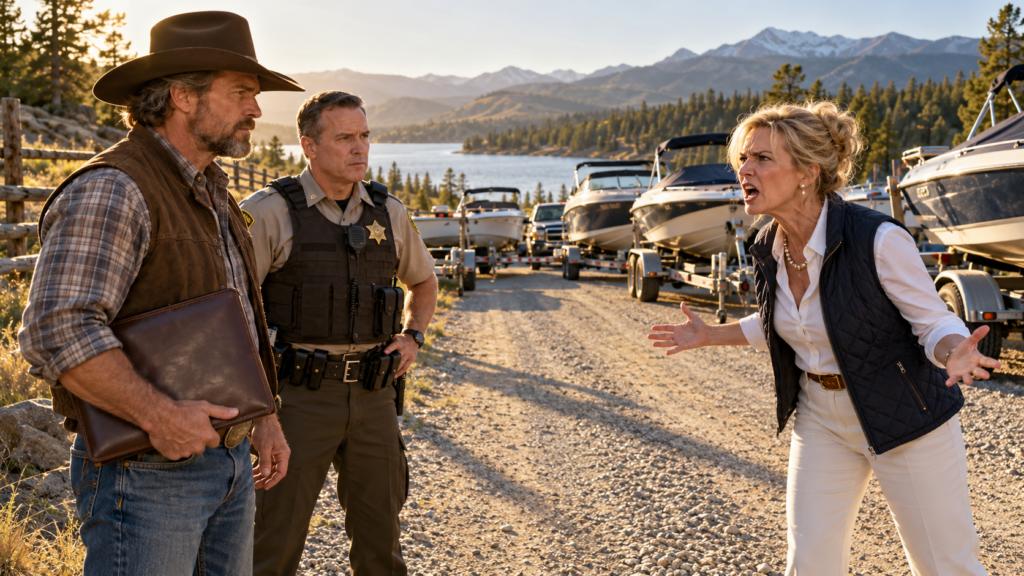
For the first time since I bought the ranch, the eastern road was silent.
No traffic.
No engines.
No marina signs.
Just wind through oak leaves.
I replaced the old entrance marker with a simple wooden sign.
PRIVATE RANCH ROAD
ACCESS BY WRITTEN PERMISSION
No legal citations.
No threats.
Nothing about Harbor Point.
The road didn’t need a speech.
The deed was enough.
Several months later, the county asked whether I would consider granting permanent emergency-only access.
I agreed.
Fire.
Ambulance.
Law enforcement.
Disaster response.
Recorded easement.
Specific language.
No residential traffic.
No commercial use.
No expansion.
That was reasonable.
Good property law isn’t about saying no to everything.
It’s about knowing exactly what you’re saying yes to.
I learned later that Harbor Point’s new board adopted similar rules.
Every property right had to be independently verified before the HOA described it in marketing or contracts.
Every easement had to have a recording number.
Every major development agreement required title review.
George joked that the new rule could be summarized in one sentence:
“If you say we own it, prove it.”
Not bad.
The ranch changed too.
I restored an abandoned barn.
Reopened two pasture fields.
Repaired the creek crossing.
Without constant marina traffic, deer returned to the eastern woods.
One morning I saw a wild turkey standing in the middle of the road where forty boat trailers might once have passed before breakfast.
That felt like winning more than anything that happened at the sheriff’s barricade.
People still tell the story differently.
Some say I “shut down” a $6 million marina.
I didn’t.
The marina survived.
Some say I discovered the HOA had stolen my road.
Not exactly.
Nobody carried the road away.
What happened was subtler.
A temporary right expired.
People kept using it.
Then everyone forgot—or chose not to remember—that temporary permission isn’t ownership.
Years of habit filled the space where paperwork should have been.
Eventually, the habit became so normal that questioning it felt outrageous.
That’s why Caroline sounded so confident the first time I asked who owned the road.
To her, years of use had become an answer.
But land records don’t care how confident someone sounds.
They don’t care how expensive the marina is.
They don’t care how many families depend on a shortcut.
They remember dates.
Signatures.
Terms.
Expirations.
And absences.
The most important page in my entire case wasn’t a dramatic court ruling.
It was the old construction agreement.
Temporary access.
Specific purpose.
Expired eight years earlier.
One ordinary page everyone else had stopped reading.
That page turned out to be stronger than a thousand assumptions.
The following summer, Lake Festival came again.
Harbor Point’s parking lot filled.
Boats launched.
Kids carried fishing rods toward the docks.
Fuel pumps ran all day.
Everything worked.
Just not through my ranch.
George stopped by that evening.
He parked outside the gate.
Didn’t enter until I waved him through.
That small gesture told me more than any apology ever could.
We sat on the porch overlooking the lake.
“Pretty quiet,” he said.
“That was the idea.”
He laughed.
Then he looked toward the new marina road.
“You know what bothers me most?”
“What?”
“We all thought somebody else had checked.”
I nodded.
“That happens a lot.”
“The developer thought the HOA had it.”
“The HOA thought the lawyer had it.”
“The lawyer thought the old records supported it.”
“The homeowners thought closing documents meant it was settled.”
“And nobody pulled the deed.”
He shook his head.
“Until you.”
I looked across the ranch.
“No.”
I smiled.
“The deed was always there.”
That was the strange part.
The truth hadn’t been hidden.
Nobody buried it.
Nobody burned it.
Nobody erased it.
It sat quietly in the county office for years.
Waiting for someone to ask the right question.
Who owns the road?
The end
Disclaimer: This content is entirely AI-generated for fictional and entertainment purposes only. Any resemblance to actual persons, living or dead, events, or locations is purely coincidental, and the creator assumes no liability for any interpretation of this content.
