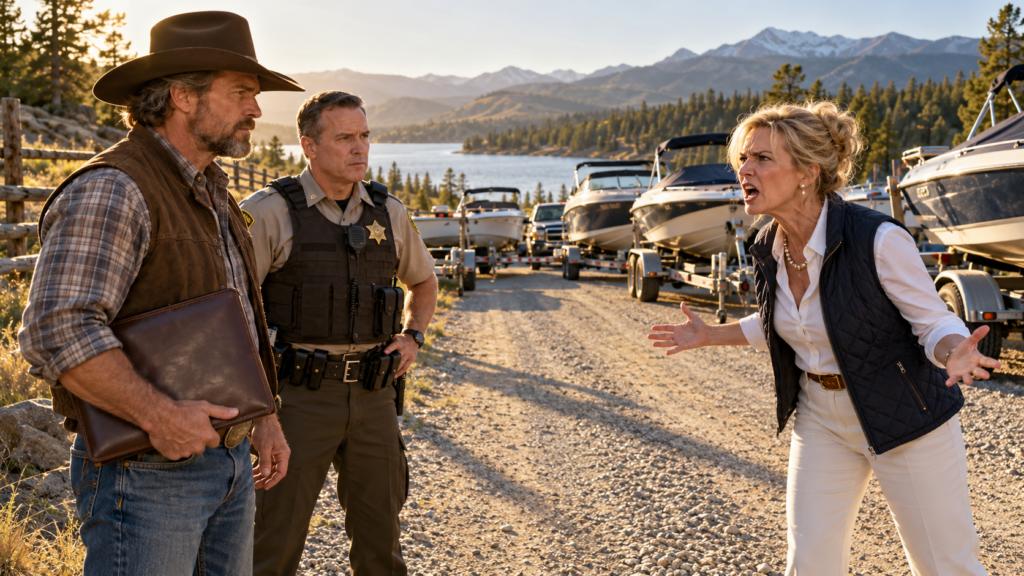
Lake Festival Saturday.
The busiest marina day of the year.
I looked at her.
“You’re sure?”
She closed the file.
“They’ve had eight years to fix this.”
At 7:06 that Saturday morning, deputies blocked the road while our surveyors marked the boundary.
And now Caroline stood in front of nearly a hundred residents, demanding the sheriff remove me from land my deed said I owned.
Sheriff Grant held up the certified survey.
“Ms. Whitmore, do you have a permanent recorded easement?”
“Our attorney handles those matters.”
“He was asked.”
She said nothing.
“He did not provide one.”
The crowd went quiet.
A man holding three fishing rods looked from Caroline to me.
“If the marina doesn’t own the road…”
He swallowed.
“Then what exactly have we been driving across all these years?”
Nobody answered.
Because that question was about to cost Harbor Point far more than one ruined Saturday.
Natalie laid the documents across the hood of my truck. Certified deed. Survey. Expired construction agreement.
County search showing no permanent easement. Homeowners moved closer. One elderly resident named George Miller picked up the temporary agreement.
“This expired eight years ago.”
“Yes,” Natalie said.
He looked at Caroline.
“Did the board know?”
“Our legal counsel has been reviewing the matter.”
George shook his head.
“That isn’t what I asked.”
Then another woman spoke.
“When we bought our house, the sales package said permanent marina access was included.”
A second homeowner nodded.
“So did ours.”
Caroline tried to regain control.
“Historical use creates rights.”
Natalie answered calmly.
“Historical use can create legal arguments under certain circumstances. It does not allow an HOA to simply declare ownership over a recorded private road.”
Sheriff Grant stepped forward.
“My office isn’t deciding civil liability today. But based on the deed, survey, and county records currently available, this roadway lies inside Mr. Avery’s property.”
That sentence changed the crowd. People stopped asking why I had closed the road. They started asking what Harbor Point had sold them.
Then George held up another paper. It was the old treasurer’s email. Natalie had decided the time was right.
He read aloud:
We never finalized permanent access.
Then Caroline’s reply:
Do not create panic over paperwork. The crowd went completely silent. Caroline stared at Natalie.
“You had no right to release internal HOA correspondence.”
George looked at her.
“You knew?”
She didn’t answer.
And that was when the marina manager walked forward carrying a folder of his own.
“I think everyone needs to see this.”
Inside was a refinancing appraisal. It valued Harbor Point Marina at more than $6 million.
One sentence was highlighted: Permanent deeded access via Avery Ranch Road. Natalie looked up.
“There is no deeded access.”
The marina manager swallowed.
“Then somebody borrowed millions of dollars against a property description that wasn’t true.”
That was the moment the dispute stopped being about me.
Until then, most Harbor Point homeowners had seen a simple conflict.
New ranch owner.
Old marina.
One road.
One stubborn disagreement.
But a $6 million appraisal changed the stakes.
If lenders had been told permanent deeded access existed when no recorded easement could be found, that raised questions far beyond weekend boating.
Natalie cautioned everyone immediately.
“An inaccurate appraisal statement does not automatically mean fraud.”
Caroline seized on that.
“Exactly.”
Natalie continued.
“But it does mean the title and financing records need to be reviewed.”
That was enough.
Within hours, homeowners were requesting documents.
Loan disclosures.
Sales brochures.
HOA minutes.
Marina contracts.
Developer correspondence.
The marina stayed closed to ordinary traffic that weekend.
Emergency services retained access under a temporary written arrangement Natalie had prepared.
Nobody was being trapped.
No ambulance was blocked.
No fire truck would be turned away.
The issue was commercial and residential traffic.
That distinction mattered because Caroline had already started telling reporters I was “holding an entire neighborhood hostage.”
By Monday morning, television trucks were outside the ranch.
I gave one statement.
“This road is private property. Harbor Point was given forty-five days to produce lawful permanent access or negotiate it. Neither happened. Emergency access remains available under written conditions.”
Then I stopped talking.
Caroline did not.
She held a press conference outside the clubhouse.
“This community has used that road for decades. One individual should not be allowed to destroy years of established expectations.”
The quote sounded powerful.
It also avoided the only question that mattered.
Where was the easement?
The homeowners’ attorneys began calling Natalie.
Not to threaten.
To negotiate.
That was when I knew the balance had changed.
The first honest proposal came from George Miller and three other residents.
They wanted temporary access while Harbor Point created a legal permanent solution.
I agreed.
Not free.
Not informal.
And not based on “tradition.”
Every term went in writing.
Fire.
Ambulance.
Law enforcement.
Fuel safety service.
Marina maintenance.
Limited homeowner access during specific hours.
No commercial expansion.
No new construction.
No claim that temporary permission created ownership.
Recorded with the county.
I signed.
The HOA’s new interim attorney signed.
For the first time in nearly a decade, people crossed my road with actual permission.
Caroline hated it.
By then, though, she was losing control of the board.
The refinancing documents became the next problem.
The marina had expanded twice after the temporary construction agreement expired.
New slips.
Fuel infrastructure.
Maintenance buildings.
Boat storage.
Each project increased the marina’s value.
Each depended on the same road.
Lenders wanted to know why appraisal reports described access as permanent.
Appraisers wanted to know what representations they had received.
Developers wanted to know which title materials had been supplied.
And title companies wanted to know why nobody recorded the easement everyone claimed existed.
The answer was messy.
Years earlier, Harbor Point’s original developer had planned to purchase permanent access from the ranch owner.
Negotiations began.
A draft agreement was prepared.
But the ranch owner rejected the price.
Instead of building another road immediately, the developer kept using the temporary construction route while discussions continued.
Then the marina opened.
