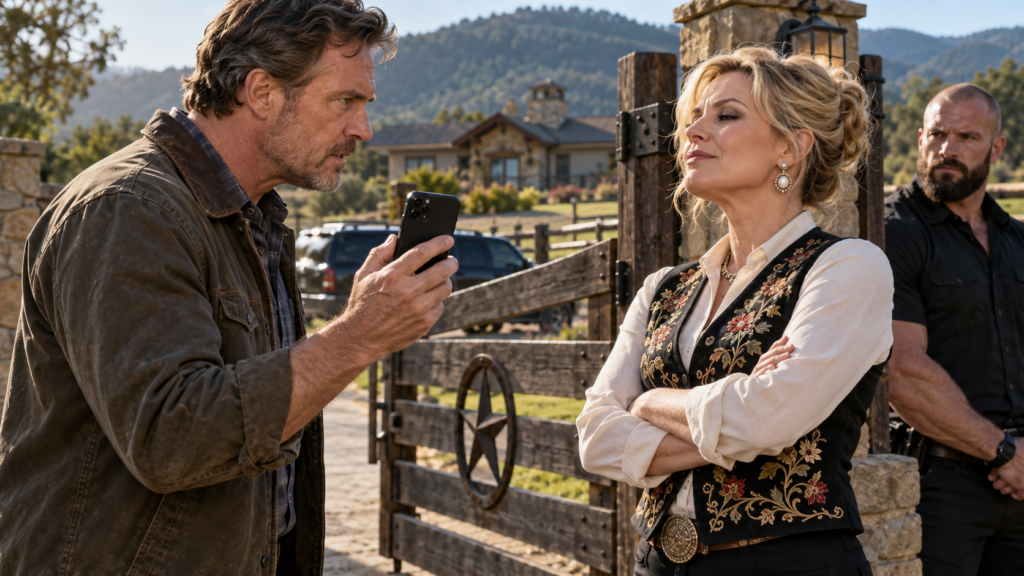
Three pickup trucks were blocking the gate to the ranch I had legally purchased three weeks earlier.
That was the first thing I saw.
The second was a woman wearing a navy vest with LAKE VIEW ESTATES HOA embroidered across the chest.
She held a clipboard in one hand and a demand for $47,000 in the other.
“You have forty-eight hours,” she told me. “After that, the association will take possession.”
I looked beyond her toward the farmhouse, the pasture, and the private dock I had just spent my entire savings to buy.
Then I looked back at her.
“Take possession of what?”
“The Morrison property.”
“My property.”
Her expression didn’t change.
“My name is Christine Gray. I’m president of Lake View Estates. The previous owner left unpaid assessments secured against this land. Until the debt is cleared, you cannot enter.”
My name is Frank Johnson.
I was fifty-one, recently divorced, and carrying almost everything I had left financially in one recorded deed inside my glove compartment.
The ranch covered forty-seven acres beside a quiet lake.
Old farmhouse.
Overgrown pasture.
Barn.
Private dock.
It needed years of work, but it had been valued near $400,000 before its previous owner went bankrupt.
I paid $183,000 cash at a court-supervised auction.
Every dollar I had.
But this wasn’t a reckless bargain.
Before bidding, I spent three months studying the title history, tax records, survey, zoning, and bankruptcy documents.
My title company confirmed the deed was clean.
No HOA covenants.
No recorded liens.
No unpaid assessments attached to the property.
Yet Christine stood in my gateway as if none of that mattered.
“Show me the lien,” I said.
“You’ll receive documentation electronically.”
“What’s the recording number?”
She glanced down at her clipboard.
“You’ll have everything within the hour.”
A muscular man standing beside one truck stepped forward.
His name tag read:
GREG NOLAN — ENFORCEMENT.
“Sir, you’re going to need to leave.”
I almost smiled.
HOAs had boards.
Committees.
Management companies.
They generally did not have men wearing homemade “enforcement” badges blocking rural gates.
“These are my premises,” I said.
Greg planted his feet.
“Not until you clear the association debt.”
I pulled out my phone.
The third person, a woman named Evelyn Watson, stepped directly in front of the camera.
“No photographs.”
“Why?”
“This is a private HOA matter.”
I studied them carefully.
Magnetic signs on personal trucks.
Cheap embroidered vests.
A president refusing to provide a recording number.
A man calling himself an enforcement officer.
Then Christine made another mistake.
“If you pay the forty-seven thousand today, we’ll issue a compliance certificate. After that, annual assessments are twelve thousand dollars, plus dock fees, road maintenance, and security.”
“Twelve thousand a year?”
“This is an expensive community, Mr. Johnson.”
Except it wasn’t my community.
I didn’t argue.
I drove backward down the road and checked into a motel six miles away.
Christine’s email arrived before I finished unpacking.
Three attachments.
A lien notice.
A demand letter.
HOA bylaws.
The supposed lien had no county recording stamp.
No instrument number.
No filing date.
Nothing tying it to the recorder’s office.
The demand letter came from someone named Raymond Voss, identified as legal counsel for Lake View Estates.
He claimed the HOA’s lien survived the bankruptcy sale and warned that entering the ranch could expose me to criminal trespass charges.
Then I reached the payment instructions.
They didn’t direct money to Lake View Estates.
They directed $47,000 to an LLC called Arvos Holdings.
That made me stop.
I searched Raymond Voss in the state bar directory.
No lawyer by that name.
I checked the office address.
It was a rented mailbox inside a shipping store.
Then I opened the bylaws.
They claimed Lake View Estates had been created in March 2012.
The county records I had already reviewed showed the subdivision itself wasn’t platted until 2014.
I leaned back.
One bad date could be clerical.
One strange account could be sloppy bookkeeping.
But a nonexistent lawyer, unrecorded lien, personal payment account, and HOA documents predating the neighborhood?
That was no longer sloppiness.
It looked designed.
I searched local forums.
Buried inside an old property discussion was one anonymous warning:
Be careful near the East Shore. They target foreclosure buyers. New owners get hit with fake HOA debts. Some pay. Some sell. Nobody fights because nobody knows the records.
I read it twice.
Then checked the time.
Forty-one hours remained on Christine’s deadline.
The next morning, I was waiting outside the county recorder’s office before it opened.
A clerk pulled every relevant record.
The result took less than thirty minutes.
My ranch predated Lake View Estates by decades.
It had its own parcel number.
Its own legal description.
Its own chain of title.
The subdivision consisted of twelve residential lots nearby.
My property wasn’t one of them.
And there was no lien.
Not one dollar.
My title company called minutes later and confirmed the same thing.
No HOA covenant.
No assessment.
No encumbrance.
No recorded claim.
I should have felt relieved.
Instead, I felt cold.
Because if Christine knew what the public records showed, then the $47,000 wasn’t a debt.
It was a demand backed by fabricated authority.
As I left the recorder’s office, I stopped at a coffee shop and opened my laptop.
That was when I noticed Greg Nolan’s truck parked across the street.
He sat behind the wheel.
Watching me.
Not hiding.
Not pretending.
Just making sure I saw him.
I closed the laptop.
And for the first time, I understood why previous buyers might have paid.
This wasn’t only about fake paperwork.
It was about making the victim feel completely surrounded.
Then my phone buzzed.
A message from an unknown number.
They did this to me three years ago.
I used to be on the HOA board.
I have documents they don’t know I kept.
If you want to know how many properties they’ve taken, meet me tonight.
I read the last sentence twice.
Because underneath it was a name.
