Derek Murphy.
Former treasurer of Lake View Estates.
Derek met me at a public fishing pier after sunset and brought a folder he had hidden for three years. Inside were emails showing Christine Gray and Raymond Voss discussing foreclosure and bankruptcy properties bordering Lake View Estates before new buyers even arrived. One spreadsheet listed seven targets, amounts demanded, payments received, and whether each owner had eventually sold.
Two names matched people I had already found. Elena Ruiz had paid more than $30,000 before selling her cabin at a loss. Howard Finch had paid $19,000 before hiring a lawyer and forcing the group to back off. Both still had wire receipts, demand letters, and copies of the same fake lien language used against me.
Derek explained that Lake View Estates itself was real but tiny—only twelve legitimate members. The fraud allegedly operated around it. Christine used her title to create credibility, Raymond drafted documents and controlled shell companies, while Greg and Evelyn handled confrontations and witnesses.
I took everything to the state consumer-fraud office and the county sheriff. They warned me not to stage my own sting or put myself in danger, but they accepted the records and opened a formal review.
Then Christine called.
My deadline had expired.
The $47,000 demand was now $52,000 because of a “late processing fee.”
I told her I wanted to settle and asked for an in-person meeting at the ranch.
She agreed immediately.
“Bring a cashier’s check,” she said. “Raymond will prepare the documents acknowledging HOA authority.”
That was exactly what investigators wanted preserved.
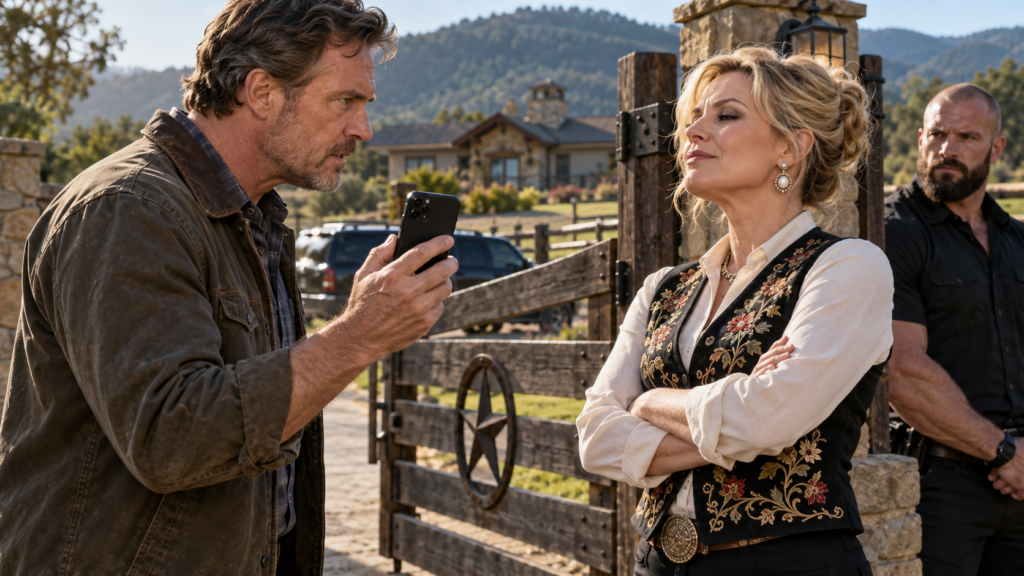
The next morning, Christine arrived with Raymond, Greg, Evelyn, and a folder of papers requiring me to admit that Lake View Estates governed my ranch.
I opened the first page.
Then I asked Raymond one question.
“Show me where my parcel appears in your recorded covenants.”
And for the first time, the man pretending to be their lawyer stopped smiling…
Raymond Voss recovered quickly.
Men like him usually do.
He adjusted his jacket and gave me the patient expression of someone explaining something complicated to a child.
“Mr. Johnson, the legal relationship here is broader than a line on a subdivision plat.”
“Then show me the document.”
“The community has operated as one integrated property area for years.”
“That wasn’t my question.”
Christine stepped closer.
“We’re not doing this again.”
I held up the paper they wanted me to sign.
“This says I acknowledge that my ranch is subject to Lake View Estates covenants. I checked the recorded declaration. My parcel isn’t there.”
Raymond’s smile thinned.
“You’re focusing on technicalities.”
“Property boundaries are a technicality?”
“Governance evolves.”
I almost laughed.
We were standing beside a forty-seven-acre ranch that existed decades before his twelve-lot subdivision.
Nothing about that required creative interpretation.
I pointed to the settlement language.
“If I don’t sign?”
Christine answered immediately.
“Then enforcement continues.”
“What enforcement?”
“Collection.”
“Against a property with no recorded HOA obligation?”
Greg shifted beside her.
Raymond raised one hand.
“Let’s keep this professional.”
“I am.”
I looked directly at him.
“Are you a licensed attorney?”
That was the first question he truly disliked.
“I provide legal consulting.”
“That’s not what your letter says.”
“My role with the association includes legal document preparation.”
“Are you admitted to the state bar?”
Silence.
Christine interrupted.
“This has nothing to do with your debt.”
“It has everything to do with the letter demanding I wire money based on legal claims.”
Raymond leaned toward me.
His voice dropped.
“You’re making this far more difficult than it needs to be.”
“How?”
“By pretending the county records are going to protect you from practical reality.”
There it was.
I let him continue.
“This community has relationships,” he said. “People know us. Contractors know us. Local residents know us. They don’t know you.”
“I own the property.”
“On paper.”
The phrase hung between us.
On paper.
I looked toward the farmhouse.
“That paper is called a deed.”
Raymond’s expression changed.
“Listen carefully. People like you come in from somewhere else, buy distressed properties, and assume the auction wipes away every obligation. It doesn’t.”
“Then record your claim.”
“We don’t need to prove everything to you before enforcement.”
“You’re demanding fifty-two thousand dollars.”
“And we’re offering you a way to resolve it.”
Christine folded her arms.
“Sign the acknowledgment. Make the initial payment. This ends today.”
I turned another page.
The document not only acknowledged HOA authority.
It also stated that I accepted all prior assessments as legitimate and waived any claim relating to access restrictions imposed before settlement.
They weren’t settling a debt.
They were trying to manufacture evidence that the debt had ever existed.
I looked at Raymond.
“One last time. Can you identify any recorded covenant, deed restriction, lien, or annexation placing Morrison Ranch inside Lake View Estates?”
His jaw tightened.
“No.”
Christine turned sharply.
“Raymond.”
He ignored her.
Then he added something more damaging.
“Recorded jurisdiction isn’t the only leverage that matters.”
The conversation ended soon afterward.
I didn’t sign.
I didn’t hand anyone a check.
And because the state investigators had already instructed me to preserve any communications rather than provoke or entrap anyone, I simply gave them the documents and notes from the meeting.
The group left angry.
This time they did not block the gate.
THE PEOPLE WHO PAID
The investigation expanded slowly.
Much more slowly than internet stories make these things sound.
Nobody was handcuffed ten minutes after an incriminating sentence.
The sheriff’s office interviewed witnesses.
The state consumer-protection division subpoenaed financial records.
The bar’s unauthorized-practice unit reviewed Raymond’s correspondence.
The county examined recorded documents.
That took weeks.
During that time, I finally moved into my house.
It smelled like dust and old wood.
The kitchen cabinets sagged.
One upstairs window leaked during rain.
The porch needed new supports.
I loved it.
Every morning I walked to the lake with coffee.
Every evening I fixed one more small thing.
For the first time since the auction, I began believing the ranch might actually become the second chance I had bought.
