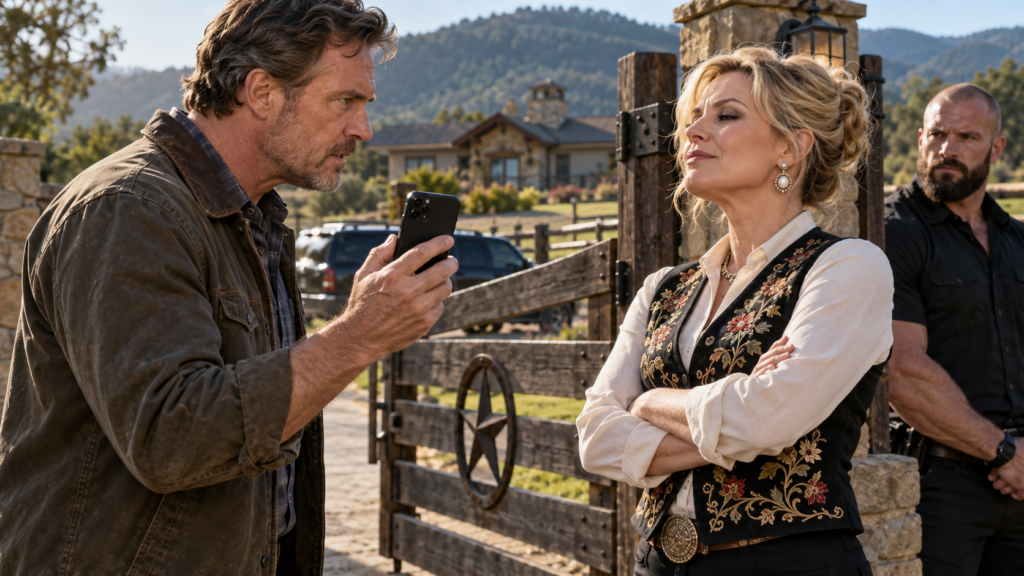
Then Elena Ruiz came to visit.
She stood beside the dock looking across the water.
“This is what mine looked like,” she said.
“Your cabin?”
“Smaller.”
She smiled sadly.
“But it had the same feeling.”
I knew what she meant.
Quiet.
Space.
The dangerous belief that you had finally found somewhere nobody could push you around.
Elena had paid Christine’s group repeatedly.
First $22,000.
Then additional “legal fees.”
Then penalties.
By the time she stopped, she had transferred more than $30,000.
Her bank records showed payments to companies associated with Raymond.
Months later, under pressure and exhausted financially, she sold the property.
A company connected through business records to one of Raymond’s associates purchased it below market value.
Howard Finch’s experience looked similar but ended differently.
He paid once.
Then hired an attorney.
His lawyer discovered the HOA had no jurisdiction and negotiated repayment of part of the money.
Howard accepted a confidential settlement because he couldn’t afford years of litigation.
He regretted it.
“I didn’t know there were other people,” he told investigators.
That was how the scheme survived.
Every victim thought he was alone.
THE REAL HOA
The legitimate members of Lake View Estates had another shock coming.
Most knew almost nothing about what Christine had been doing outside the subdivision.
Their HOA really existed.
They legitimately paid dues.
They had a private road, landscaping, and a small common shoreline area.
Christine used that real organization as camouflage.
When the state requested financial records, legitimate homeowners learned that outside “collection matters” had been conducted in the HOA’s name without being clearly reflected in the ordinary member reports.
One resident named Susan Keller called me.
“I owe you an apology.”
“You don’t know me.”
“Exactly.”
She explained that Christine had described me at a board meeting as a speculator trying to steal association property through a bankruptcy sale.
Several homeowners believed her.
Why wouldn’t they?
Christine had been president for years.
She carried binders.
Quoted rules.
Used legal vocabulary.
Presented Raymond as counsel.
Confidence had done most of the work.
Susan asked:
“Is your property actually outside our subdivision?”
“Completely.”
“We saw a map showing it inside.”
I wasn’t surprised.
“Ask the county for the recorded plat.”
She did.
Then other residents did.
The board scheduled an emergency meeting.
Christine refused to resign.
She insisted the state investigation was harassment inspired by me.
She said Raymond had always served only as a “consultant.”
Then Derek Murphy walked into the room.
According to Susan, the reaction was immediate.
Derek had disappeared from HOA affairs years earlier.
Christine once told residents he left because of personal problems.
Now he carried original meeting files, emails, and copies of financial records.
He didn’t give a dramatic speech.
He simply told them why he resigned.
“I believed people were being charged money we had no right to collect.”
THE FOLLOWING THE MONEY
Financial records mattered more than arguments.
Investigators traced payments from previous property owners into several accounts.
Some had clear legitimate connections to Lake View Estates.
Others did not.
Arvos Holdings appeared repeatedly.
So did two additional LLCs linked through business filings, banking records, or signatories to Raymond and people associated with him.
Investigators eventually alleged that fake or unsupported HOA claims had been used to obtain payments from multiple outside property owners.
That was the heart of the case.
Not whether Christine was unpleasant.
Not whether Raymond sounded like a lawyer.
Whether people knowingly used false authority to obtain money.
My $52,000 demand became one transaction among several.
Elena’s receipts became another.
Howard’s became another.
Derek’s spreadsheet gave investigators a roadmap.
The photographs and warning slipped under my motel door mattered too, especially after surveillance images from businesses and witness statements helped establish who had been monitoring some of my movements.
But not every suspicious act could be proven.
That was another thing I learned.
A good case doesn’t require turning every fear into a fact.
You prove what the evidence supports.
And you leave the rest alone.
THE BOARD COLLAPSES
Lake View Estates removed Christine as president before the criminal case was resolved.
The vote wasn’t close.
Susan later became interim president.
Her first action was to send me a letter stating the obvious:
Morrison Ranch was not subject to Lake View Estates covenants.
The HOA claimed no lien.
The HOA claimed no right to block my access.
The HOA disavowed any purported collection demand issued against my ranch.
I framed that letter.
Not because it gave me rights.
I already had those.
Because it showed how far a lie could travel before someone finally forced everyone to check the starting point.
The three trucks never returned.
Neither did the magnetic HOA signs.
THE CHARGES
Months after I first found Christine at my gate, prosecutors announced charges against several people arising from the investigation.
The exact allegations differed by defendant.
Some concerned fraudulent representations.
Some concerned attempted collection of money through unsupported claims.
Raymond also faced proceedings related to representing himself in ways investigators alleged crossed into unauthorized legal practice.
Nobody was sentenced simply because I said they were guilty.
They had lawyers.
They had hearings.
Evidence was challenged.
Some charges changed as the cases developed.
Eventually, plea agreements and convictions resolved portions of the matter.
Christine and Raymond faced the most serious financial consequences.
Greg and Evelyn’s roles were narrower, and their outcomes reflected the evidence tied to their individual conduct.
That felt right to me.
Justice isn’t making everyone connected to something equally guilty.
It’s sorting out who actually did what.
Civil recovery followed.
State authorities pursued restitution for documented victims.
Assets and accounts linked to the scheme became part of those proceedings.
Elena received some money back.
Not all.
Money cannot restore years.
It cannot return the exact cabin she lost.
But when she called me after receiving the first restitution payment, she cried.
“So somebody finally believed me,” she said.
I understood.
Sometimes money is only the visible part of what was taken.
THE ACCOUNT ABOVE RAYMOND
