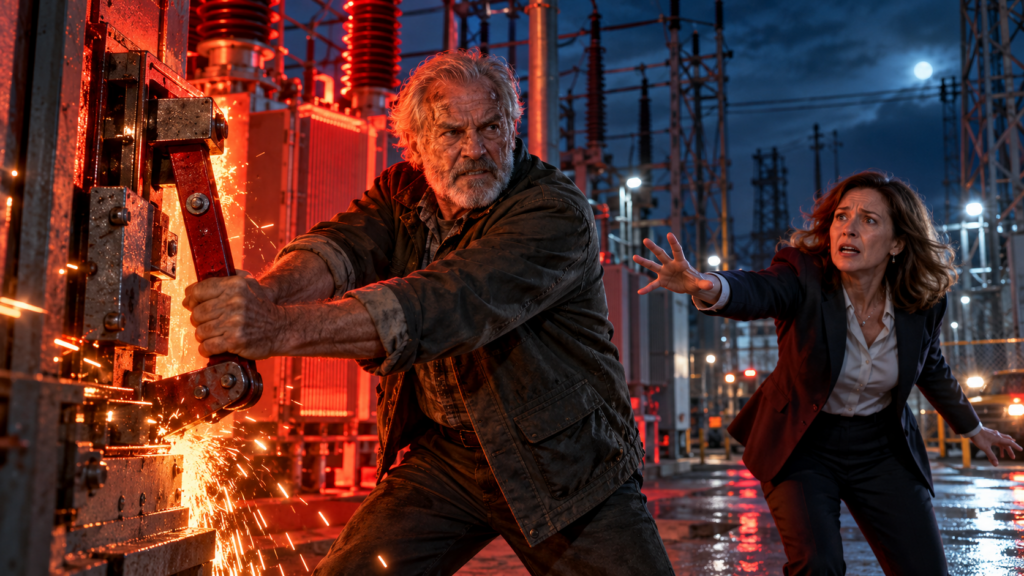
At 11:52 p.m., three of the wealthiest neighborhoods around Falcon Lake went dark.
Not dim.
Dark.
Security gates froze halfway open. Marina lights vanished. Home alarms screamed across the shoreline. Backup generators coughed to life behind million-dollar homes.
Within minutes, 911 dispatchers were flooded with calls.
And before midnight, people were already blaming me.
My name is Owen Mercer.
I was fifty-seven years old, a recently retired transmission engineer, and four months earlier I’d inherited nearly six thousand acres of Texas ranchland from my father.
By 12:20 a.m., local social media had decided I had deliberately blacked out the lake communities over a property dispute.
By 1:00, a television reporter was standing outside my ranch gate saying authorities were investigating whether “a disgruntled landowner” had intentionally interrupted electrical service.
That part was technically true.
I had interrupted it.
But not because I was angry.
I had shut the corridor down because if I hadn’t, someone could have died.
Sheriff Marcus Bell called just after one.
“Owen.”
“Marcus.”
“Half the county wants me to arrest you.”
“I figured.”
“Did you shut down the south feeder?”
“I isolated it.”
“That sounds like engineer language for yes.”
“It is.”
A pause.
“Why?”
I looked through my kitchen window toward the dark shoreline.
“Because the equipment was arcing over dry grass.”
Another pause.
“And because?”
“Because it had been overloaded for years.”
Marcus exhaled.
“You’re going to have to explain that.”
“I will.”
“When?”
“When everyone’s finished calling me a terrorist.”
The real story had started twenty-eight days earlier.
I was checking fences after a thunderstorm when my ATV headlights found a trench running through the south pasture.
Fresh.
Straight.
Machine-cut.
My father had granted a narrow utility easement across that land in 1976 for ranch pumps, barns, and two residences.
Nothing more.
Yet someone had excavated nearly four hundred yards of pasture.
Farther down the line, portable lights illuminated an active construction site.
Excavator.
Cable reels.
New switching cabinet.
Workers in reflective vests.
And a black SUV.
I asked the foreman who authorized the work.
He wouldn’t answer.
Then the SUV door opened.
Caroline Voss stepped out.
Caroline chaired the Falcon Lake Community Alliance, an umbrella organization representing three luxury developments around the water.
“What are you doing on my property?”
“Modernizing infrastructure.”
“Under whose authority?”
“The utility corridor already exists.”
“So does my deed.”
She smiled.
“The upgrades serve thousands of residents.”
“That isn’t permission.”
I pointed toward the excavation.
“Show me the easement amendment.”
Her smile faded slightly.
“Our attorneys have reviewed everything.”
“Then they can show me the document.”
No one did.
Within ten minutes, the contractors packed up.
Too quickly.
People with valid permits don’t usually flee a jobsite because the landowner asks to see paperwork.
Before leaving, Caroline stepped close enough that only I could hear her.
“You don’t understand how interconnected this system is.”
“My father taught me to understand one thing first.”
“What?”
“Who owns the ground.”
That night, I opened his office.
My father, Harold Mercer, had saved everything.
Survey maps.
Utility agreements.
Repair logs.
Inspection notices.
The original easement was exactly where I expected.
Purpose: limited agricultural electrical service.
No high-capacity distribution.
No commercial transfer equipment.
No authority to widen or materially modify the corridor without written approval from the landowner.
There was no later amendment.
The next morning, I called Ray Sutton, a retired transmission technician who’d worked with me for decades.
We walked the corridor with thermal and electromagnetic equipment.
The readings bothered him immediately.
“This line is carrying way too much load.”
“For one ranch?”
“For fifty ranches.”
We followed it toward the lake.
New concrete pads.
Modern switching cabinets.
Oversized conduit.
Cooling systems running continuously.
None appeared in my father’s records.
Then Ray stopped beside a transformer hidden among cedar trees.
“Owen.”
“What?”
“This isn’t ranch service.”
“What is it?”
“Regional distribution.”
I looked toward Falcon Lake.
Three luxury developments sat around the shoreline.
Lakeside Hills.
Juniper Point.
Canyon Harbor.
All built over the previous fifteen years.
I suddenly understood why Caroline had said the system was interconnected.
My father’s agricultural easement had quietly become the backbone for three entire neighborhoods.
Without legal authority.
I hired land-rights attorney Sarah Keene.
She told me not to sue.
“Not yet.”
“Why?”
“Because they’ll expect a lawsuit.”
She tapped the easement.
“They won’t expect regulators.”
We sent identical evidence packets to the state utility commission, the electric cooperative, county land-use officials, and wildfire authorities.
Then Caroline called.
She offered me seven figures to “formalize” the corridor.
I refused.
She increased the number.
I refused again.
Finally she said, “Thousands of people depend on this line.”
“Then somebody should’ve secured the legal right before building it.”
Three days later, the cooperative requested immediate access to inspect the corridor.
State investigators followed.
Their first conclusion was worse than I expected.
Not only had the corridor been expanded without proper recorded authority—
the system was overheating.
One investigator rested a thermal camera against a switching cabinet.
The display glowed red.
“Demand isn’t dropping at night anymore.”
Ray looked at me.
“That means there’s no recovery cycle.”
Then came the heat wave.
One hundred five degrees.
Every pool pump running.
Every air conditioner fighting Texas summer.
EV chargers.
Boat lifts.
Marina systems.
The corridor grew hotter every day.
And instead of stopping construction, someone tried something desperate.
At 12:18 a.m., my security cameras activated.
New crews had entered the south pasture.
More cable.
More trenching.
Temporary switching equipment.
A bypass.
Caroline was there.
I called the state investigator.
Then the sheriff.
By the time we reached the site, a transformer was already groaning under load.
Tiny blue arcs flashed across an insulator.
The state engineer stared at the thermal display.
“Everyone back.”
Caroline protested.
“If you stop this work, those neighborhoods could lose power.”
The engineer looked at her.
“If we don’t stop it, they could lose more than power.”
The next afternoon, record demand pushed the system beyond its safe range.
An alarm sounded from the monitoring trailer.
