Rachel laughed without humor.
“So they waited until it became more expensive.”
“That’s one way to put it.”
We stayed until the last daylight disappeared.
Below us, fresh grass covered much of the area where the unauthorized corridor had been removed.
If you hadn’t known what was there, you’d never guess.
That bothered me sometimes.
People assume dangerous things look dangerous.
They don’t.
The overloaded transformer had stood behind cedar trees.
The illegal feeders were underground.
The misleading easement claims lived in binders.
The financial decisions lived in spreadsheets.
The system looked peaceful right up until the night it started arcing.
My father understood that better than I did.
When we finally cleaned out his office, I found another note in the old utility folder.
Not legal language.
Just handwriting.
Systems fail quietly before they fail loudly.
Ask what changed.
Harold had written it decades earlier.
Probably about a broken pump.
But it fit.
Three neighborhoods didn’t go dark because one rancher got angry.
They went dark because every earlier warning had been quieter than the consequences of listening to it.
Replacing the corridor would have delayed development.
So it waited.
Obtaining legal easements would have cost money.
So they waited.
Admitting the existing system was overloaded might have scared lenders.
So they waited.
Eventually physics stopped waiting.
The ranch recovered.
The pasture was reseeded.
Fence lines repaired.
The south corridor returned almost entirely to its original agricultural use.
One narrow legal utility strip remained, serving exactly what the 1976 agreement allowed.
Water pumps.
Barns.
The house.
Nothing more.
Sarah asked once whether I wanted the easement removed entirely.
“No.”
“After all this?”
“It still serves the ranch.”
She nodded.
“You’re more reasonable than people said.”
“Low bar.”
She laughed.
The three neighborhoods survived too.
Home values recovered.
Nobody abandoned the lake.
The new HOAs published infrastructure budgets publicly.
Emergency gates received mechanical overrides.
Backup power requirements changed.
Medical-response planning improved.
The blackout became something residents hated remembering but couldn’t afford to forget.
Caroline eventually sold her home.
I saw the moving truck from across the lake.
No celebration.
No satisfaction.
By then, she barely mattered to me.
She hadn’t created every problem.
She had simply become the person most committed to keeping the problems hidden long enough to finish one more deal.
What mattered was that the hiding stopped.
Today, when I stand on the ridge after dark, Falcon Lake shines again.
Three neighborhoods.
Hundreds of homes.
Marinas.
Streetlights.
All fed by infrastructure built where it belongs.
Legally.
Safely.
With every easement signed before construction.
Sometimes people still call me the man who blacked out Falcon Lake.
I don’t correct them.
Technically, they’re right.
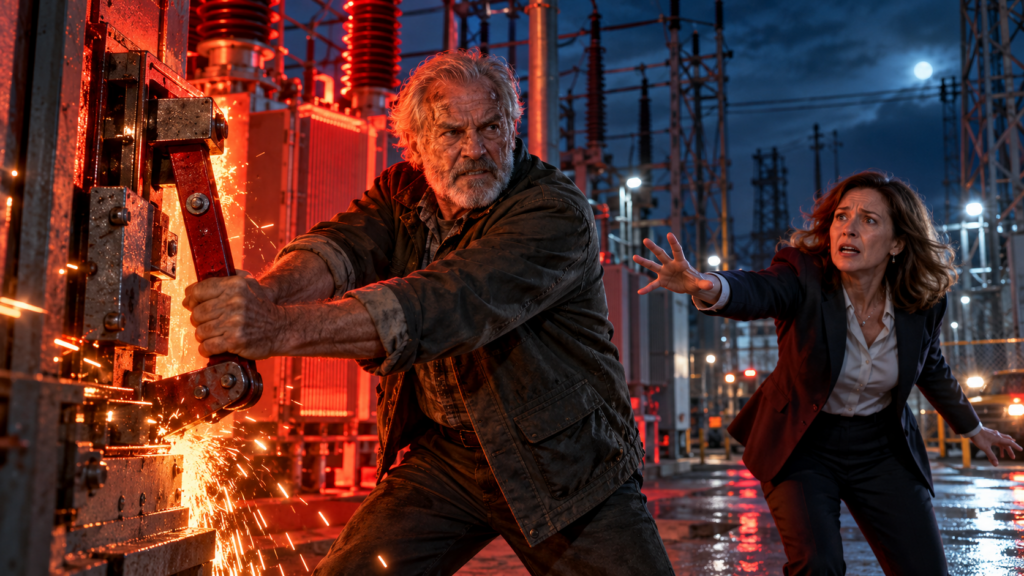
At 11:52 that night, I pulled the disconnect.
Three communities went dark.
But the switch was never the beginning of the story.
It was the end of a much longer failure.
The moment everyone finally had to stop pretending.
And if I had to make that choice again—lights or lives—I would pull it twice.
The end
Disclaimer: This content is entirely AI-generated for fictional and entertainment purposes only. Any resemblance to actual persons, living or dead, events, or locations is purely coincidental, and the creator assumes no liability for any interpretation of this content.
