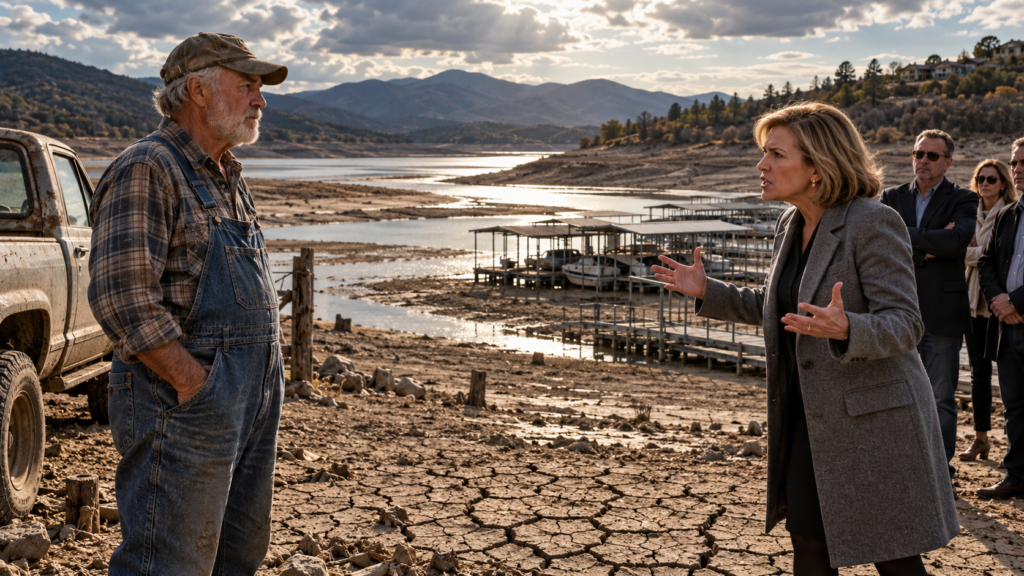
The pile driver started hammering steel into my reservoir at six in the morning.
Twenty-two new pilings.
A barge.
A crane.
Six men in orange vests.
And not one of them had permission to be there.
I was seventy-six years old, standing forty feet away in wet grass, watching strangers drive steel into a lake bed I had excavated myself in 1983.
“Shut it down!” I shouted.
The machine stopped long enough for a woman in a gray coat to step off the barge.
Delphine Ross, president of the Wakefield Shores homeowners association.
She walked straight toward me.
“You need to leave the shoreline.”
I stared at her.
“This shoreline is on my deed.”
“Two hundred and ten families have legal access to this water.”
“Show me the easement.”
Her face tightened.
“I don’t carry property records around for farmers.”
“Then stop drilling holes in property you can’t prove you have a right to use.”
She raised her phone and began recording me.
“Touch that equipment and I’ll have you arrested for interfering with a community amenity.”
I looked past her.
Forty boat slips floated along my eastern bank.
A pavilion stood thirty-five feet inside my boundary.
A concrete launch ramp cut across ground my father once used for cattle.
For sixteen years, Wakefield Shores had treated my irrigation reservoir like a private country club.
I had objected from the beginning.
They had ignored me from the beginning.
My name is Harlan Osborn.
Before returning to my family’s ranch, I worked thirteen years as a state irrigation engineer. I understood canals, diversion structures, dams, and water decrees better than most people understand their own mortgages.
The twenty-eight-acre body of water behind my house wasn’t a natural lake.
It was an irrigation reservoir.
I designed it.
I permitted it.
I paid for it.
And years before I built it, my family had obtained adjudicated rights to the two streams that fed it.
Those rights mattered because I farmed 520 acres of hay ground in a western state where senior water rights could be more valuable than the land beneath them.
My decree allowed me to divert the adjudicated stream flow for beneficial agricultural use, subject to its terms and state water administration.
When I built the reservoir, the permit included an eastern diversion gate.
Open one way, water entered the reservoir.
Open the other, part of the stream bypassed the basin and traveled directly into my irrigation system.
Ordinary farm infrastructure.
Nothing dramatic.
I had rarely needed to operate it at full diversion.
Then Wakefield Shores arrived.
The subdivision was built east of my property in 2006.
Its developer marketed sixty lots as “lakefront.”
The problem was that the “lake” wasn’t theirs.
In 2007, I sent the developer a certified letter making that clear.
In 2009, when the first dock appeared, I sent another certified objection to the newly formed HOA.
Both times I searched the county records.
No easement.
No shoreline agreement.
No recorded access right.
Nothing.
Still, the dock grew.
Then came a marina.
A pavilion.
A boat barn.
And annual “lake access” fees charged to all 210 households.
I should have sued years earlier.
Instead, I kept writing letters.
That was my mistake.
Delphine apparently interpreted patience as surrender.
Three weeks before the pile driver arrived, she sent me a demand letter.
It ordered me to dredge the eastern shallows.
Install shoreline lighting.
Maintain year-round navigation depth.
And guarantee a minimum reservoir level for Wakefield’s boats.
At my expense.
The second page was worse.
If I refused, the HOA threatened to pursue the cost against my property, report my farming operation as a nuisance, and raise concerns with the state about the condition of my dam.
My dam passed regular inspections.
They knew nothing was wrong with it.
The message was obvious.
Give us the water conditions we want, or we’ll make your life expensive.
That was when I called my granddaughter Merritt.
She was a water-rights attorney.
She read the file at my kitchen table without speaking.
The old decree.
The reservoir permit.
My certified objections.
The HOA’s demand.
Finally she looked at me.
“Grandpa, they’re demanding that you operate your irrigation system for their recreational benefit.”
“That’s how I read it.”
“Do they have an easement?”
“Not that I’ve ever found.”
She hired another attorney, Boyd Whitaker, to run a full title and county-record search.
His answer came one week later.
No recorded easement.
No shoreline agreement.
No assignment from the original developer.
Nothing giving Wakefield Shores a permanent right to use my reservoir bed or eastern bank.
Then he read my water decree.
Afterward, he asked one question.
“How quickly would the reservoir drop if you diverted the inlet to your fields under normal irrigation operations?”
I gave him an estimate.
He didn’t accept estimates.
We hired a certified hydrologist.
Her measurements showed that under dry-season conditions and lawful full diversion, the reservoir could fall more than thirteen feet in roughly three days.
At that level, Wakefield’s launch ramp would end nowhere near the water.
The floating docks would settle onto exposed mud.
Boyd looked at me.
“You’re entitled to operate your system according to your decree and permits.”
Merritt added one warning.
“Don’t do this as revenge. Do it only if it serves your actual irrigation needs, and document everything.”
That mattered.
I had hay fields coming into their driest period.
The water was useful there.
So on Monday morning, Boyd filed our property action.
At 9:20 a.m., I walked to the eastern diversion gate.
Checked the mechanism.
Opened the bypass toward my field laterals.
Then I wrote one sentence in the irrigation log.
Eastern diversion opened for agricultural use pursuant to existing water decree and reservoir permit.
For the first day, nothing dramatic happened.
By the second, the shoreline began creeping away.
On the third morning, someone from Wakefield Shores posted a photograph online.
Their boat ramp ended in gray mud.
Eight dock sections were sitting on the reservoir bottom.
