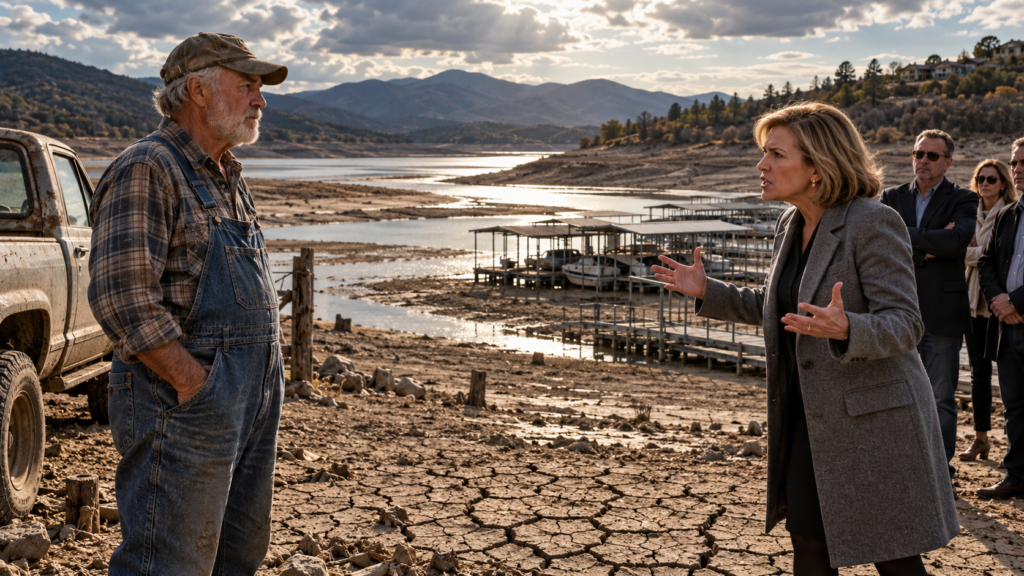
I wondered what he would have thought of everything.
Probably that I should have sued them in 2009.
He was less patient than I was.
THE CHANGE IN WAKEFIELD
The subdivision survived.
That matters because dramatic stories often pretend entire neighborhoods collapse after one legal dispute.
Wakefield didn’t vanish.
People still lived there.
Children still rode bicycles.
Lawns still needed mowing.
Homes still sold.
But listings changed.
Nobody advertised deeded lake access unless the seller could actually prove it.
The entrance sign eventually stopped calling the reservoir a community lake.
The HOA rewrote its amenity documents.
Future boards were required to verify recorded property rights before authorizing projects involving neighboring land.
Augustine was elected president formally.
His first major policy was painfully simple:
No property project without title review.
At the meeting where it passed, someone joked that the policy should have existed sixteen years earlier.
Augustine replied:
“It did. It was called common sense.”
THE FINAL ENCOUNTER
I saw Delphine once after she resigned.
She still lived in Wakefield.
We met accidentally at a hardware store.
She was buying garden soil.
I was buying hydraulic fittings.
For a moment, we stood in the same aisle.
She looked older.
So did I.
“You destroyed that community,” she said quietly.
I considered answering sharply.
Instead I said, “No.”
Her eyes hardened.
“You emptied the lake.”
“I operated my irrigation system.”
“You knew what it would do.”
“Yes.”
“People lost something they loved.”
I nodded.
“They did.”
That seemed to surprise her.
Then I continued.
“They lost something they were told belonged to them.”
She looked away.
“Same result.”
“No.”
I picked up the fittings.
“Because one version is my fault.”
I walked past her.
She didn’t follow.
THE REFILL
The reservoir took months to recover.
Snowmelt helped.
Spring rain helped.
By the following year, water stretched across most of the basin again.
But this time, there was nothing floating on it.
No marina.
No pleasure boats.
No Wakefield banners.
Just twenty-eight acres of water held for irrigation.
One April morning, I walked the eastern shore with Merritt.
She stopped where the pavilion once stood.
“You miss any of it?”
“The pavilion?”
“The fight.”
I laughed.
“At seventy-seven?”
“You seemed energized.”
“I was angry.”
“Sometimes that’s energizing.”
We reached the old dock location.
Young grass covered much of the disturbed soil.
Merritt looked across the water.
“You know the ironic part?”
“What?”
“If they had come to you sixteen years ago with a reasonable proposal and offered fair compensation, you might have granted some limited access.”
She was right.
I had never hated neighbors enjoying water.
What I hated was being told I no longer controlled what I owned.
There is an enormous difference between permission and entitlement.
Permission begins with asking.
Entitlement begins with assuming.
Wakefield had skipped the first step for sixteen years.
THE LOGBOOK
Back at the house, I opened the irrigation log.
The pages went back decades.
Rainfall.
Flow estimates.
Gate adjustments.
Maintenance.
Repairs.
Nothing dramatic.
Agriculture is mostly records of ordinary things repeated carefully.
I turned to the page where I had written about the diversion.
Then I added another entry beneath it.
Eastern inlet restored to reservoir supply following irrigation season and final property settlement. Reservoir refilling. Shoreline structures removed. Matter closed.
I put down the pen.
People later asked whether I felt guilty about what happened to Wakefield Shores.
My answer depends on who they mean.
Do I feel sorry for families who bought homes believing advertisements that should have been accurate?
Yes.
Do I feel sorry for board members who trusted documents they should have checked?
Sometimes.
Do I feel sorry for Augustine, who asked the right question before the second dock went in and was ignored?
Absolutely.
Do I regret stopping an HOA from treating my private reservoir like property it owned?
Not for one second.
Delphine once stood on my shoreline while a pile driver hammered steel into my reservoir bed.
She told the crew I was an old man who wrote letters.
She was right about one thing.
I wrote letters.
Two of them mattered more than every speech she gave, every glossy brochure the developer printed, and every board resolution Wakefield passed.
Because those letters proved something very simple.
I never consented.
For sixteen years, the truth sat inside certified envelopes, county records, surveys, permits, and a water decree anyone could have read.
Nobody needed influence to find it.
Nobody needed an FBI badge.
Nobody needed political connections.
They needed forty minutes at the recorder’s office and the willingness to accept the answer.
The reservoir was always mine.
The shoreline was always mine.
And the right to operate my irrigation system had been there long before anyone sold the first “lakefront” house.
The only thing that changed was that, after sixteen years, I finally stopped letting other people pretend otherwise.
The end
Disclaimer: This content is entirely AI-generated for fictional and entertainment purposes only. Any resemblance to actual persons, living or dead, events, or locations is purely coincidental, and the creator assumes no liability for any interpretation of this content.
