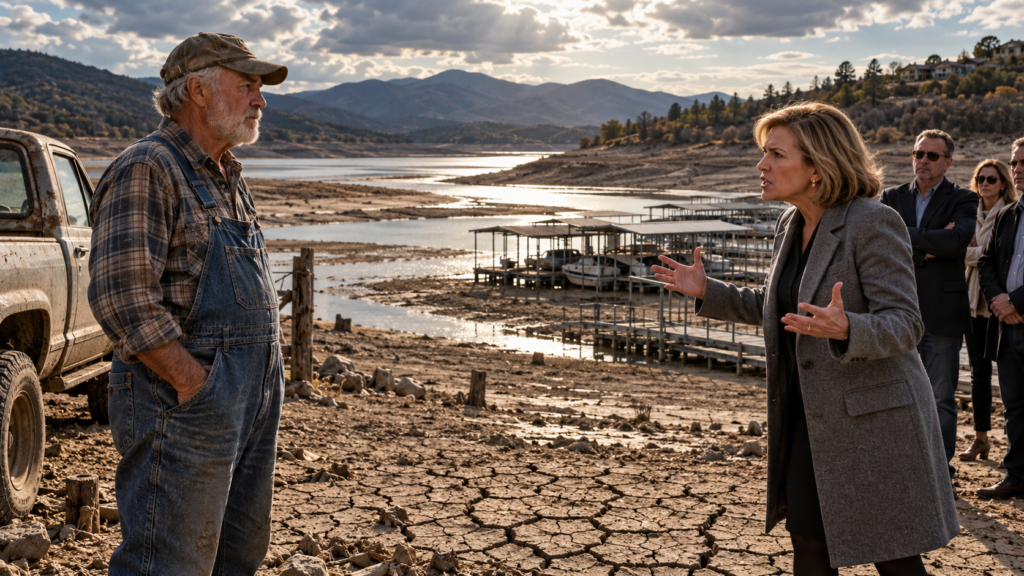
And beneath the photograph were three words:
WHERE IS THE LAKE?
I looked out my kitchen window.
The water was still dropping.
And for the first time in sixteen years, two hundred and ten families were about to discover that the most valuable “community amenity” in their subdivision had never belonged to their community at all.
By seventy-two hours, the transformation was impossible to ignore. The marina had settled onto exposed sediment, the launch ramp stopped dozens of feet short of the water, and residents flooded the HOA office demanding answers. State water officials inspected my diversion, reviewed the decree and permit, and found no basis to order me to restore a recreational water level merely for Wakefield Shores.
Then the association made its worst mistake. Two residents drove a rented skid steer onto my property at night and attempted to block part of the diversion channel so water would back toward the reservoir. Their crude barrier failed, damaged a farm-road culvert, and brought sheriff’s deputies to my land before midnight.
The HOA’s insurer began reviewing the entire dispute. That review uncovered sixteen years of marina operations, annual access fees, my certified objections, and the absence of any recorded easement. It also uncovered an internal email from retired infrastructure planner Augustine Vail, a board member who had repeatedly asked Delphine to produce the recorded instrument supposedly granting access.
She never had.
Worse, the HOA’s own attorney had privately warned Delphine that a prescriptive-right argument was weak because I had formally objected in writing years earlier.
Residents who had bought expensive “lakefront” homes began asking what exactly they had purchased.
Delphine resigned.
Augustine became interim president and called my lawyer.
“We’re done pretending,” he said. “Tell us what Mr. Osborn needs.”
Boyd looked at me.
After sixteen years, I finally had the chance to answer.
I didn’t ask for revenge.
I asked them to remove everything they had built on my land…
Boyd wrote the settlement framework on a yellow legal pad at my kitchen table.
He numbered each condition carefully.
“One,” he said, “the unauthorized structures come out.”
I nodded.
Every dock section.
Every piling.
The launch ramp.
The pavilion.
The boat barn.
Anything physically occupying my property without a valid right had to be removed or addressed through a written agreement I actually accepted.
There would be no agreement.
“Two,” Boyd continued, “the county land records need clarity.”
For sixteen years, brochures, newsletters, signs, and real estate listings had called the reservoir Wakefield Lake.
That name didn’t bother me.
The implied ownership did.
I wanted a recorded instrument acknowledging that the reservoir bed and eastern shoreline were private property and that Wakefield Shores held no recorded easement or recreational access right.
Not because I wanted to humiliate homeowners.
Because I never wanted another buyer receiving a glossy brochure and assuming someone else’s land came with the house.
“Three,” Merritt said, “we address the money.”
That part was harder.
Wakefield had collected approximately $175 per household each year for what it called lake access and related amenities.
Two hundred and ten homes over sixteen years represented hundreds of thousands of dollars.
Not every dollar necessarily represented profit.
Some maintained docks.
Some paid insurance.
Some repaired structures.
And Boyd warned me that recovering every historic fee would depend on the legal claims, evidence, limitations periods, and eventual settlement.
So we did not invent a dramatic number and pretend a judge had already awarded it.
We demanded full accounting.
Every access fee.
Every marina expense.
Every payment related to structures located on my property.
Every representation made to homeowners about the reservoir.
Then the lawyers could determine what had to be repaid, credited, or resolved.
“Four,” Boyd said, “your water rights remain yours.”
That term was nonnegotiable.
Wakefield would acknowledge that reservoir operations, inlet diversion, irrigation use, and water-level management remained governed by my decrees, permits, and applicable water administration—not by HOA preferences about boating.
No more letters ordering me to keep a permanent recreational pool.
No more threats because hay fields needed water.
No more board votes pretending a subdivision could rewrite a senior agricultural water right.
“Five.”
The association would withdraw its claim that sixteen years of use had somehow created a prescriptive right.
My certified letters from 2007 and 2009 mattered enormously.
They proved I had not quietly accepted the marina.
I had objected.
Repeatedly.
In writing.
Those two envelopes had sat in a filing cabinet for more than a decade.
Delphine once mocked me for writing letters.
Now those letters were some of the most important evidence in the case.
“And six,” Boyd said.
He tapped the original development file.
“We correct the historical record.”
THE BROCHURE PROBLEM
The original developer’s materials described an “existing recreational lake” beside the subdivision.
Planning documents referred vaguely to an access arrangement with the neighboring landowner.
No one could locate that arrangement.
My name wasn’t on one.
My father’s name wasn’t on one.
No recorded easement referenced it.
Yet lots had been marketed as lakefront.
That created a problem much larger than one angry farmer.
Sixty homes along the eastern edge had reportedly sold for substantial premiums because of water views and advertised access.
Some owners had lived there since the beginning.
Others had bought resale homes from people who bought from the developer.
They weren’t conspirators.
Most had done what ordinary buyers do.
They saw a marina.
They saw boats.
They saw HOA documents calling the reservoir a community amenity.
They assumed someone had checked.
Nobody had.
That realization made me angrier than Delphine ever had.
Because the residents hadn’t created the original fiction.
They inherited it.
At one meeting, a woman named Rachel Mercer stood near the back holding a folder.
She and her husband had purchased their house eighteen months earlier.
“Our listing said deeded lake access,” she said.
The room became silent.
The association’s attorney asked whether she had the listing.
She did.
Another homeowner raised his hand.
His closing packet contained similar language.
Then another.
